
The study was commissioned by the Occupational Safety and Health Administration (OSHA) following an October 1989 explosion at a Phillips 66 plastics plant in Pasadena, Texas, that killed 23 workers and injured another 232. The accident involved an outside contracting firm that had experienced a fatality at the same site earlier in the year. These two incidents produced a Congressional hearing at which union representatives argued that these were not merely isolated incidents but part of a growing problem associated with the increased use of contract workers who lacked adequate training and experience to work safely in petrochemical plants. In response to this controversy, OSHA indicated it would conduct a study to address the controversies raised by these incidents. OSHA specified that the study would collect data on the following issues:
- The prevalence and trends in the use of contract workers,
- the motivation for using contract workers,
- the role of safety and health in the selection of contractors,
- the safety and health training received by contract workers,
- the responsibility and methods of safety oversight of contract workers, and;
- the injury/illness experiences of contract and direct-hire workers.
The management safety practices examined in the study were derived from the recognized standards of excellence or “best practices”, included in OSHA’s Voluntary Protection Program and those identified in a 1982 construction users’ guide developed by the Business Roundtable.
Sample Designs and Methodology
OSHA selected five (5) Standard Industrial Classifications (SIC) for the study:
- SIC 1321, Natural Gas Processing;
- SIC 2821, Plastic Materials and Resins;
- SIC 2822, Synthetic Rubber;
- SIC 2869, Organic Chemicals; and
- SIC 2911, Petroleum Refining.
These sectors of the petrochemical industry are thought to have the greatest potential for a vapor cloud release, a bubble-shaped cloud of potentially explosive gases or chemicals, such as that which ignited and exploded at the Phillips plant. These SICs include 2,090 U.S. facilities employing approximately 268,247 workers.
Findings from the study reported here are based on four surveys:
- a national survey of industry plant managers;
- a survey of approximately 600 direct-hire employees working in facilities managed by respondents to the plant managers’ survey;
- a survey of approximately 600 contract employees working at a subset of the facilities included in the direct hire survey; and
- a survey of 300 contracting firms servicing these facilities.
In addition, the study made use of nine plant-level case studies.
The plant manager survey sample was drawn from a Dunn and Bradstreet list of all facilities in the chosen SICs. After correcting this list to exclude duplications and plants that had gone out of business, a national probability sample of 395 plants was surveyed. Data were obtained from 309 of these plants for a response rate of 78% of the plants and 88% of the workers in the sampling frame. Lists of direct hire employees, contract employees, and contractor firms working in their plants were requested from 120 of the plant managers who responded to the plant manager survey. Direct hire employee lists were obtained from 40 of these plants; lists of contract employees were obtained from 29 plants; and; lists of contractors were obtained from 53 plants. Names of direct hire and contract employees were then randomly drawn from these lists and surveyed by telephone by Louis Harris and Associates.
The plants that participated in the survey of direct-hire and contract employees were, on average, larger than the average plant in the industry. This difference is due to the failure of plants with less than 250 employees to provide lists of employees to Harris and Associates. However, more than 90 percent of employees in the industry work in plants having 250 or more employees and a comparison of respondent and nonrespondent plants indicates that the plants whose workers are included in the direct-hire and contract employee surveys are representative of larger plants in the industry. Moreover, given that compared to the overall industry, the large respondent plants have higher than average safety management practices and lower than average injury rates, any sampling bias that may exist in these data is more likely to understate than to overstate the safety problems in the industry. In any event the data collected for this study provide the most comprehensive and detailed body of information ever collected on the characteristics of the workers employed in this industry, their experiences related to safety, and management systems under which they work.
Results
The Prevalence of Contract Workers.
Respondents to the plant manager survey reported that contract employees accounted for 32% of the work hours in the average plant in 1989. However, during “turnarounds,” large-scale, round-the-clock maintenance of process units, contract workers accounted for 54% of the work hours in a typical plant in 1989. Moreover, contract workers and direct hire workers often work in close proximity to each other. 61% of contract employees and 73% of direct-hire employees reported having “regular” contact with each another while working in these plants. Wide variability in the use of contract workers across plants and work areas was also found. Reliance on contract workers in the case study group, for example, ranged from 9% to 44% of the non-turnaround workforce. Plant managers also reported that the use of contract workers varied widely across work areas. As the data in Table 1 indicate, contract workers account for 50% of the work forces in these facilities performing major renovation projects; 40% of those performing specialty work; and 37% of those working on turnaround projects. In routine maintenance and repair, contract workers were reported to comprise 22% of the workforce while they accounted for only 9% of the workforce in the area of plant operations.
Trends in Use of Contract Workers.
The cross-sectional character of this study precluded direct measurement of trends in the use of contract workers. However, estimates were obtained from plant managers and contractors of changes in the employment of contract workers at host plants over the past five years. These estimates are reported in Tables 2 and 3. The vast majority of host plants indicate either no change or an increase in their use of contract workers. Thus, the net result is an increase in the number of contract workers in the industry in the past five years. A similar pattern emerges from the survey of contracting firms reported in Table 3. The overwhelming majority of contractors stated that in their view the numbers of contract workers had remained “about the same” or increased in the industry overall, at the plant, and in facilities owned by the host plant’s parent company. Non-union contractors accounted for nearly all of the increase. Case study evidence suggests that the increase in demand for contract workers is part of a long-term trend, dating back a decade or more.
Profile of Contract Workers.
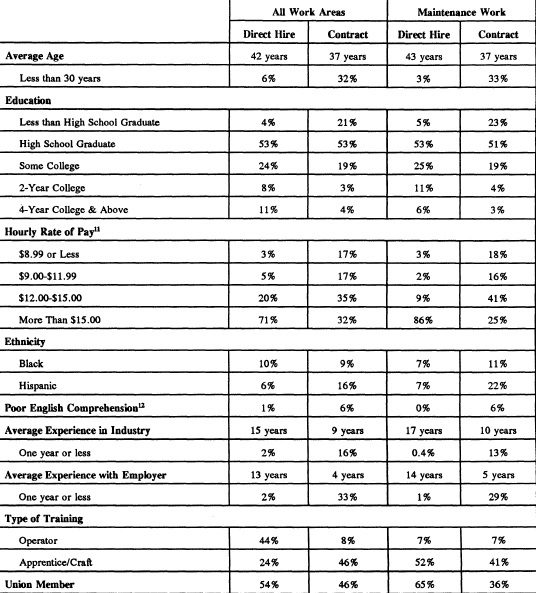
Given the controversy about the alleged differences in the training, experience, and compensation of direct hire and contract workers, a special effort was made to obtain data on the human resource characteristics of these two work forces. Table 4 summarizes the characteristics of direct hire and contract workers included in our surveys. The first two columns compare all direct hire and contract workers surveyed while columns three and four compare only those direct hire and contract employees who do maintenance work. The average contract worker is younger, less educated, less experienced (in terms of years in the industry and job tenure), lower paid, more likely to be of Hispanic origin and more likely to have difficulty with the English language than the average direct hire employee. Nearly one third (32%) of the contract workers are between the ages of 18 and 29, compared to 6% of the direct hire workers. 4% of the direct hire workers have less than a high school education compared to 21% of the contract workers. 2% of the direct hire workers had less than one year tenure with their employer compared to 33% of the contract workers. 6% of the direct hire workers are Hispanic compared to 16% of the contract workers. While 70% of direct hire workers earn more than $15 per hour, only one third (32%) of the contract workers are paid at this level. At the lower end of the pay scale, 3% of the direct hire workers reported earning less than $9 per hour compared to 17% of the contract workers.
Motivations for Using Contract Workers.
One of the most controversial and difficult to investigate questions OSHA asked the study team to address was the motivation for the use of contract workers. This question was explored in the plant managers’ survey and in the case studies. The petrochemical industry has historically relied on contract workers to deal with fluctuations in demand for turnaround and major renovation work. This practice is accepted as a necessary feature of this industry, given the high costs of the capital equipment that is idle when these projects are underway. In recent years, however labor union leaders charged that plants were increasing the use of contract workers to avoid the need to hire and train more expensive direct hire workers and to weaken the presence of unions in the industry. Respondents to the plant managers’ survey most often cited the need for specialized services and flexibility as principal reasons for their reliance on contract workers. Some plant managers report the need for specialized services and flexibility had increased because of increased capital investments in plant expansions or renovation projects, some of which were reported to have come in response to government regulations. Lower labor costs for completing a given project were assigned significantly less importance by plant managers. A difference in management responses, however, was observed in the case study group where managers most often cited labor cost differences between direct hire and contract workers as well as flexibility in the numbers of employees required at different points in time as motivations for their increased use of contract workers.
While it is difficult to obtain reliable data on whether or not union avoidance is a factor motivating the use of contract workers from management surveys and interviews, the net results of the growth in use of contract labor has been to decrease the presence of unions in this industry. Contractors reported that nearly all the growth in business in the past three years occurred among non-union contractor firms. The case studies indicate that this trend toward non-union contractors is particularly strong in the Gulf Coast region where as much as 60% of this industry is concentrated.
The decline in union membership among direct hire workers in the industry and the corresponding growth in non-union contract workers has increased tensions in labor management relations in this industry. These tensions surfaced at various points in this study as the labor and management representatives who participated in the oversight of this research disagreed over research methodology, the questions to be asked in surveys, the significance and interpretation of the results, and the policy recommendations to be drawn from the findings. Tensions were not limited to labor and management representatives. Direct hire and contract workers reported considerable tension, conflict, and communications breakdowns between direct hire and contract workers employed in these plants. For example, nearly one-third (31%) of direct-hire workers surveyed perceived contract workers as a threat to direct-hire jobs. Just over one-fourth of the direct hire (28%) and contract (26%) workers who have regular contact with each other report they have often or sometimes seen evidence of tension or conflict between direct hire and contract workers at their plant.
Finally, the role of the legal doctrine of co-employment emerged as a complex and controversial issue influencing the management and possibly the motivation for using contract workers. The issue of co-employment deals with the question of whether the host plant or the contractor firm is responsible for the costs of workers’ compensation premiums, other fringe benefits, third party liability claims, and terms of employment of contract workers. To avoid potential costs of being judged to be a co-employer, plant managers are advised by their legal counsel to refrain from supervising, training, or determining the terms and conditions of employment of contract workers. These decisions and responsibilities are to be left to the contractor. The prevailing legal opinion of the attorneys who advise employers in this industry is that holding contractors responsible for these managerial functions will protect the plants from these liabilities and will also protect plant managers from union claims that contract workers should be included in the bargaining unit of direct hire workers. As will be noted below, this doctrine produces a fragmented system of managerial responsibility for the training, supervision, and general oversight of direct hire and contract workers and increases the risks of injuries in these facilities.
The Role of Safety in the Selection of Contractors.
The study found wide variability in the extent to which petrochemical plants include safety in their contractor selection criteria. According to the plant manager survey, 38% of employees in this industry work in plants that have no formal procedures for examining safety issues in the contractor selection process. In contrast, the other 62% of the employees in this industry work in plants that require submission of one or more of the following as part of the pre-bid qualification or the contractor selection process:
- OSHA 200 records,
- Workers’ Compensation experiences ratings (EMR Rates), and/or
- descriptions of the contractor’s safety and health programs.
Moreover, two facilities in the case study group had developed rigorous selection procedures heavily weighted towards safety performance including such things as careful checking of the safety programs of contractors and in one case, inspections of these programs by a Safe Operations Committee composed of plant supervisors, safety professionals, and hourly employees. These two plants with the most thorough procedures for considering the safety records and practices of contractors also had the lowest injury experiences of the plants included in the case studies.
Respondents to the survey of contracting firms consistently reported that submissions of safety performance data were largely determined by plant requirements. Among contractor respondents, 55% reported submitting information on their safety and health programs, 52% of whom were required to do so; 40% submitted and 34% were required to submit OSHA injury statistics; and 63% submitted while 52% were required to submit Workers’ Compensation EMR Rates. In almost all cases, however, these data covered the contractor’s overall safety record. Only 4% of the contractors supplied data on their prior experiences in the petrochemical industry and only 3% provided data on prior experiences in the specific plant where the work was to be performed.
A number of the plant managers expressed limited confidence in the data supplied by contractors. Assessments of contractor safety programs were rated by plant managers survey respondents as among the least effective methods of monitoring safety compliance. Managers interviewed in the case studies also expressed concern about the reliability and usefulness of these data given the variable reporting procedures used in different firms. It was these types of concerns that led some of the plants to conduct actual site visits and inspections of contractor practices as part of the qualification and selection process.
Safety and Health Training.
Direct hire employees received safety training from host plants. In contrast, the majority of contract employees received most of their safety training from contractors. For example, plant managers reported that in every area but operations (where there is relatively little use of contractors), from 66% to 72% of employees work in plants where the responsibility for safety and health training is being met principally by contractors.
Case study evidence suggests that the host plants typically assume responsibility for initial contract worker orientation training, usually in the form of videotaped orientations to the facility, and verbal instructions to contract supervisors. Respondents to the contractor survey reported on the extent of this initial plant training. Table 5 presents these responses. The majority of contractors (54%) reported that their employees had received two hours or less of initial orientation training from the host plant. Further, non-union contractors reported that their employees were twice as likely as union contractors to have received no initial training.
The quality of the initial training experience for contract and direct-hire employees was also explored in the study. Higher percentages of direct-hire workers reported receiving each of five types of safety orientations:
- a talk (89% contract; 95% direct-hire);
- a tour of the work area (45% contract; 67% direct-hire),
- a film (82% contract; 88% direct-hire);
- an interactive discussion (70% contract; 90% direct-hire); and
- a test on safety related materials (48% contract; 66% direct-hire).
These data illustrate similar experiences in more passive training experiences, such as watching a film or listening to a talk; however, they suggest that direct-hire training is more likely to be augmented by participatory or interactive experiences. The case studies and supporting data suggest that, outside of initial orientations by host plants, contractors are principally responsible for providing their employees with additional pre-work training, as well as ongoing safety and health training in such areas as hazardous materials, safe work conduct, and plant procedures. When questioned about the extent of pre-work, off-site training provided by their employer, 48 percent of contract workers reported that they had received none prior to work in the petrochemical industry and 54 percent reported having received none prior to working in the host plant about whose practices they were questioned.
The plant manager survey data also confirm that contract employees receive less overall safety training than direct-hire employees. Plant managers report that contract employees receive less training in every work area except major renovation. In the average facility, plant managers report that contract workers receive 116% of the training provided direct-hire employees in the work area of renovation; 73% in turnaround; 68% in maintenance and repair; 84% in specialty; and 46% in operations.
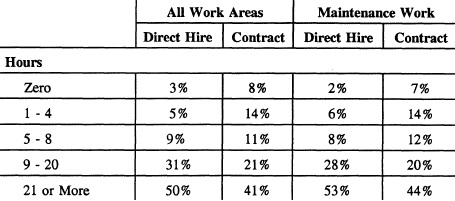
The results of the workers’ survey, however, suggest a more significant disparity in the safety training experiences of these two worker groups. Direct-hire employees reported receiving more hours of annual safety training from their employers, and as the data reported in Table 6 illustrate, contract workers report they are twice as likely as direct hire workers to receive no annual safety training from their employers. A similar pattern is observed for direct hire and contract employees involved in maintenance work.
When asked about the number of times safety discussions with supervisors or coworkers occurred during the preceding year, the experiences of contract and direct-hire workers again differed. Among direct-hire respondents, 21% reported meeting one to six times as compared to 26% of contract workers; 29% reported meeting seven to 12 times as compared to 17% of contract workers; and 40% reported having met 12 or more times compared to 35% of contract workers. More than twice as many contract workers (18%, contract; 7%, direct-hire) reported never having participated in a safety discussion during the preceding year.
When asked to evaluate the quality of the safety training and communication, respondents from both worker groups offered very similar assessments. For example, 75% of contract and 73% of direct-hire workers rated their training in safety procedures as excellent or good. However, significant minorities of both worker groups rated training and communication as fair or poor. For example, 18% of contract and 21% of direct-hire respondents rated their training in safety procedures as fair, while similar percentages of both worker groups (6%, contract; 5%, direct-hire) rated it poor. Oversight and Monitoring Systems. Wide variability was again found in the management practices employed in the oversight of contract employees. Plant managers reported that the most frequently used methods of monitoring the safety practices of contractors are job-site surveys or audits, the requirement that all accidents be reported, and periodic safety meetings with contractors. Respondents to the contractor survey confirmed the widespread use of these monitoring methods; however, some respondents reported that plant monitoring of their safety and health performance occurred only sometimes (10%), rarely (2%), or never (2%).
Again, the issue of co-employment was found to influence management practice in this area. The case study findings suggest that plant management regards contract supervisors as being principally responsible for the oversight of contract employees. Plant oversight of contract employees in the case study group was observed to be secondary and generally diffuse in seven of the nine sites studied. Nevertheless, nearly half (49%) of contractors reported that they do not assign a full-time or a part-time safety professional to the work site while 30% assign a part-time safety professional and 20% assign a full-time safety professional.
Contractors, plant managers, and employees confirm that written or the combination of written and oral authorization systems for high-risk procedures, such as confined space entry or work on “hot” or running equipment, are widely used in these facilities. While a majority of the worker respondents reported that compliance with these high risk procedures always occurs, compliance is not universal. For example, 27% of direct-hire and 23% of the contract employees reported that they were only “usually”, “sometimes”, or “rarely” rather than “always” informed about toxic materials they were working with. Across the range of ten safety procedures for high-risk activities examined, (lock-out tag out procedures, start-up procedures, emergency response tests, fire fighting systems, air quality checks, confined space procedures, information on toxic materials, information on explosive/flammable materials, procedures of handling toxic materials, and procedures for handling explosive procedures) the percentages of respondents reporting that the procedures were not always followed ranged from a low of 10% for checking air quality levels to a high of 30% for testing emergency response equipment.
In response to other questions, the majority of contract workers reported that they are encouraged to report safety problems to their supervisors (79% to plant supervisors; 85% to contract supervisors). Similarly, 90% of directhire employees reported being encouraged to report safety problems. The majority of respondents from both employee groups also reported that employee suggestions are always taken seriously. But, substantial minorities of respondents reported that employees are afraid to report safety problems to supervisors.
Among direct-hire workers, 3% reported employees were “always” afraid, while 22% said they were “sometimes” afraid to report safety problems. Similarly, 10% of contract employees reported they were always and 19% sometimes afraid to report safety problems to plant supervisors, while 27% reported similar levels of fear in reporting safety problems to contract supervisors (8%, always; 19%, sometimes). The majority of respondents from both worker groups (73%, direct-hire; 78% contract) also reported that accidents are always reported.
Plant managers reported that labor-management committees are present in 85% of these facilities. But contractors and plant managers report that contract workers rarely are covered by or participate in these committees.
Injury/llness Experiences.
One of the most important findings of this study was that both OSHA and the majority of plant managers lack reliable site-specific data on the injury experiences of contract workers. Slightly less than half of the plant managers could supply OSHA 200 records for contract workers employed at their worksites. This was consistent with the case study findings. Less than half of the plants in the case study sample collected data on the site specific injury or illness experience of contract workers. Among those plants that collected injury statistics among contract workers, the coverage and quality of these data varied considerably across contractors. Moreover, further doubt was cast on the reliability of the contractor safety data that were collected by plant managers as a result of the multivariate analysis performed on these data. No correlations were found between any management safety practices and the contractor injury rate data provided by the plants managers, even though significant negative correlations were observed between the presence of same management practices and the injury rates of direct hire workers. Overall, these results suggest the need for new and better data collection efforts to track the injury experiences of contract workers.
Data on the injury experiences of direct hire and contract workers were obtained from the employee surveys. Multivariate analysis of these data ° showed that contract workers experience higher accident probabilities, in part because they are more likely to engage in higher risk work, receive less safety training, and are less experienced in these plants and the petrochemical industry than are direct hire workers. Moreover, the analysis found that the training and experience of contract workers is less effective in reducing the risk of accidents than that of direct-hire workers. Finally, those contract workers who were closely supervised by the host plant experienced lower probabilities of accidents than did contract workers who were supervised only by the contractor firm.
Conclusions and Recommendations
Based on these results we concluded that significant reforms in the management systems and government policies regulating these employment relationships are needed if the risks of accidents are to be effectively controlled in employment relationships that mix direct hire and contract workers. The specific recommendations included in our report were three broad objectives in mind:
- to improve the safety information available to OSHA, management, and labor to support root cause analysis, problem solving, and policy evaluation;
- to encourage the diffusion of “best practice” safety procedures; and
- to bring all of the stakeholders (managers, workers, labor representatives, and contractors) into the process of improving safety and reducing the risks of accidents in the industry.
Specifically, we recommended that OSHA:
- hold plant managers accountable for the safety of all those working at their sites, including employees of contractors;
- require plant managers to collect site specific safety data for direct hire and contract workers;
- establish minimum training standards appropriate for the different types of work employees perform in these plants;
- require and strengthen the roles of labor-management committees that involve representatives of both direct hire and contract workers at these sites, and;
- support regional experimental and demonstration projects to test and diffuse across the industry best practice models for training and managing safety.
Many questions regarding the management of contingent workers in this industry remain unanswered by this research. However, the micro data collected and summarized here raise serious questions about the adequacy of present policies and management practices governing the safety of these workers. More research of this nature in other industries and perhaps addressing other labor standards therefore appears to be warranted.
Table 1 – Contract Employees as a Percent of Total Workforce by Work Area (Plant Weighted)
Work Area Percent of Total Workforce
Major Renovation 50%
Turnaround 37%
Maintenance/Repair 22%
Specialty 40%
Operations 9%
Source: Southwest Econometrics, A Survey of Plant Managers in the Petrochemical Industry, 1990.
Table 2 – Proportion of Plants Reporting a Change In the Use of Contract Employment Over Past Five Years by Work Area (Plant Weighted)
Work Area Increased Decreased Unchanged Total Net Change*
Major Renovation 28% 9% 63% 100% 19%
Turnaround 20% 6% 74% 100% 14%
Maintenance/Repair 20% 17% 63% 100% 3%
Specialty 25% 5% 70% 100% 20%
Operations 4% 11% 85 % 100% -7%
* The net change in the use of contract labor is calculated by subtracting the percentage of plants reporting a decrease from the percentage of plants reporting an increase.
Source: Southwest Econometrics, A Survey of Plant Managers in the Petrochemical Industry, 1990.
Table 3 – Change in Number of Contract Workers as a Proportion of the Total Workforce Since 1985
Site of Change Increased Decreased About the Same Not Sure
Petrochemical Industry 37% 16% 38% 9%
Host Plant 25 % 17% 45% 13%
Parent Company 39% 16% 40% 6%
Source: Louis Harris & Associates, Safety in the Petrochemical Industry: A Survey of Contractors, 1991.
Table 4 – Human Resource Profile – Direct Hire and Contract Employees
11 Numbers may not sum to 100 because of rounding error
12 Interviewer reported respondent understood questions not very well or not at all well.
Table 5 – Hours of Initial Safety and Health Training Contractor Employees Received at Host Plant
Hours of Training All Contractors Union Contractors Non-Union Contractors
None 11% 6% 15%
1-2 43% 49% 39%
3-4 17% 22% 14%
More Than 4 19% 14% 21%
Not Sure 10% 9% 11%
Mean 10 hours 6 hours 10 hours
Median 2 hours 2 hours 2 hours
Source: Louis Harris & Associates, Safety in the Petrochemical Industry: A Survey of Contractors, 1991.
Table 6 – Hours of Safety Training Provided by Employer
CLICK HERE to download the original study file (pdf)