
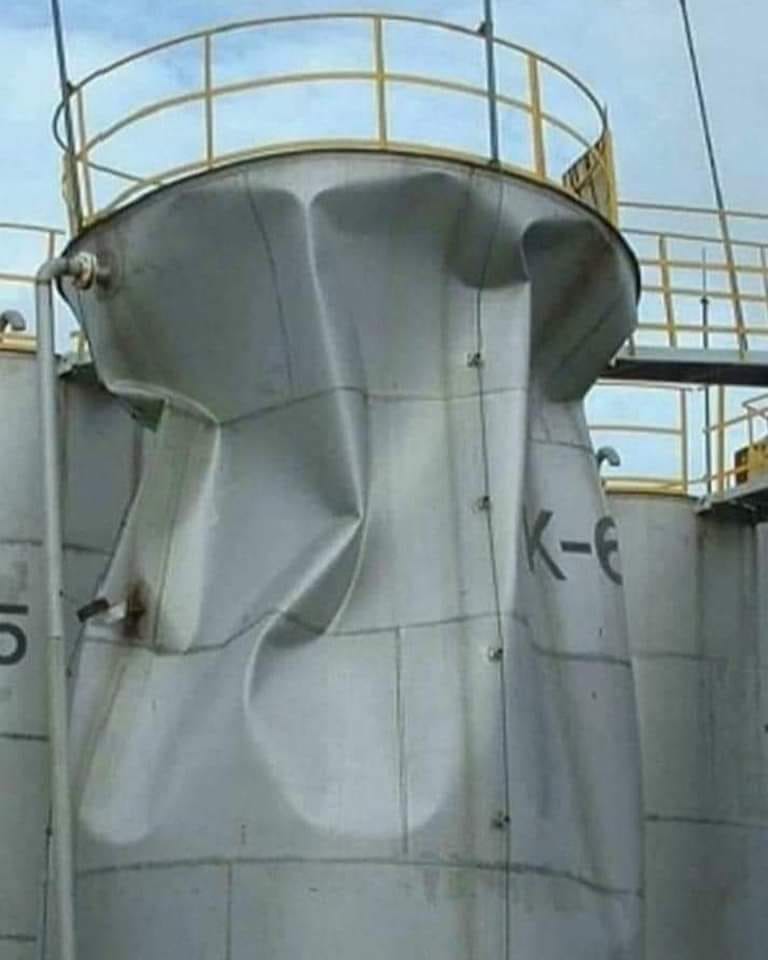
I see far more damage to atmospheric storage tanks from vacuums than I do from over-pressure events. In almost every case, the tank had undergone a “change” that created the conditions for a vacuum to occur. And once we have a pressure differential with a lower pressure inside the tank than the atmospheric outside the tank, the atmosphere will simply collapse the tank.
The tank is NOT being “sucked in”; it is being crushed from the 14.7 pounds per square inch of atmospheric pressure.
Now, we need to take measures to ensure we do not CREATE this pressure differential inside the tank. This differential can be caused by a number of processing/design errors, with the most common being “vent too small.”
But we are in luck; a 50-year-old OSHA standard offers us some basic design requirements. The trick is MANAGING CHANGES to these tanks when they are OUTSIDE of the PSM standard!
Here is what OSHA says about vent sizing for NORMAL and EMERGENCY operations.
(emphasis by me)
|
1910.106(b)(2)(iv) Normal venting for aboveground tanks. 1910.106(b)(2)(iv)(a) Atmospheric storage tanks shall be ADEQUATELY VENTED to prevent the development of vacuum or pressure sufficient to distort the roof of a cone roof tank or exceeding the design pressure in the case of other atmospheric tanks, as a result of FILLING or EMPTYING, and ATMOSPHERIC TEMPERATURE CHANGES.
1910.106(b)(2)(iv)(b) Normal vents shall be SIZED either in accordance with: 1910.106(b)(2)(iv)(b)(1) The American Petroleum Institute Standard 2000 (1968), Venting Atmospheric and Low-Pressure Storage Tanks, which is incorporated by reference as specified in § 1910.6; or 1910.106(b)(2)(iv)(b)(2) other accepted standard; or 1910.106(b)(2)(iv)(b)(3) shall be at least as large as the filling or withdrawal connection, whichever is larger but in no case less than 1¼ inch nominal inside diameter.
1910.106(b)(2)(iv)(c) Low-pressure tanks and pressure vessels shall be ADEQUATELY VENTED to prevent development of pressure or vacuum, as a result of FILLING OR EMPTYING and ATMOSPHERIC TEMPERATURE CHANGES, from exceeding the design pressure of the tank or vessel. Protection shall also be provided to prevent overpressure from any pump discharging into the tank or vessel when the pump discharge pressure can exceed the design pressure of the tank or vessel.
1910.106(b)(2)(iv)(d) If any tank or pressure vessel has MORE THAN one fill or withdrawal connection and simultaneous filling or withdrawal can be made, the vent size shall be based on the maximum anticipated simultaneous flow.
1910.106(b)(2)(iv)(e) Unless the vent is designed to limit the internal pressure 2.5 p.s.i. or less, the outlet of vents and vent drains shall be arranged to discharge in such a manner as to prevent localized overheating of any part of the tank in the event vapors from such vents are ignited. |