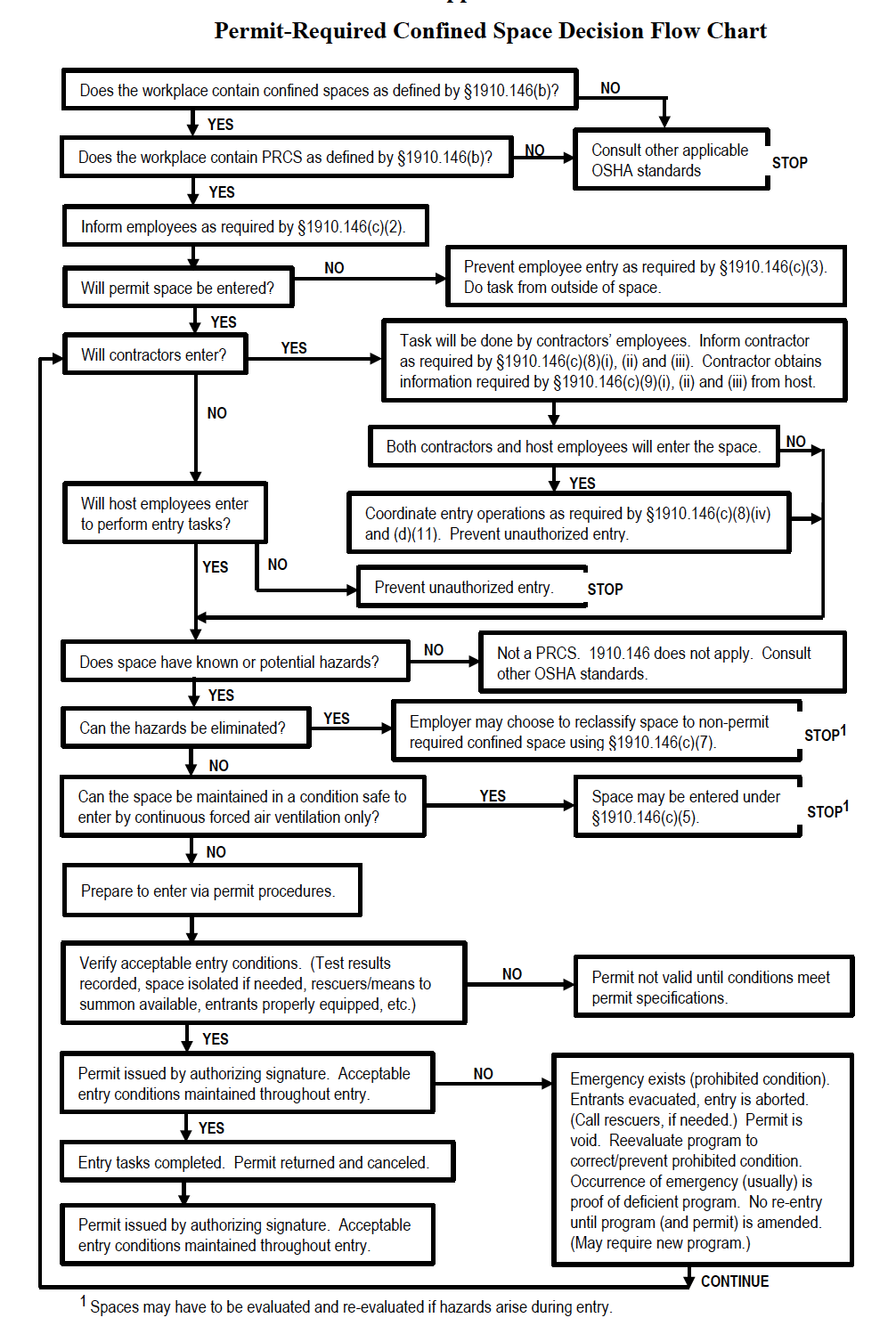
Lets walk through a process in which we will isolate a PRCS using either the blinding/blanking or disconnect and misalignment provisions. The vessel we will enter is a PSM/RMP covered piece of equipment. Here’s how I was taught the process works…
Since this is a PSM/RMP covered process we will be impacted by three key OSHA standards:
1910.147 – The control of hazardous energy (lockout/tagout)
1910.146 – Permit-required confined spaces
1910.119 – Process safety management of highly hazardous chemicals (specifically (f)(4)… opening process equipment or piping)
So let’s look at what has to happen to SAFELY install a blind/blank at our space’s nozzle(s). First, generate our energy control plan so that the piping can be purged/flushed/drained to get it to a ZERO energy state. This will entail us locking out at least one (1) isolation valve upstream of our flange/nozzle. Remember that we have already emptied/purged/flushed/drained the vessel/space, so we need ample energy isolation on the upstream side of this flange/nozzle. An operator (authorized employee) enters the field, closes, and secures the isolation valve in the CLOSED position using a LOTO LOCK. He/she then VERIFIES ZERO ENERGY state using a pressure gauge or some other means to verify the valve is holding.
PLEASE NOTE: we also lock out the pump so that we are NOT deadheading against our isolation device. Suppose we must keep the pump in service because it provides pumping for other parts of the process. In that case, we lock OPEN a pathway so that we NEVER have a pump applying pressure (i.e. deadheaded) against our isolation device. This is NOT an OSHA requirement, just a good practice.
Once the valve has been VERIFIED to achieve ZERO ENERGY STATE on this pipe, the pipe is ready to be OPENED using our Line Break/Process Opening Permit. A Responsible Person-In-Charge (RPIC) will walk down the LOTO and inspect the break/opening location with the workers doing this work. He/She would then review the permit conditions with the workers and walk them through the safety requirements (e.g., EW/SS location, PPE, Egress, etc.) and then verify they are part of the correct LOTO. They then proceed to OPEN the flange per the permit requirements and install the blind properly. When these guys are done with this line, this permit, and their Work Order, they return the permit to the RPIC who issued it, who then inspects the area and their work for SAFETY and closes out the permit. The workers remove their LOTO locks and are released from the LOTO/Permit/Job.
This same process goes on for EACH of the pipes attached to the vessel/space, considering that this same group or other workers could install other blinds. But each line/pipe will have its energy isolation plan and Line Break/Process Opening Permit. In some facilities, all the blinds would be installed under one master energy isolation plan and a single Line Break/Process Opening Permit. I frown upon this exercise unless ALL the lines/pipes contained the same hazardous materials at the same pressures/temperatures. Many of these vessels have dozens of pipes/lines to isolate and each one often times represents special and unique hazards/challenges. Unfortunately, engineers do not make LOTO easy in many situations so some blinds will be installed at ground level. Some will be 50’ in the air, and I promise you this – a line break at ground level is NOTHING like doing a line break in a scissor lift 50’ in the air!
Once all the blinds are installed, the RPIC or maybe someone else who acts as an “entry supervisor” will then begin his/her work preparing this space/vessel for entry. This means someone will go to the space/vessel and develop an energy isolation plan for entry into the space/vessel. Remember that the blinds that were installed were done by a crew who may not have even known why they were installing the blinds as that task is ENTIRELY a separate task done under an entirely separate safe work permit and energy isolation plan. Now that we want to use those blinds as our means to ISOLATE the PRCS, we will have an entirely different isolation plan than before. The entry supervisor will assign an Authorized Employee the task of developing the energy isolation plan in which the blinds are the energy isolation devices for entry into the space/vessel. The authorized employee will then apply a means to either LOCK or TAG the blinds in place so that they are CLEARLY identifiable as being energy control device(s) for entry into the space/vessel. I have always preferred locking the blinds into place using several means to do so, but I have seen tagout work well. Now I know many will say that OSHA considers the blinds “locked out” since it is bolted in place; however, without a lock or tag on them, what keeps the blind from being pulled while our entry is taking place? We NEED to make it clear to anyone who comes across our blind that it is part of an energy isolation plan and that it can ONLY be removed once the lock/tag has been removed!
Once the blinds have been locked (or tagged) in place, the energy isolation plan for the entry into the space/vessel is now complete, and the entry supervisor may begin his review of the entry provisions. He/She should ALWAYS walk down the isolation plan, and they will take their initial atmospheric readings and discuss the scope of work that will be permitted inside the space with the entrant(s) and attendant(s). He will then make sure the entrant(s) AND attendant(s) are part of the LOTO (yes, we required our attendants to be on the LOTO) and that they understand the permit requirements. The entry supervisor will complete his duties as the entry supervisor, sign the permit, and hand it to the attendant, who will maintain it at the entry portal. The entry can now take place.
Key points to be made:
- the line break energy isolation plan(s) is COMPLETELY SEPARATE from the energy isolation plan for the actual entry into the space/vessel. One plan used valves to break open a flange and install a blind. The entry isolation plan then used the blinds as their isolation device.
- the line break energy isolation plan involved a single valve and in no circumstance(s) is a single valve permitted to be the sole energy isolation device for “flowable hazardous materials” into a PRCS.
- We did NOT unlock the valves from the line break permit as we know that once the entry is over we will have to pull our blinds using the same energy control plan as the one we used to install them. BUT PLEASE note that we will NOT be using the same line break permit, as once a permit is CLOSED it can not be re-opened. I would also suggest that the LB permit NOT be kept open for the ease of pulling blinds. This is especially true if the entry occurred over several days and the crew who will be pulling the blinds may be a different crew than those who installed them.
- Do not list the closed and locked valves used to install the blinds as part of your entry energy isolation control plan for your entry into the PRCS, as they have NOTHING to do with your isolation plan for the entry. I guess it would not hurt to list them ON TOP OF listing the blinds – but the blinds are your energy isolation devices for the entry and NOT the locked-out valves!
- It matters HUGELY that the entrants are part of the PROPER LOTO. The entrants need to be on the LOTO associated with the means to lock/tag the blinds in place and NOT the LOTO used to install the blinds. Another reason why we want that Line Break Permit to be CLOSED OUT to lessen the potential for human error.