They’re at it again… does this door eliminate a “limited means of egress”

BAC door1

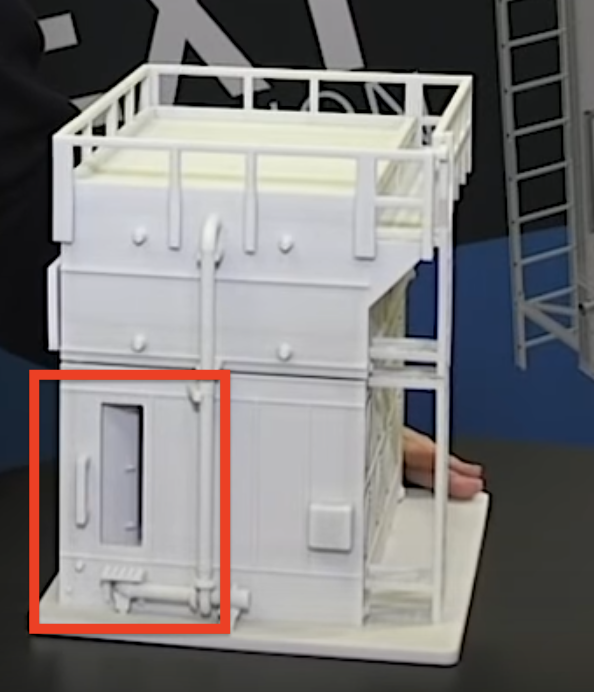
Almost two years ago to the month I wrote about a condenser manufacturer’s marketing practices regarding their “man-sized” access door, only to be rebuffed by the manufacturer and those who were buying their model so they no longer had to follow Permit-Required Confined Space (PRCS) practices and procedures.  Now in 2019, we have a competitor who has followed suit in their concept of what a Confined Space actually is and is marketing their enlarged door as one which now eliminates their condenser from being a Confined Space, thus it’s also not a PRCS.  This is the door they are claiming eliminates the “restricted or limited means of egress”…
BAC door1

From their manual:

3. Accessibility: As standard, unit will be provided with:

a. Access door(s) at least 68” in height. This may exempt the condenser from being considered a confined space. Check your local code for confirmation.

  BAC Door2

Here is the marketing video they produced this year; in it, they use slightly more aggressive language about the doorway eliminating the space from being a CS (vs. their manual language as shown above)

NOTE: go to 1:13 in the video to see their bit on the new door size

By their own measure (and I mean their actual measurements as shown below) this door is 20 inches wide and 68 inches tall.  A normal door, such as one used in a workplace, will be at least 32 inches wide and 80 inches tall.  But in all fairness, 20″ in width, I could fit through without turning too much and I am 6’0, 230 pounds.  I’m not in the shape I was in 25 years ago but I still wear a 48 suit coat so I am not a small stature by most measures.  I should also point out that in the video they mention that a person who is 6’5 can pass through the opening standing up, but as we can see below, the height of the opening is 68 inches, which means a person who is 5’5″ could walk in standing straight up.  Anyone over 5’6″ tall will have to bend/squat down in order to pass through the opening.

BAC door3

Another issue is the doorway is not open at the bottom and is designed more like a hatchway, where we have to step over the lip and duck under the top of the opening to enter this space rather than walk upright into the space.  It is this step and ducking that some may claim poses a “limited means of egress” as one could simply NOT walk out of the space.  I know a few OSHA CSHO’s (although most have retired now) who will argue that for the access opening NOT to be considered one that poses a “limited means of egress” that the portal must be a full-size personnel door (e.g. 32″ wide and 80″ tall) – end of discussion.

But this is what makes us earn our money – we need to be logical and SAFE when performing our CS and PRCS Evaluations.  For me, this “enlarged door” still does not eliminate this space within the condenser from being a CS.  Just not wide enough nor tall enough and it is not a normal opening, as one has to step in and duck under in order to enter and exit out of the space, thus for me, this access portal still represents a LIMITED MEANS OF EGRESS. 

Look at it this way… does OSHA permit this size and arrangement in an EXIT door?  What if you had an 8″ plate across the bottom of our posted emergency exits and all personnel had to step over this 8″ plate to exit the area while ducking to pass under the top of the 68″ tall opening- would OSHA accept this or would they view this 8″ plate and 68″ tall opening as an “obstruction” (e.g. limited means of egress)?  I will leave this one up to you, but for me – it is a limited means of egress.

Scroll to Top