
Most safety professionals know there is an actual rationale as to when use DANGER, CAUTION, and WARNING signs and how these signs are color-coded; however, there are a lot facilities who may not have a safety professional who can offer this guidance as to when to use signs, how to use them and which one to use for the specific need. Hence, OSHA has a standard that provides us with some VERY SPECIFIC requirements regarding “Specifications for accident prevention signs and tags”. This OSHA standard is often overlooked, until OSHA issued a citation because a facility’s e-stop buttons were not red in color. My e-mail and phone lit up with questions about that posting, asking if it was real. I promise it was real and I even posted a snap shot of the actual citation. But 1910.145 requires so much more.
These standard’s specifications apply to
the design, application, and use of signs or symbols that indicate and, insofar as possible, define specific hazards that could harm workers or the public, or both, or to property damage.
The standard is intended to cover ALL safety signs except those designed for streets, highways, and railroads, but it does NOT apply to plant bulletin boards or to safety posters. The standard also specifically requires that all NEW signs and REPLACEMENTS of old signs MUST be in accordance with the specifications found in the standard.
The standard classifies signs according to their use.
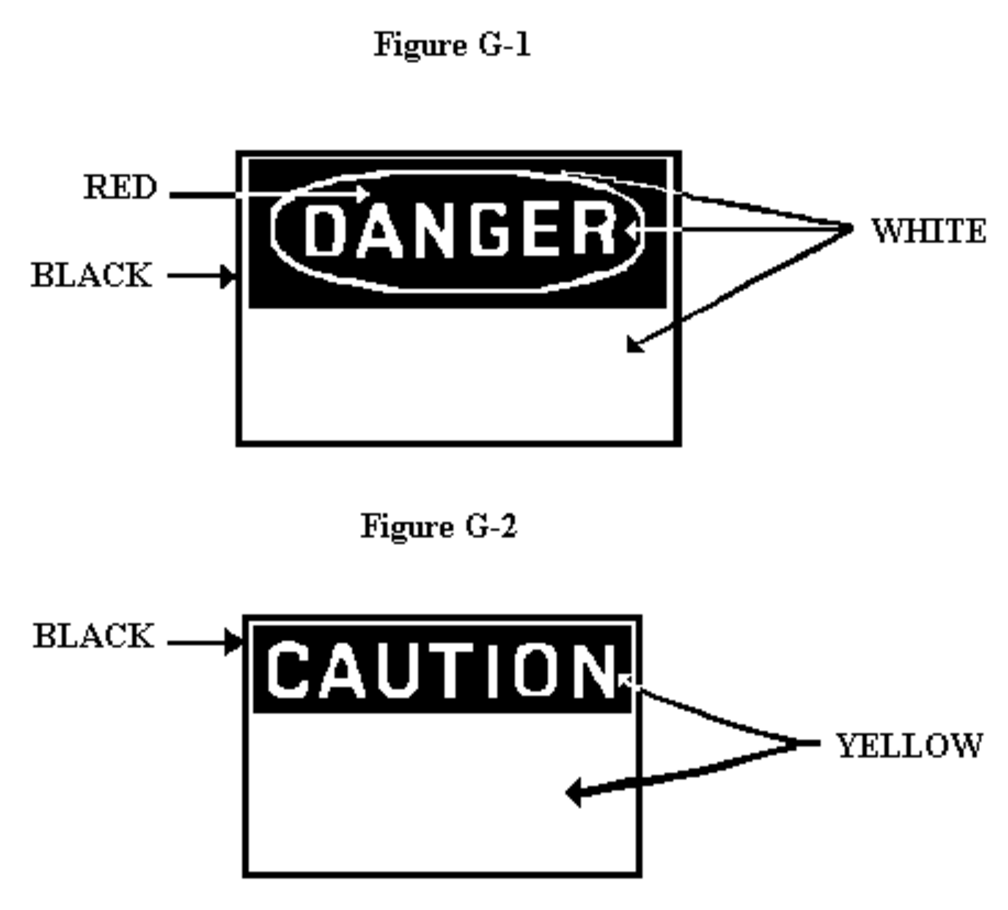
Danger signs
There shall be NO variation in the type of design of signs posted to warn of specific DANGERS and RADIATION hazards. ALL employees shall be instructed that danger signs indicate IMMEDIATE DANGER and that special precautions are necessary.
Caution signs
Caution signs shall be used ONLY to warn against POTENTIAL hazards or to caution against unsafe practices. ALL employees shall be instructed that caution signs indicate a possible hazard against which proper precaution should be taken.
Safety Instruction signs
Safety instruction signs shall be used where there is a need for GENERAL INSTRUCTIONS and suggestions relative to safety measures.
Design Features
ALL signs shall be furnished with rounded or blunt corners and are free from sharp edges, burrs, splinters, or other sharp projections. The ends or heads of bolts or other fastening devices shall be located in such a way that they do NOT constitute a hazard.
Danger Signs
The colors red, black, and white shall be those of opaque glossy samples as specified in Table 1, “Fundamental Specification of Safety Colors for CIE Standard Source ‘C,’ ” of ANSI Z53.1-1967 or in Table 1, “Specification of the Safety Colors for CIE Illuminate C and the CIE 1931, 2° Standard Observer,” of ANSI Z535.1-2006(R2011), incorporated by reference in § 1910.6.
Caution Signs
The standard color of the background shall be YELLOW; and the panel, BLACK with YELLOW letters. Any letters used against the YELLOW background shall be BLACK. The colors shall be those of opaque glossy samples as specified in Table 1 of ANSI Z53.1-1967 or Table 1 of ANSI Z535.1-2006(R2011), incorporated by reference in § 1910.6.
Safety Instruction signs
The standard color of the background shall be WHITE; and the panel, GREEN with WHITE letters. Any letters used against the WHITE background shall be BLACK. The colors shall be those of opaque glossy samples as specified in Table 1 of ANSI Z53.1-1967 or in Table 1 of ANSI Z535.1-2006(R2011), incorporated by reference in § 1910.6.
Sign Wordings
The wording of any sign should be easily read and concise. The sign should contain sufficient information to be easily understood. The wording should make a POSITIVE, rather than negative suggestion and should be accurate in fact.
The biological hazard warning shall be used to signify the actual or potential presence of a biohazard and to identify equipment, containers, rooms, materials, experimental animals, or combinations thereof, which contain, or are contaminated with, viable hazardous agents. The term “biological hazard,” or “biohazard,” shall include ONLY those infectious agents presenting a risk or potential risk to the well-being of man.
Accident Prevention Tags
The standard also applies to all “accident prevention tags” used to identify hazardous conditions and provide a message to employees with respect to hazardous conditions or to meet the specific tagging requirements of other OSHA standards. Tags shall be used as a means to prevent accidental injury or illness to employees who are exposed to hazardous or potentially hazardous conditions, equipment or operations which are out of the ordinary, unexpected or not readily apparent. Tags shall be used until such time as the identified hazard is eliminated or the hazardous operation is completed. Tags need not be used where signs, guarding or other positive means of protection are being used.
General tag criteria:
-
- All required tags shall meet the following criteria:
- Tags shall contain a signal word and a major message.
- The signal word shall be either “Danger,” “Caution,” or “Biological Hazard,” “BIOHAZARD,” or the biological hazard symbol.
- The major message shall indicate the specific hazardous condition or the instruction to be communicated to the employee.
- The signal word shall be readable at a minimum distance of five feet (1.52 m) or such greater distance as warranted by the hazard.
- The tag’s major message shall be presented in either pictographs, written text or both.
- The signal word and the major message shall be understandable to all employees who may be exposed to the identified hazard.
- All employees shall be informed as to the meaning of the various tags used throughout the workplace and what special precautions are necessary.
- Tags shall be affixed as close as safely possible to their respective hazards by a positive means such as string, wire, or adhesive that prevents their loss or unintentional removal.
Danger tags
Danger tags shall be used in MAJOR hazard situations where an immediate hazard presents a threat of death or serious injury to employees. Danger tags shall be used only in these situations.
Caution tags
Caution tags shall be used in MINOR hazard situations where a non-immediate or potential hazard or unsafe practice presents a lesser threat of employee injury. Caution tags shall be used only in these situations.
Warning tags
Warning tags may be used to represent a hazard level between “Caution” and “Danger,” instead of the required “Caution” tag, provided that they have a signal word of “Warning,” an appropriate major message, and otherwise meet the general tag criteria of this section.
Biological hazard tags
Biological hazard tags shall be used to identify the actual or potential presence of a biological hazard and to identify equipment, containers, rooms, experimental animals, or combinations thereof, that contain or are contaminated with hazardous biological agents.
Other tags
Other tags may be used in addition to those required or in other situations, provided that they do not detract from the impact or visibility of the signal word and major message of any required tag.