
We keep hearing how the tragedy in WA state at the Papermill was some type of tank implosion and then explosion. I have serious doubts about that theory. I think this was just a simple seam/weld failure, possibly caused by Stress Corrosion Cracking (SCC), but I am sure the CSB will get to the bottom of this failure in due time. I come to this conclusion based on all the pics and videos we’ve seen. Why do I believe that was NOT an implosion (vacuum) event?
When a tank experiences a vacuum event, the first parts of the tank that are typically damaged is the “head space”. Looking at the pic of the tank post-event, we just do NOT see signs of a vacuum event.
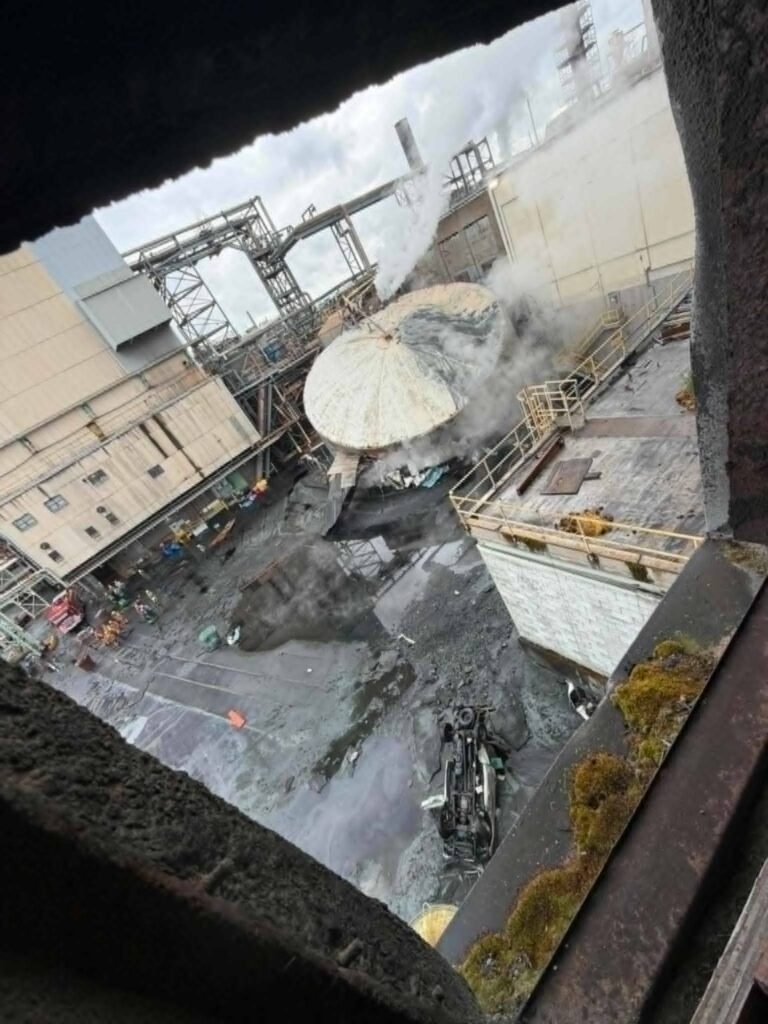
We have to remember that although we like to say “the tank got sucked in”, that is NOT an accurate statement. Tanks get crushed by the atmospheric pressure of 14.7 psi. The vacuum simply creates the pressure differential to allow the 14.7 psi outside the tank to crush the tank. So when a tank is 50% full of a fluid, the FIRST damage will be ABOVE the fluid level, especially the roof, as it’s the weakest part of the vessel, because the fluid applies pressure against the sides of the tank simply by its hydrostatic pressure. We see the roof fully intact and the walls, except where the failure occurred, showing no visible signs of inward collapse. Here is my scientific explanation for SAFTENG members:
Large atmospheric storage tanks are designed to handle liquid loads and small internal pressures, but not to withstand significant external pressure (vacuum). When an internal vacuum develops, the surrounding atmospheric pressure exerts a crushing force on the tank’s exterior.
The lower portions of the tank shell are often reinforced by the hydrostatic pressure of the stored fluid, which helps maintain the shell’s shape and resistance to inward deformation.
In a tank that is only partially full, the “vapor space” (the empty area above the fluid) is the most vulnerable point. Because this area lacks the structural support of the liquid column, it is where the shell is most likely to buckle first when the internal pressure drops significantly below atmospheric pressure.
Since the roof is typically the lightest part of the structure and sits directly above the vapor space, it is often deformed or drawn inward, along with the upper shell rings, as the vacuum intensifies.
When the external pressure exceeds the buckling resistance of the thin-walled shell, it results in a sudden, geometric instability where the metal shell deforms inward.
While the liquid level provides some stabilization to the lower walls, a severe vacuum event can still compromise the tank’s structural integrity, potentially leading to catastrophic failure of the base-to-shell connection or rupture of pipe fittings due to sudden vertical and lateral shifting of the structure.