
A fine example of how the safety profession has drifted from science is the vast misunderstanding of hazardous gases. From their hazards to their behaviors, we have a lot of myths and misconceptions about hazardous gases. Sadly, the fact that OSHA does not have a “flammable gas” standard plays a role in this situation – hence we have a profession too dependent on OSHA to frame up hazards in our workplaces. In this article, I hope to explain the different types of hazardous gases, their hazards, and how they behave (sometimes making them more hazardous). I will discuss the following:
- Compressed Gas
- Liquefied Gas
- Refrigerated Liquefied Gas
- Dissolved Gas
First, let us look at how these four (4) categories are DEFINED and QUANTIFIED.
1) Compressed Gas – A gas which, when packaged under pressure, is ENTIRELY GASEOUS at -50°C (-58°F); including all gases with a critical temperature of -50°C (-58°F).
2) Liquefied Gas – A gas which, when packaged under pressure, is PARTIALLY LIQUID at temperatures above -50°C (-58°F). A distinction is made between:
- High-pressure liquefied gas: a gas with a critical temperature between -50°C (-58°F) and +65°C (149°F); and
- Low-pressure liquefied gas: a gas with a critical temperature above +65°C (149°F).
NOTE: Critical temperature means the temperature above which a pure gas can NOT be liquefied, regardless of the degree of compression.
3) Refrigerated Liquefied Gas – A gas which, when packaged, is made partially liquid because of its low temperature.
4) Dissolved Gas – A gas which, when packaged under pressure, is dissolved in a liquid phase solvent.
When a gas is ENTIRELY GASEOUS at temps above -58°F, we call it a COMPRESSED GAS. There is NO liquid in the container/cylinder. We see these containers all over the place as this is the most common type of compressed gas container. They are usually at a higher pressure, up to 5,000 psi and higher.
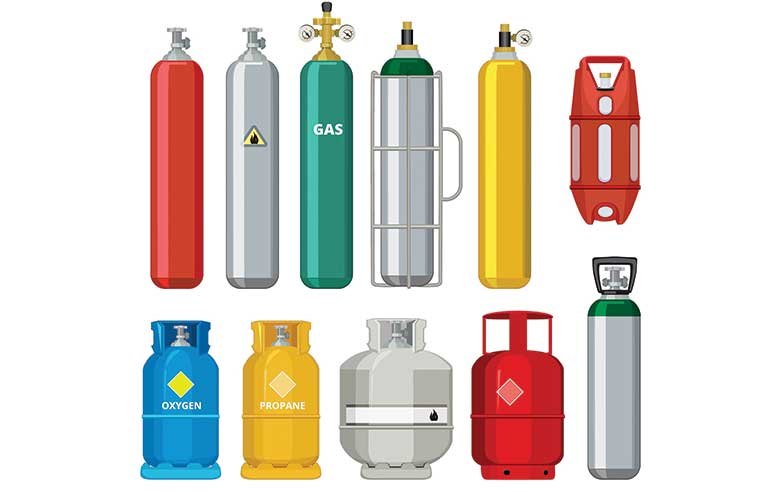
Some gases are stored and transported as a LIQUEFIED GAS. This means the container has BOTH a gas and liquid state inside the container. It is the gas sitting on top of the liquid that keeps the liquid from becoming a gas. But as soon as the container is breached/opened and the pressure is reduced/removed from the surface of the liquid – the liquid will begin to boil, generating more gas. These containers pose MORE serious hazards, as they can BLEVE or the release can be substantially larger based on the chemical’s expansion ratio. The leak may be a liquid leak, but the liquid will convert to a gas rapidly, even in cold weather. Both Anhydrous Ammonia and Chlorine are stored as LIQUEFIED GASES, although, as discussed below, ammonia is also stored as a Refrigerated Liquefied Gas.
Some LIQUEFIED GASES are kept in their liquefied state by REFRIGERATION. For example, anhydrous ammonia is stored in large quantities as a Refrigerated Liquefied Gas. The refrigeration process works just like a regular system by taking the gas from the head space of the tank and refrigerating it back to a liquid, and returning the liquid back to the tank. These tanks operate around 2-4 psi, but the liquid ammonia is colder than -28°F (i.e., it’s boiling point).

The most recognized DISSOLVED GAS is Acetylene. Acetylene is normally dissolved in a solvent, typically acetone, at pressures up to 275 psig at 20°C (68°F). The dissolved acetylene is packaged in specially designed cylinders filled with a porous material to prevent voids where gaseous acetylene could collect.
