
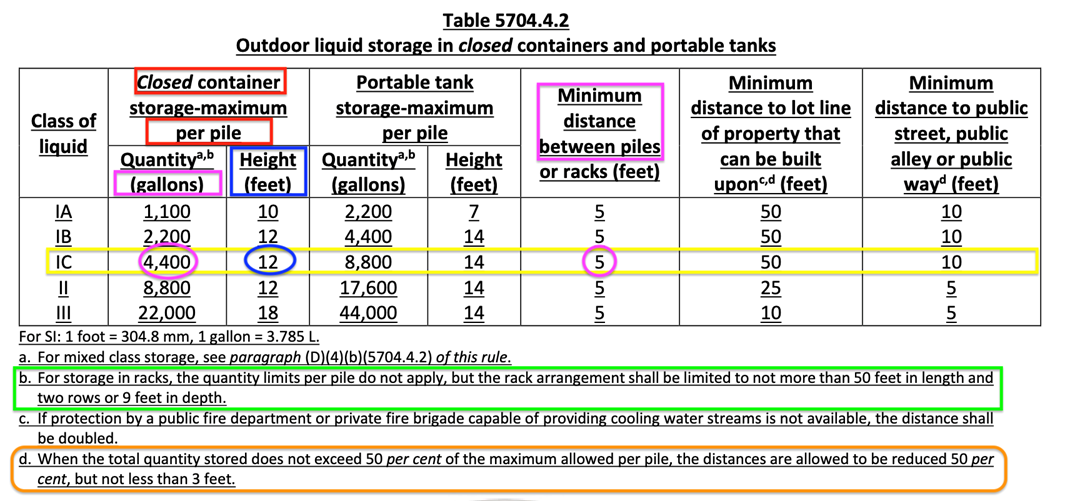
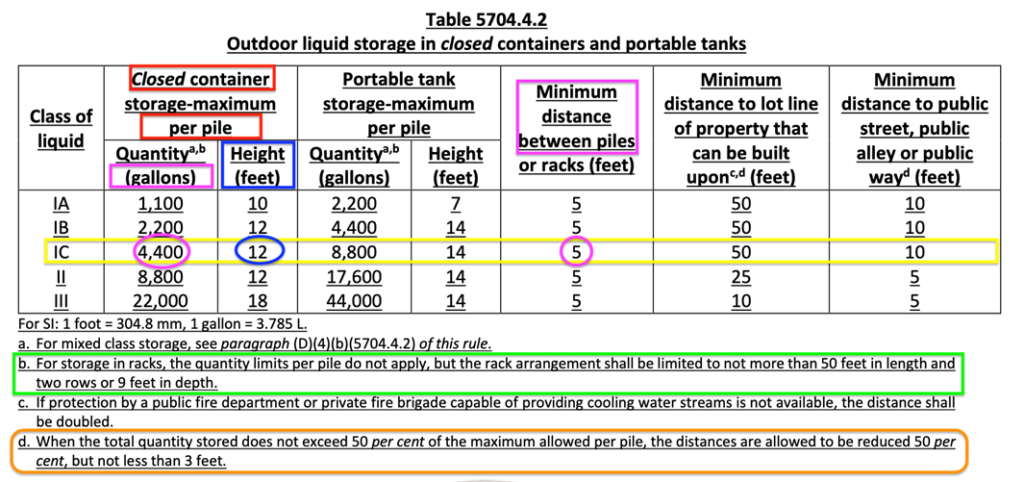
 Table 5704.4.2—Outdoor liquid storage in closed containers and portable tanks (see below) is often referenced when a business wants to store flammable liquids outside the main building. I wanted to take a second to explain the application of that table to those on the EHS team who may not be experienced with the OH Fire Code/IFC.
Table 5704.4.2 – Outdoor liquid storage in closed containers and portable tanks does NOT apply to the storage when a Fire-Rated HAZMAT Locker will be used. Table 5704.4.2 and its data are based on “closed containers,” such as drums and smaller containers, sitting on pallets in “open air” and stacked to their maximum height.
You will see the phrase “per pile” used in the table. To visualize a “pile,” imagine a pallet with four (4) drums sitting on it. Another pallet of four (4) drums is sitting on top of those drums (i.e., stacked 2 pallets high). Based on Table 5704.4.2, we can have a Class IC flammable liquids 12’ tall/high pile.
For example,
a Class IC (FP between 73 and 100F) means (see table below) we could store 4,400 gallons in drums (or smaller containers) up to a 12’ high pile (e.g., a stack of three (3) pallets high). That is eighty (80) 55-gallon drums in a “pile. “
So envision a “pile” that is three (3) pallets high (no taller than 12’ as shown above) with four (4) drums on each pallet.
Each of these “piles” MUST have a separation distance between them of 5’.
The closest we can have one of these “piles” from our property line that can be built upon is 50’ and 10’ from a public way/road.
I have highlighted the table to try and point out the critical data….
Language from the IFC Commentary that explains the limitations of Table 5704.2
Storage of flammable and combustible liquid next to a building can expose the flammable and combustible liquid or the building to fire; however, placing flammable and combustible liquids next to a building may be necessary for the facility’s operation. To control fire exposure, the flammable and combustible liquid next to the building and the building itself must be on the same property and under the same management. Two types of buildings may have flammable and combustible liquid stored adjacent to them.
- A building of noncombustible construction not more than one story in height used for the storage of flammable
and combustible liquid that is of noncombustible construction and not more than one story in height can have outdoor storage next to it. This building has fire protection features installed to protect the building and its contents from an interior fire, but is not designed for the exterior fire exposure. Limiting the quantity of flammable and combustible liquid to 1,100 gallons (4163 L) in closed containers reduces the exterior fire exposure. If the exterior quantity of flammable and combustible liquid exceeds 1,100 gallons (4163 L) in closed containers, or this building does not meet the criteria for construction, height or use as storage for flammable and combustible liquids, the fire protection must be increased by using the distance between the building and the pile. The clearance required between the class of flammable and combustible liquid and the property line is to be used. - A building can have outdoor storage next to it, where the building’s exterior wall adjacent to the storage of flammable and combustible liquid has a minimum 2-hour fire-resistance rating and protected openings. The restriction on openings above grade is to prevent an interior or exterior fire from bypassing the 2-hour fire-resistance-rated wall construction. The restriction on an opening below grade is to prevent flammable or combustible liquid or vapors from entering the building. The maximum quantity of flammable and combustible liquid is limited to 1,100 gallons (4163 L) in closed containers per pile. More than one pile can be located adjacent to this fire-resistant construction if the piles are located a minimum of 10 feet (3480 mm) from the building.