
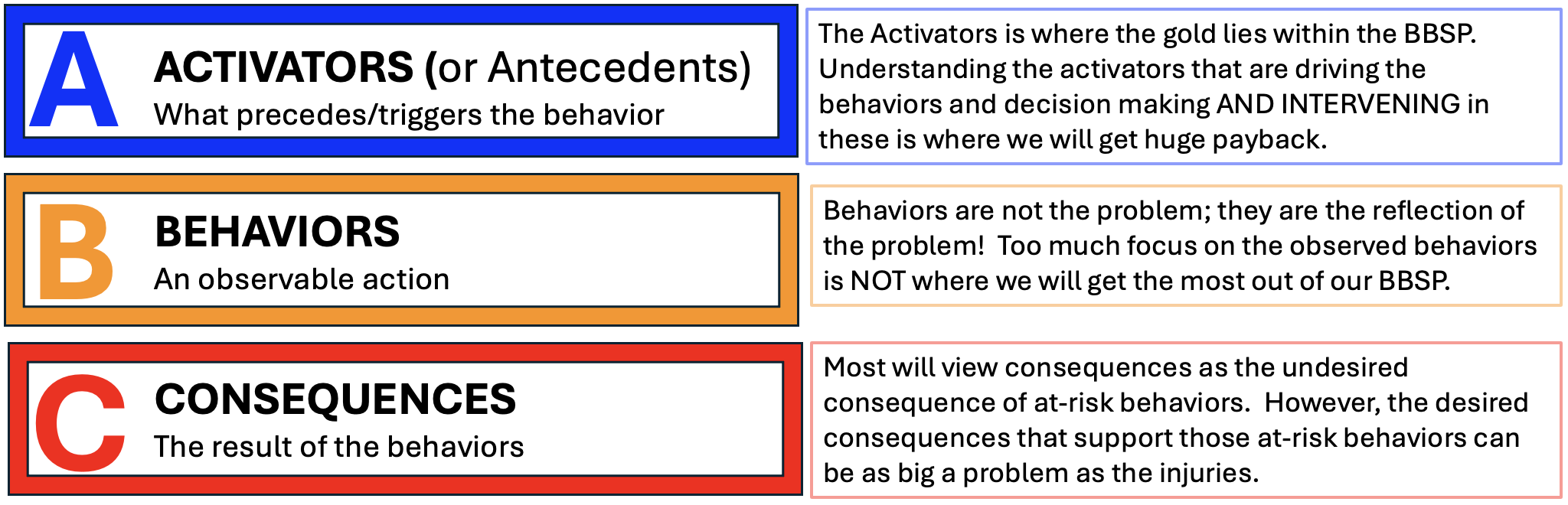
Understanding the basics of the ABC model is a MUST for safety professionals

ABC Model

ABC ModelUnderstanding the basics of the ABC model is a MUST for safety professionals, even if your organization is not ready for a formal Behavior Based Safety Process (BBSP).  This simple model will enlighten many and help them understand WHY workers and management do what they do.  Seasoned safety pros will often focus far too much on the Behaviors and Consequences when, in fact, it is the Activators (or Antecedents) that offer us so much opportunity for improvement.

Several years ago, I read Clive Lloyd’s book Next Generation Safety Leadership: From Compliance to Care where he coined the phrase: Behaviors are not the problem; they are a reflection of the problem. Oh, how I wish I could have read that book in 1995 or heard that phrase, as it could have saved me a lot of “growing pains” as I navigated the choppy waters of implementing BBSPs and focusing too much on the observed behaviors and consequences and far too little on the activators that were driving those observable behaviors.  Believe it or not, a Causal Analysis course I took in 1996 changed how I view behaviors and decision-making.  In that course, then supported by all the Plant Managers I worked for, we learned to focus on the Latent Organizational Failures more than the Active Failures, and by doing so, we created Corrective Action Plans (CAPs) that were designed to address the “activators” rather than the behavior.

By the way, the two (2) books that I will suggest that every safety professional must read are:

  1. The Psychology of Safety, by Dr. E. Scott Geller
  2. From Compliance to Care, by Clive Lloyd

Both books are easy to read and will profoundly impact your approach to managing safety, especially Behavior Based Safety matters.

So, let’s discuss the ABC model and how each element can improve safety performance and culture.

As my image states, we tend to focus far too much energy and resources on the Behaviors when, in fact, it is the Activators that hold the gold.  This is also the #1 cause of BBSP failures; looking at the behaviors and NOT the Activators that preceded/triggered the at-risk behavior. 

And let’s be honest, the Consequences are a moot point.  If we have a negative consequence, we have failed.  However, it is those “positive consequences” that we need to pay close attention to, as they are the consequences that support at-risk behavior.  For example, an employee knowingly commits a “Violation” (Reason, 1998), and yet he/she receives a “positive consequence” in that they were not injured and save time and “hassle.”  This type of consequence WILL drive that behavior again.  So, if we want to utilize consequences, we should most fear these unobservable positive consequences that will drive repeat at-risk behaviors.

Some consequences carry more weight than others in our decisions. The most sought-after behaviors are those that are perceived to have

  • Immediate (I)
  • Certain (C)
  • Positive (+) consequences

Consequences ICSI

Image Source: ICSI


As I said, the gold lies in understanding the Activators (Antecedents); however, most BBSPs never get far enough along to recognize this need and the value of understanding WHY workers perform at-risk behaviors.  Sure, sometimes it is a personal choice, but most of the time, those at-risk behaviors are driven by LATENT ORGANIZATIONAL FAILURES (Reason, 1998).  Correcting/Changing the activators (Antecedents), such as the “work environment,” can profoundly impact BOTH safety performance and culture. 

Geller talks about the relationship between person, environment, behavior, and safety culture.

Geller Culture Triangle

Bottom line, looking back on the accidents where we determined the root cause was an “unsafe act”, we failed to look deep enough into the activators that were present when the worker made the decision(s) to perform the tasks in that manner.  Remember, Reason’s Human Failure model breaks down our failures into three (3) groups:

  1. Errors
  2. Mistakes
  3. Violations

Even under violations, there are three (3) sub-groups:

  1. Routine
  2. Situational
  3. Exceptional

I have come to understand that ONLY in those cases where we arrive at “Exceptional Violation” is discipline warranted.  Routine and Situational violations are heavily influenced by LATETNT ORGANIZATIONAL FAILURES.  Even when we have the at-risk behavior “caught on tape,” that “ACTIVE FAILURE” we are witnessing will fall into one of those three (3) subgroups, and ONLY after an extensive causal analysis can we arrive at “Exceptional Violation.”

Scroll to Top