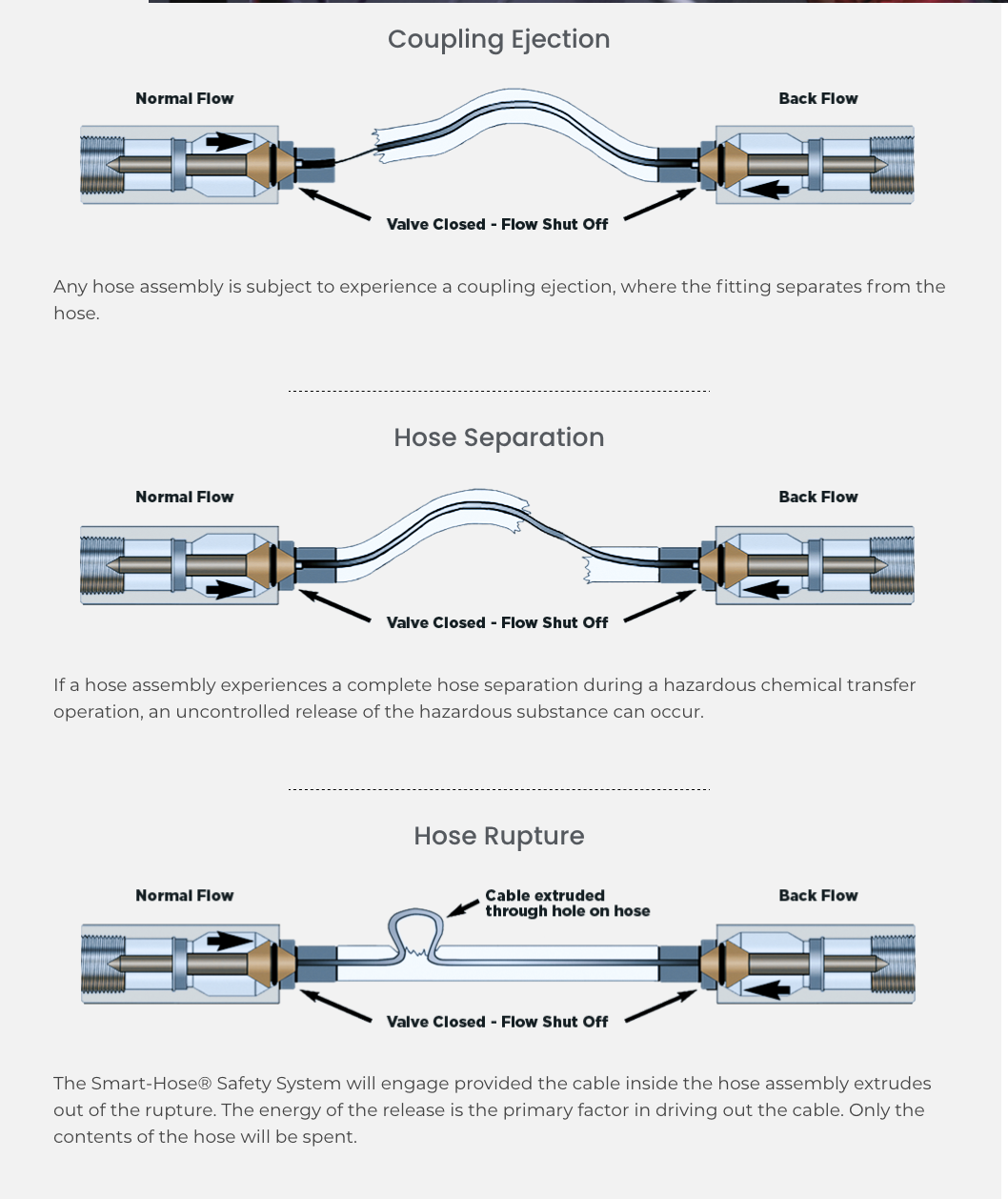
Years back a facility had to apply for a “Special Permit” (example of a permit at link) to get an exemption for their HAZMAT Attendance requirements and then it was very specific to the loading/unloading station and came with many caveats. Now 49 CFR 177.834 has this exception built into the standard and it reads:
|
A qualified person “attends” the loading or unloading of a cargo tank ONLY IF, throughout the process: … 49 CFR 177.834(i)(3)(iii) Hoses used in the loading or unloading operations are equipped with cable-connected wedges, plungers, or flapper valves located at each end of the hose, able to stop the flow of product from both the source and the receiving tank within one second without human intervention in the event of a hose rupture, disconnection, or separation. (A) Prior to each use, each hose must be inspected to ensure that it is of sound quality, without defects detectable through visual observation; and (B) The loading or unloading operations must be physically inspected by a qualified person at least once every sixty (60) minutes. |
Source: https://smarthose.com/
NOT an endorsement of this brand, but they were the originals as I understand it. There are other brands now.
So if we have hoses that become known by their original trade name, “Smart Hose®” then the hose becomes the “attendant”. These smart hoses are really nice when doing an Alternative Release Scenario (ARS) for a Risk Management Plan. We always see facilities, and I have written about this often, stating their ARS will last only X minutes but then they can not explain where X minutes came from. With these smart hoses, we can clearly state with documented engineering (AND these hoses are PASSIVE MITIGATION) how long our ARS will release.
In some cases, with some of the more toxic hazardous materials, these are nice to have because it allows the hazard zone to be clear of people, and if a failure does occur a person does not have to enter a hazard area to take mitigative measures. But take NOTICE of the two (2) qualifiers when using these hoses in lieu of a human attendant…
(A) Prior to each use, each hose must be inspected to ensure that it is of sound quality, without defects detectable through visual observation; and
(B) The loading or unloading operations must be physically inspected by a qualified person AT LEAST ONCE EVERY SIXTY (60) MINUTES.
Interestingly enough that when we would get a special permit, this hourly inspection was always one (1) of the requirements, but we had to maintain a log of these inspections. The DOT inspector would ALWAYS, every single time, find gaps in our hourly inspections. Luckily the gaps were sporadic and the inspector just waved their finger at us and told us to “figure it out”! But the regulation does NOT require a log or any means to document that the hourly inspection is occurring.
The same goes for the pre-use hose inspection – no requirement to document this inspection.
But what I can not find, I have requested it, is the annual maintenance of these “smart hoses”. Typically a bulk transfer hose will have some annual, or more frequent, inspection and testing requirements. These hoses have 3-4 more moving parts to test to ensure they function as designed. I would think these functional tests would be ABSOLUTELY CRITICAL since we will be relying 100% on these devices to stop the flow should we experience a hose failure or hose connection failure and there will no human available to intervene.
For the record, I watch several Smart Hose Technologies® videos, and these videos state their hoses have no annual maintenance requirement. I have sent an inquiry regarding this as I find this shocking, but they may surprise me. I have lived by what is now called ARPM/IP-11-7 Chemical Hose my entire career and this Hose RAGAGEP most certainly require Daily, Quarterly, and Annual inspection and testing; however, as we know, a manufacturer’s recommendation(s) come first and will trump a general RAGAGEP such as ARPM/IP-11-7/2015.
NOTE: I also recommend a hose with these special designs for process applications where a hose is used as a “flex joint” in a pipe run. Many times these joints will be in a ceiling and not accessible and should the hose fail, the release will be massive and fast based on the means to shut down the pipe flow. These hoses have about the same reliability as an Excess Flow Valve.