
Our #1 RAGAGEP for labeling/marking piping that contains a hazardous material, ASME A13.1, saw a significant updates in 2020 and 2023. The major revisions include:
- revising the Scope,
- updating each of the definitions,
- expanding the Legend section, and
- revising both the Color section and Table 4.2-1, Designation of Colors
- adding a new paragraph to address abandoned piping
Also, ASME A13.1 was changed from periodic maintenance to a continuous maintenance Standard.
Here are the highlights of these changes:
SCOPE
This Standard establishes a common system to assist in identification of fluids conveyed in piping and their characteristics. The Standard describes requirements for the identification of aboveground piping used in industrial, commercial, transmission, distribution, and institutional installations, and in buildings used for public assembly.
It does not apply to electrical conduits.
An alternative system for identification is acceptable if
(a) the system is described in writing
(b) employees are trained to recognize the contents of the piping based on the system
(c) the system meets local jurisdictional requirements
DEFINITIONS
fluids: liquids, gases, slurries, pneumatically conveyed solids, and their mixtures.
combustible: a fluid that can burn, but that is not flammable.
corrosive: a fluid that causes visible destruction of, or irreversible alterations in, living tissue or materials by chemical action at the site of contact.
firefighting: water, foam, and C02, among other fluids, that are used to control, suppress, or extinguish fires.
flammable: a fluid that, under ambient or expected operating conditions, is a vapor or produces vapors that can be ignited and continue to burn in air. The term thus may apply, depending on service conditions, to a fluid
defined for other purposes as flammable or combustible.
oxidizing: a fluid that may, generally by providing oxygen, cause or contribute to the combustion of other material more than air does.
toxic: a fluid that may constitute a hazard to life or health, either temporary or permanent, from exposure by contact, inhalation, or ingestion.
piping: conduits used to convey, distribute, mix, separate, discharge, meter, control, or snub fluid flows that are constructed from pipe, tube, fittings, valves, and their coverings. Supports, brackets, and other accessories are specifically excluded from applications of this Standard.
Legend
This Standard requires the preparation of a legend that describes the contents of the piping system. Legends shall be brief, informative, pointed, and simple for the greatest effectiveness. The following are examples of content descriptions appearing in a legend:
(a) “HOT WATER”
(b) “Phosphate Slurry”
(c) “Air 700 kPa”
(d) “ARGON 500 PSIG”
(e) “PROPANE”
(f) “Chilled Water”
(g) “HYDRAULIC OIL”
(h) “AFFF Foam”
(i) “CARBON TETRACHLORIDE”
(j) “Liquid CO/
(k) “SULFURIC ACID”
(l) “STEAM 100 PSJG”
(m) “Crude Oil”
(n) “Natural Gas”
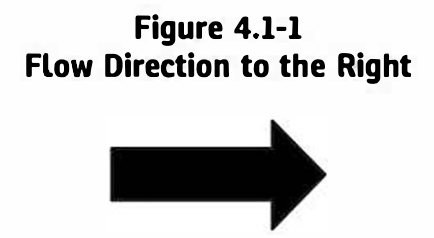
In addition to the legend, arrows shall indicate the direction of flow.
The direction shall be indicated by a single-headed arrow (see the example in Figure 4.1-1).

Where flow can be in both directions, either a double-headed arrow (see Figure 4.1-2) or two arrows pointed in opposite directions (see Figure 4.1-3) shall be displayed.
![]()
Contents shall be identified by a legend with sufficient additional details, such as temperature and pressure, as are necessary to identify the hazard.
Legends may be stenciled or taped on, or marked in ink.
In any situation, the number and location of identification markers shall be based on the particular piping system.
Where piping is connected to containers that are labeled in accordance with GHS requirements, a corresponding label on the piping may be provided.
The corresponding label should contain at least the product name or identifier, the pictogram, the signal word, and the physical, health, and environmental hazard statements.
Color
Color should be used to identify the characteristics of the contents.
Color should be displayed on, or contiguous to, the piping by any physical means.
Its use shall be in combination with a legend.
Color may be used in continuous, total-length coverage or in intermittent displays.
Colors preceded by the word “Safety” shall meet the requirements of ANSI/NEMA 2535.1 (see Table 4.2-1).
Placement
Attention shall be given to the visibility of the pipe markings.
Where piping is located above or below the normal line of vision, the lettering shall be placed below or above the horizontal centerline of the pipe.
Legends shall be applied close to valves or flanges; adjacent to changes in direction, branches, and where pipes pass through walls or floors; and at intervals on straight pipe runs sufficient for identification.
For piping layouts where applying legends in this way is impractical, substitute techniques to achieve positive identification are acceptable.
One such technique is placing the legends on plates that are attached to the piping.
Type and Size of Letters
Contrast shall be provided between the color field and legend for readability.
Use of letters of standard style, 1 in sizes 0.5 in. (13 mm) and larger, is recommended.
For the identification of materials in piping with an outside cover diameter less than 0.75 in. (19 mm), a permanently legible tag is recommended.
The tag should follow the identification scheme described in this Standard except for the size of the letters, which should be such that they can be easily read from a position along the typical line of vision.
Abandoned Piping
Piping that has been abandoned in place should be identified.
The recommended color scheme is SAFETY WHITE BACKGROUND WITH BLACK LETTERS.
A black border should be added to the identification.
When the abandoned piping is protected from corrosion by the addition of a pressurized fluid or contains residual hazardous material, the legend should indicate that.
