(emphasis added by me – NOT OSHA)
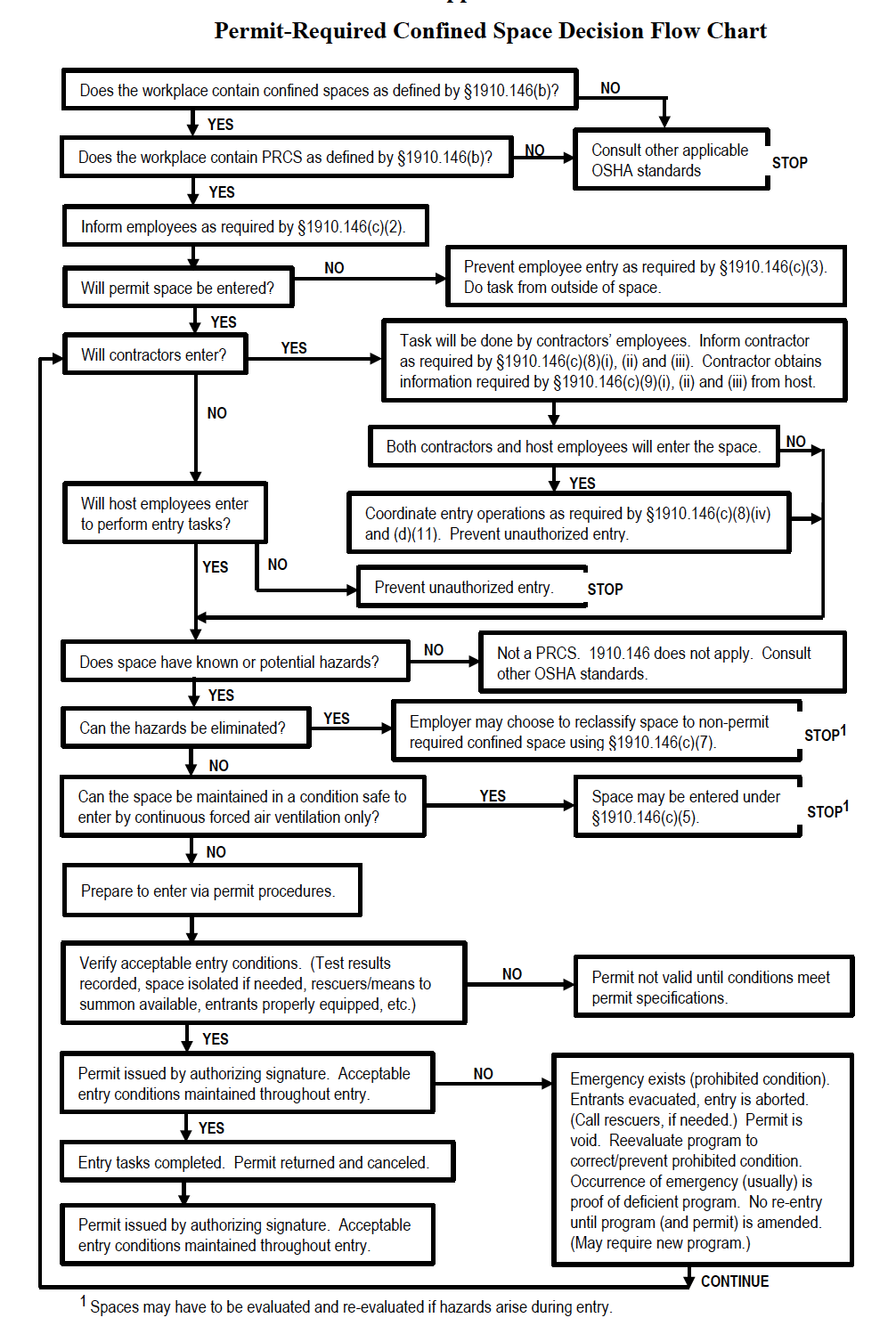
Paragraph (c)(5) of the final rule sets provisions that employers can follow in lieu of complying with paragraphs (d) through (f) and (h) through (k)…
IF the employer can demonstrate that the permit space contains ONLY atmospheric hazards AND that continuous forced air ventilation will maintain those permit spaces safe for entry. This paragraph is based, in part, on paragraph (i) of the proposed rule.
OSHA decided NOT to carry the proposed paragraph (i) forward into the final rule. OSHA had concerns that a “low hazard” designation for certain permit-required confined spaces would lead to confusion and reduce the protections afforded employees under the final section 1910.146. While OSHA believed that different levels of risk should lead to different levels of protection, the permit space program will necessarily require the employer to implement protective measures that will address the hazards in the permit spaces adequately and appropriately. Under the final rule, employers will need to take increasingly stronger steps to ensure the safety of employees involved in entry operations in more and more hazardous permit spaces. The basic performance-oriented nature of the permit space standard forces employers to develop whatever procedures are necessary to eliminate OR control hazards in permit-required confined spaces. Spaces posing the least risk (above the threshold set by the definition of permit-required confined space) will necessitate the fewest procedures to ensure safe entry. Spaces containing severe or multiple hazards will require more detailed and comprehensive procedures. Lastly, confined spaces not posing the minimum risk set by the definition of a permit-required confined space require the least amount of effort to render them safe for employees; such spaces need neither attendants nor permits(11).
__________
Footnote(11) These spaces are addressed in the definition of non-permit-required confined space and in paragraphs (c)(1) and (c)(6) of the final rule. These provisions require employers to evaluate these confined spaces to ensure that they are not permit spaces and to re-evaluate them if their use or configuration changes in a manner that might pose hazards to entrants.
On the other hand, there are some confined spaces that do not normally contain a hazardous atmosphere, but might under certain conditions. These spaces are typically designed for employees to enter periodically, but they usually lack adequate ventilation to prevent the accumulation of a toxic or flammable atmosphere or to prevent the depletion of oxygen. Many of the “low-hazard” spaces mentioned in the record are spaces of this type. For example, diked areas, as noted by several commenters, do not normally pose hazards severe enough to warrant the issuance of permits or the presence of attendants. The telecommunications industry contended that their manholes do not contain sufficient hazards to justify coverage under the permit space standard. Under industry practices currently used for entry into such spaces, these confined spaces normally do not have a potential to contain any hazard capable of causing death or serious physical harm, except in very rare circumstances.
OSHA believed that the practices necessary to make confined spaces that merely have the potential to contain hazardous atmospheres (as opposed to one that contains a hazardous atmosphere under normal conditions) safe are widely recognized and used throughout various industries. OSHA requirements for such spaces are contained in section 1910.268(o), for underground telecommunications manholes and unvented vaults, and 1926.956, for underground electric transmission and distribution work. OSHA included similar requirements in section 1910.269(e), for “enclosed spaces” in its standard for electric power generation, transmission, and distribution work (54 FR 5012), and in proposed section 1910.146(i), for “low-hazard” permit spaces. The practices necessary for eliminating the potential hazardous atmosphere for these spaces as set out in these documents include checking the cover for evidence of possible hazards, placing barriers after the removal of the cover, performing atmospheric testing, and providing continuous mechanical ventilation. Atmospheric testing includes testing for oxygen content, for the presence of flammable vapors and gases, and for potential toxic air contaminants. Mechanical force-air ventilation is provided if a hazardous atmosphere is detected.
OSHA believed that these practices can be adopted to ensure safe entry into any confined space that can be maintained safe for entry by ventilation ALONE. Some confined spaces are designed for employees to enter under normal operating conditions, although they do not provide sufficient natural or mechanical ventilation to ensure an adequate supply of oxygen or to disperse flammable gases and vapors and toxic air contaminants that may be introduced accidentally into the permit space environment. Testing the atmosphere within the space and providing adequate continuous ventilation can normally eliminate or control the hazardous atmosphere, producing the equivalent of a non-permit confined space (OSHA’s view point). Other types of permit spaces with ONLY atmospheric hazards can be isolated, purged, and ventilated from outside the space. If no entry is needed to achieve a safe atmosphere, then OSHA allows for procedures similar to those for the telecommunications and electric utility industries can be followed to ensure the safety of entrants.
By contrast, however, for a permit space that contains a hazardous atmosphere under normal operating conditions, it is usually necessary to make an initial entry in order to control the hazards within the space. The initial entry involves the exposure of the entrant to any hazards within the space, since the purpose of the entry is to control the hazards for future entries. The measures that must be taken to control the hazards, such as cleaning the space, vary with the types of hazards present within the space. Similarly, permit spaces into which hazards (such as welding or toxic or flammable cleaning materials) are introduced during entry need the protection afforded by the complete permit space program in order to assure that all measures, in addition to ventilation, necessary for the protection of entrants are followed. In these cases, the employer’s evaluation of the space before entry must take into account these additional sources of hazardous atmospheres that will be introduced into the space during entry. Pre-entry monitoring will NOT provide the needed assurances of safety in these situations. Accordingly, the permit system is necessary to provide protection from hazards in the permit space during these types of entries. The permit identifies the measures that must be taken to ensure that employees can safely enter the permit space, and the attendant watches for conditions not envisioned during the preparation of the permit and for other prohibited conditions. These two elements of the permit space program are essential for the safety of authorized entrants working in spaces that would contain a hazardous atmosphere under normal operating conditions.
Additionally, ANSI Z117.1-1989 (Ex. 129), Section 2, provides that
a space which, by configuration, meets the definition of a confined space but which is found, after evaluation, to have little potential for the generation of hazards or to have had its hazards eliminated by engineering controls is to be considered as a non-permit confined space.
The ANSI standard treats these spaces separately from permit-required confined spaces, applying only the requirements for identification of confined spaces and evaluation of their hazards and for atmospheric testing, along with special provisions for non-permit confined spaces. The ANSI standard does not apply the other requirements of the consensus standard to such spaces, but provides only that these other requirements be considered for application to the procedures used for entry.
OSHA has determined that it is NOT appropriate to require the entry permit program to be implemented for entries into permit spaces that contain ONLY atmospheric hazards which the employer demonstrates can be controlled with ventilation alone. These spaces can be made safe for entry following specific procedures that are spelled out in paragraph (c)(5) of the final rule. Paragraph (c)(5) of the final rule allows employers to conduct entry operations for such spaces in accordance with these procedures without following the non-training related provisions of the permit space program (paragraphs (d) through (f) and (h) through (k) of the final rule). The procedures in paragraph (c)(5) are based on proposed paragraph (i), with modifications supported by the rulemaking record, and are explained in the following discussion.
Additionally, OSHA has determined that spaces that have had ALL hazards eliminated can be reclassified as non-permit spaces for as long as the hazards remain eliminated. (It should be noted that continuous forced air ventilation controls atmospheric hazards – it does NOT eliminate them.) For spaces posing ONLY non-atmospheric hazards, IF those hazards can be removed without entry into the space, the permit space may be reclassified as a non-permit confined space AFTER the hazards are removed/elminated. For example, the engine for a cement mixer can be locked out, and the mixer can then be safely entered for maintenance (assuming there are no other hazards inside the mixing drum). For spaces with atmospheric hazards and for spaces with non-atmospheric hazards that can only be eliminated through entry into the space, the permit space can first be entered following all the requirements spelled out in paragraphs (d) through (k) of the final rule; and, after the employer certifies that the hazards have been eliminated, the space can be reclassified as a non-permit confined space. Requirements for the procedures to be used in reclassifying permit spaces are contained in final section 1910.146(c)(7), discussed later in this section of the preamble.
OSHA believes that the approach taken in paragraphs (c)(5) and (c)(7) of the final rule is consistent with that taken in ANSI Z117.1-1989. The major difference is that the consensus standard treats all non-permit required confined spaces(12) alike, whereas the OSHA standard separates them into two categories –
- permit spaces with atmospheric hazards controlled by means of ventilation alone and
- permit spaces that have been reclassified as non-permit confined spaces because the hazards have been eliminated.
__________
Footnote(12) The ANSI definitions of “confined space”,”permit-required confined space”, and “non-permit confined space” differ somewhat from OSHA’s definitions of these terms. OSHA’s definition of “permit-required confined space” is basically the same as ANSI’s definition of “confined space”. Under the ANSI’s definition, all confined spaces have an actual or potential hazard, while OSHA’s definition of “confined space” includes spaces with no hazards at all (which are not regulated under final section 1910.146). The final rule’s definition of “non-permit-required confined space” covers these hazard-free confined spaces, as well as spaces that have had their hazards eliminated under paragraph (c)(7). The ANSI definition of “non-permit-required confined space” covers confined spaces whose hazards have been eliminated by engineering controls and confined spaces that have “little potential for generation of hazards”. It is the ANSI “non-permit-required confined spaces” that are regulated under paragraphs (c)(7) and (c)(5) of the final rule.
This two-pronged approach better protects employees than the ANSI standard for two basic reasons.
First, by minimizing the amount of regulation that applies to spaces whose hazards have been eliminated, it encourages employers to actually remove all hazards from permit spaces, which is the best possible protection for entrants. The rules that do apply in such situations (paragraph (c)(7)) are only those necessary to ensure that the hazards have indeed been removed.
Second, for permit spaces that can be maintained safe by ventilation ALONE, the regulation specifies exactly what is required of the employer. As noted earlier, the practices required by paragraph (c)(5) for these spaces have been demonstrated in the telecommunications and electric utility industries as being highly effective in protecting entrants from the limited hazards present in such spaces. The ANSI standard does not specifically require such protective measures as ventilation in such cases. If the employer needs ADDITIONAL flexibility in controlling the hazards in these permit spaces, it is available by following the FULL PERMIT procedures outlined in paragraphs (d) through (k) of the final rule. These provisions, although they require additional protection in the form of attendants and permits, give the employer more flexibility in applying different controls to the hazards that are present.
Based on review of the record, OSHA has determined that there are circumstances in which employers can control atmospheric hazards without following the full permit procedures outlined in paragraphs (d) through (k) of the final rule. As noted earlier, some industries, such as telecommunications (regulated under section 1910.268(o)), have successfully protected employees from atmospheric hazards in workspaces through testing and continuous ventilation, without following all the requirements proposed in section 1910.146. OSHA believes that such experience indicates that ventilation and testing could protect employees throughout general industry from atmospheric hazards posed by similar types of permit spaces. Accordingly, OSHA has decided to allow employers, under certain conditions, to control atmospheric hazards within a permit space following specific procedures that are spelled out in the final rule in lieu of compliance with paragraphs (d) through (f) and (h) through (k) of the final rule. The ONLY requirements from the full permit space program that would apply to entry following these procedures are the training provisions in paragraph (g) of the final rule. The Agency has determined that training employees in the procedures is necessary and appropriate and that paragraph (g) contains the relevant requirements for this training.
Paragraph (c)(5)(i) of the final rule sets forth the conditions that MUST BE MET BEFORE a permit space may be entered under the alternative procedures, which are specified in paragraph (c)(5)(ii).
The first condition, set out in paragraph (c)(5)(i)(A) of the final rule, is that the employer MUST be able to demonstrate that the ONLY hazard posed by the permit space is an actual or potential hazardous atmosphere. The procedures required under paragraph (c)(5)(ii) are ONLY appropriate for atmospheric hazards, and the spaces for which these procedures can be used pose ONLY this type of hazard. If the space poses other hazards as well, either all the hazards must be eliminated, under paragraph (c)(7) of the final rule, or the space may only be entered following the full permit space procedures set out in paragraphs (d) through (k).
The second condition, set out in paragraph (c)(5)(i)(B) of the final rule, is that the employer MUST be able to demonstrate that ventilation ALONE is sufficient to maintain the permit space safe for entry. In order for the space to be considered safe, the atmosphere within the space after ventilation may NOT be expected to approach a hazardous atmosphere. This is necessary so that, if the ventilation shuts down for any reason (such as loss of power), the employees will have enough time to recognize the hazard and either exit the space or restore the ventilation. A guideline of 50 percent of the level of flammable or toxic substances that would constitute a “hazardous atmosphere” may be used by employers in making the determination required under paragraph (c)(5)(i)(B)(13). Additionally, the work to be performed within the space must not introduce any hazards – work with hazardous quantities of flammable or toxic substances and hot work are not permitted. (SPECIAL NOTE: A recent LOI does allow welding) This type of work would introduce hazards beyond those accounted for by the determination that the permit space can be maintained safe for entry. Paragraph (c)(5)(i)(B) indicates clearly that an employer who relies on continuous forced air ventilation to maintain spaces safe for entry must be able to establish that other measures are not needed to protect entrants.
__________
- Footnote(13) Two examples may help to clarify this guideline. (1) The LFL for methane is a concentration of 5 percent by volume. Ten percent of this value is 0.5 percent, a concentration which would be considered hazardous, by definition. Under the guideline, the measured concentration of methane should not exceed 0.25 percent after ventilation in order for the procedures specified in paragraph (c)(5)(ii) of the final rule to be acceptable. (2) The 8-hour time weighted average PEL for chlorine, under Table Z-1, is 0.5 parts per million. This concentration of chlorine would be considered hazardous by the definition of “hazardous atmosphere”. Under the guideline, the measured concentration of chlorine should not exceed 0.25 parts per million after ventilation in order for the procedures specified in paragraph (c)(5)(ii) of the final rule to be acceptable.
The third condition, set out in paragraph (c)(5)(i)(C) of the final rule, is that the employer MUST develop monitoring and inspection data that supports the demonstrations required by paragraphs (c)(5)(i)(A) and (c)(5)(i)(B). The atmospheric monitoring data MUST show that ventilation will keep the air inside the permit space within the guidelines of paragraph (c)(5)(i)(B), discussed earlier. The data required by paragraph (c)(5)(i)(C) are essential for the employer and employees, as well as OSHA, to be able to determine whether or not the space can be maintained safe for entry with the use of ventilation alone.
The fourth condition, set out in paragraph (c)(5)(i)(D) of the final rule, is that, if an initial entry is performed to gather the monitoring and inspection data required under paragraph (c)(5)(i)(C), it be conducted in accordance with the full permit space program requirements given in paragraphs (d) through (k). OSHA recognizes that monitoring and inspection data may be obtained either through entry into a space, or from outside the space, as long as the data provide complete and accurate information on air contaminants throughout the confined space. In many instances, however, it will be necessary to make an initial entry into the space in order to make the necessary determination. Paragraph (c)(5)(i)(D) requires that any entry to obtain the data be performed in accordance with all the provisions of the standard, because any relief from permit space program requirements is not allowed until the process of demonstrating, inspecting, monitoring, and documenting the conditions to be expected during entry is completed.
The fifth condition, set out in paragraph (c)(5)(i)(E) of the final rule, is that the determinations and supporting data required by paragraphs (c)(5)(i)(A) through (c)(5)(i)(C) be documented and made available to employees who enter the spaces under the terms of paragraph (c)(5). This documentation will enable the employer, employees, and OSHA to evaluate the determination that paragraph (c)(5) applies to a given permit space.
The sixth, and final, condition, set out in paragraph (c)(5)(i)(F) of the final rule, is that the entry be performed in accordance with the specific procedures required by paragraph (c)(5)(ii).
Paragraph (c)(5)(ii) of the final rule sets forth the procedures that must be followed for entries under paragraph (c)(5). The procedures detailed in this paragraph have been derived from several sources. Proposed paragraph (i) set out procedures that could be used for spaces that presented an extremely low probability of encountering atmospheric hazards. Proposed paragraphs (i)(1) and (i)(2) would have required testing, ventilation, and other measures necessary to ensure that the space remained safe for entry. These provisions, modified as warranted by the public record, have formed the basis of most of the requirements contained in paragraph (c)(5)(ii) of the final rule.
Section 4 of ANSI Z117.1-1989 provides requirements necessary for safe entry into non-permit confined spaces. OSHA also relied on some of these provisions, specifically the training and testing requirements contained in Sections 4.2 and 4.4, respectively, in the development of paragraph (c)(5)(ii) of the final rule.
Lastly, OSHA based some of the provisions of this paragraph of the final rule on the existing telecommunications and proposed electric power generation, transmission, and distribution standards. Paragraph (o) of section 1910.268 sets forth requirements for the protection of employees performing telecommunications work. Current industry practice in compliance with these requirements has provided effective protection for employees performing work in such spaces as manholes and unvented vaults. Paragraph (e) of proposed section 1910.269 set out provisions that OSHA believed were necessary (and widely used) for the protection of employees performing electric power generation, transmission, and distribution work in “enclosed spaces”(14). (This proposed paragraph was also based largely on section 1910.268(o).) These proposed and existing standards provide provisions that OSHA believes are necessary and appropriate for the protection of employees in the two industries from atmospheric hazards that can be controlled through the use of ventilation alone. OSHA has determined that these standards, with appropriate modification, can also be used to protect employees in general industry from permit spaces presenting atmospheric hazards that can be maintained safe for entry by means of ventilation alone.
__________
Footnote(14) Defined in proposed section 1910.269 as a working space, such as a manhole, vault, tunnel, or shaft, that has a limited means of egress or entry, that is designed for periodic employee entry under normal operating conditions, and that under normal conditions does not contain a hazardous atmosphere, but that may contain a hazardous atmosphere under abnormal conditions.
Paragraph (c)(5)(ii)(A) of the final rule requires that any conditions that make it unsafe to remove an entrance cover be eliminated before the cover is removed. Some conditions within a permit space, such as high temperature and high pressure, may make it hazardous to remove a cover from the space. For example, if the atmospheric hazards within the space cause high pressure to be present within the space, the cover could be blown off in the process of removing it. To protect employees from such hazards, a determination must be made as to whether or not it is safe to remove the cover. Such a determination would require the employer to examine the conditions that are expected to be in the permit space. The cover would be checked to see if it is hot; and, if it is fastened in place, it would be loosened gradually to release any residual pressure. An evaluation must also be made of whether conditions at the site could cause a hazardous atmosphere to accumulate in the space, which would make it unsafe for employees to remove the cover. The cover could NOT be removed until it is safe to do so.
Paragraph (c)(5)(ii)(B) of the final rule requires that openings to permit spaces be guarded to protect employees from falling into the space and to protect employees in the permit space from being injured by objects entering the space. The guard could be in the form of a railing, a temporary cover, or any other temporary barrier that provides the required protection. If the opening to the space is situated so that employees and objects cannot fall into the space, no additional guarding is necessary. This provision was taken from existing section 1910.268(o)(1)(i), which sets forth an equivalent requirement for underground telecommunications work.
Paragraph (c)(5)(ii)(C) of the final rule requires the internal atmosphere of the permit space to be tested with a calibrated, direct-reading instrument before any employee enters the space. The atmosphere MUST be tested, in sequence, for oxygen content, for flammable gases and vapors, and for potential air contaminants. This provision, which is based on proposed paragraph (i)(1)(ii), is necessary to determine whether or not ventilation alone will be able to maintain the space safe for entry. The results of this testing must be within the expected range for the space, based on the employer’s determination under paragraph (c)(5)(i)(A).
Paragraph (c)(5)(ii)(D) of the final rule PROHIBITS employees from being in the space when a hazardous atmosphere is present. Any entry into a permit space containing a hazardous atmosphere must be conducted in accordance with the full permit space program requirements given in paragraphs (d) through (k).
Paragraph (c)(5)(ii)(E) of the final rule sets out requirements for the continuous forced air ventilation that must be used to maintain the permit space safe for entry.
First, NO employee may enter the space until the forced air ventilation has eliminated any hazardous atmosphere found within the space.
Second, the ventilation must be directed to ventilate the immediate areas where an employee is or will be present within the space and must continue until all employees have left the space.
Third, the air supply for the ventilation must be from a clean source and must not increase the hazards in the space.
These provisions, which have been taken from ANSI Z117.1-1989 Sections 9.1 and 9.1.1 and from proposed section 1910.269(e)(10) and (11), ensure that the atmosphere within the permit space remains safe during the entire entry operation.
Paragraph (c)(5)(ii)(F) of the final rule requires the permit space to be periodically tested as necessary during the entry to ensure that the continuous forced air ventilation is preventing the accumulation of a hazardous atmosphere. The frequency at which such testing would have to be performed is dependent on the nature of the permit space and the results of the initial testing performed under paragraph (c)(5)(ii)(C) of the final rule. For example, if the initial testing found no evidence of flammable gases or vapors and if the permit space is not normally expected to present the hazards posed by such gases and vapors, no further testing would be necessary. (SPECIAL NOTE: PLEASE act as if you NEVER read that last sentence!) If a flammable gas or vapor is initially detected, frequent or continuous testing would be appropriate. The testing required by final paragraph (c)(5)(ii)(F), in combination with continuous forced air ventilation required by paragraph (c)(5)(ii)(E), ensures that entrants remain protected the entire time they are present within the permit space.
Paragraph (c)(5)(ii)(G) of the final rule requires employees to exit the permit space immediately if a hazardous atmosphere is detected. Additionally, the employer is required to evaluate the permit space to determine how the hazardous atmosphere developed and to implement measures to protect employees from the hazardous atmosphere before any subsequent entry under paragraph (c)(5) procedures is undertaken. Obviously, if a hazardous atmosphere is detected during entry, the permit space has not been maintained safe for entry. For any subsequent entries to be authorized under paragraph (c)(5), the employer must determine what went wrong, must take whatever measures are needed to prevent a recurrence, and must demonstrate that the subsequent entries can be performed safely, as required by paragraph (c)(5)(i).
Paragraph (c)(5)(ii)(H) of the final rule requires the employer to verify that the permit space is safe for entry and that the measures required by paragraph (c)(5)(ii) have been taken. The verification MUST BE IN WRITTEN FORM of a certification that contains the date, the location of the space, and the signature of the certifying individual and that is made available to entrants. The certification documents the employer’s compliance efforts. The certification, in combination with the documentation required under paragraph (c)(5)(i)(E), will maintain employer accountability for compliance with paragraph (c)(5)(ii), will enable OSHA to evaluate compliance with the standard, and, where permit space incidents have occurred, will assist OSHA in ascertaining how those incidents arose.