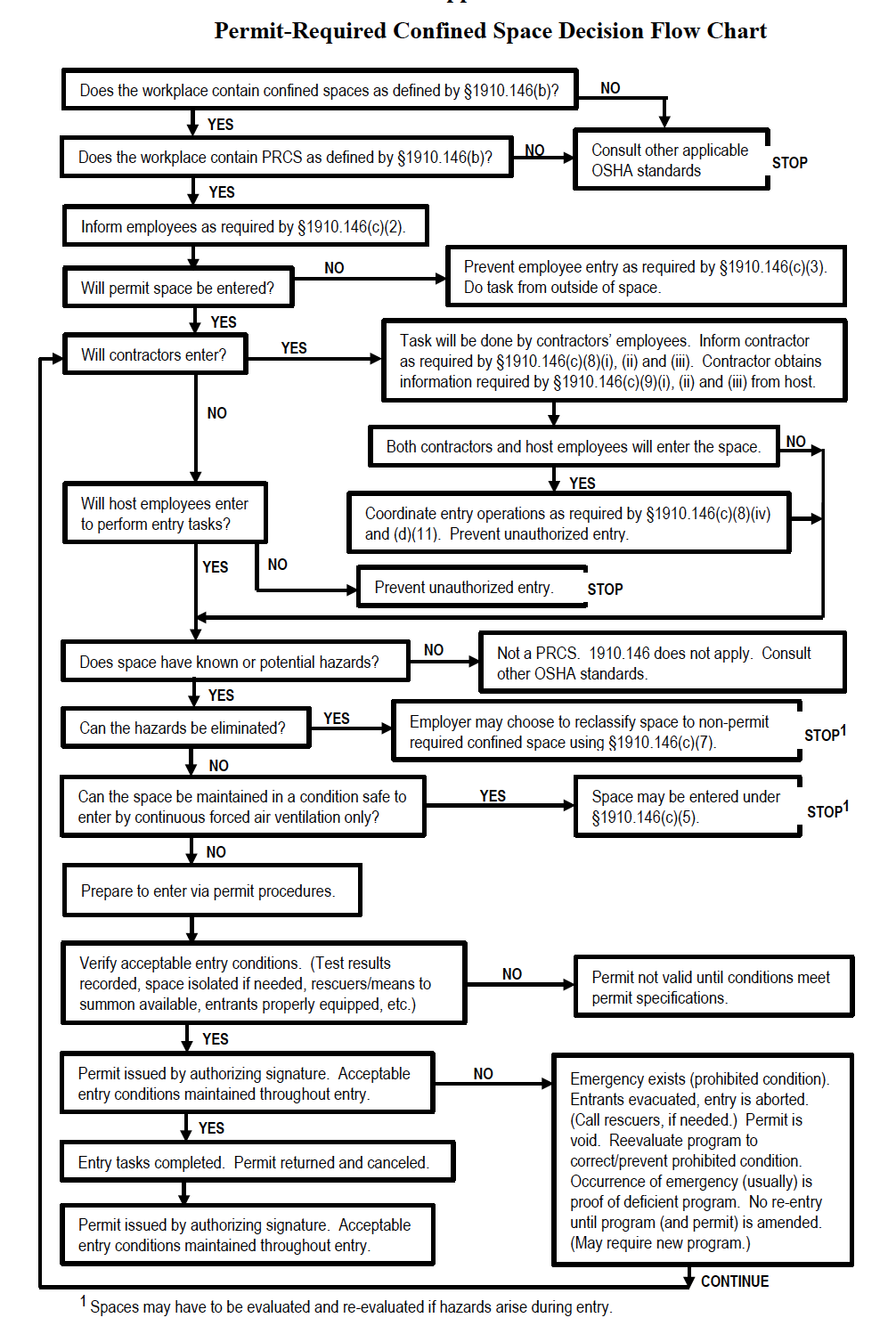
As we have discussed before, several years ago a governor of the great state of Washington passed a bill that required all the state’s codes and standards to be written in “everyday language” and oh how I love this approach. Even career safety professionals can struggle to try to decipher what Federal OSHA is really saying in their standards and we are still debating standards that have been in place for 30+ years; so this WA-OSHA approach is extremely helpful and refreshing. I have been working with a client who is just about ready to start up their facility and we are implementing their PRCS program. I used the language from WAC 296-809-20002 and the safety professional wanted to thank me for doing what WA-OSHA did. He is now hooked on using their standards and he is NOT in the state of WA. Here is how WA-OSHA explains how to perform a CS/PRCS evaluation:
Remember, all of the WA-OSHA standards are written in this manner!
WAC 296-809-20002 – Identify permit-required confined spaces
You must identify all permit-required confined spaces in your workplace. Use a person with the knowledge, skills, and abilities, capable of identifying actual and potential hazards related to permit-required confined spaces and with the authority to take prompt corrective action, such as an entry supervisor or competent person.
Important: Identification of Permit-Required Confined Space(s) involves a two-step process.
Step 1:Identify confined spaces.
Confined space. A space that is all of the following:
- Large enough and arranged so an employee could fully enter the space and work
- Has limited or restricted entry or exit. Examples of spaces with limited or restricted entry are tanks, vessels, silos, storage bins, hoppers, vaults, excavations, and pits.
- Not primarily designed for continuous human occupancy.
See Appendix A Frequently Asked Questions and Examples of Confined Spaces at https://lni.wa.gov/safety-health/safety-rules/chapter-pdfs/WAC296-809.pdf
Step 2: Evaluate the actual and potential hazards of each confined space to identify the permit-required confined space(s).
Permit-required confined space or permit space. A confined space that has one or more of the following characteristics capable of causing death or serious physical harm.
- Contains or has a potential to contain a hazardous atmosphere.
- Contains a material with the potential for engulfing someone who enters.
- Has an internal configuration that could allow someone entering to be trapped or asphyxiated by inwardly converging walls or by a floor, which slopes downward and tapers to a smaller cross-section.
- Contains any physical hazard. This includes any recognized health or safety hazards including engulfment in solid or liquid material, electrical shock, or moving parts.
- Contains any other recognized serious safety or health hazard that could either:
- Impair the ability to self-rescue; or
- Result in a situation that presents an immediate danger to life or health.
See Appendix B Examples of Permit-Required Confined Space Hazards at https://lni.wa.gov/safety-health/safety-rules/chapter-pdfs/WAC296-809.pdf
I absolutely love how they broke down the items that make a CS a PRCS, especially the breakdown of Item #5. So many safety folks want to encompass every hazard under the sun to make a CS into a PRCS. WA-OSHA makes it perfectly clear, that we are to consider “recognized serious safety or health hazards” that impair the entrant’s ability to self-rescue or creates a situation that presents an immediate danger to life or health. They have also broken out the “physical hazards” such as augers, sweep arms, agitators, mixers, etc.