
1/29/16 UPDATE – CSB Investigation Video and Investigation Report
5/16/14 UPDATE – The Texas State Fire Marshal has released their investigation report for this tragic accident. CLICK HERE for the full report.
10/11/13 UPDATE – OSHA Citations
OSHA has issued 27 Serious citations to Adair Grain, Inc. dba West Fertilizer Co. totaling $118,300. Citations issued were:
- 1910.109 – Explosives and blasting agents
- 1910.111 – Storage and handling of anhydrous ammonia
- 1910.120 – Hazardous waste operations and emergency response
- 1910.134 – Respiratory Protection
- 1910.146 – Permit-required confined spaces
- 1910.147 – The control of hazardous energy (lockout/tag out)
- 1910.157 – Portable fire extinguishers
- 1910.178 – Powered industrial trucks
- 1910.303 – General
- 1910.1200 – Hazard Communication
Here is a breakdown of the citations and a pdf file of the citations…
Citation 1 Item 1 Type of Violation: Serious; $7,000
OSH ACT of 1970 Section (5)(a)(l): The employer did not furnish employment and a place of employment which was free from recognized hazards that were causing or likely to cause death or serious physical harm to employees in that employees were exposed to the hazards of chemical burns and inhalation of anhydrous ammonia. On or about April 17, 2013 and at times prior thereto, at the south end of the fertilizer plant employees working with or in proximity to two large 12,000 gallon liquid anhydrous ammonia storage/service tanks were exposed to the hazards of contact with liquid ammonia and inhalation of ammonia vapor from leaking or failed ammonia systems. Among other methods, one feasible and acceptable abatement method to correct these hazards is to inspect and/or replace pressure relief valves in accordance with manufacturers specifications and per American National Standard Institute K61.l/Compressed Gas Association G-2.1-1999 Section 5.8.12 – 5. 8.16, and inspect pressure vessels in accordance with the National Board of Inspection Code 23 Part II Section 4.
Citation 1 Item 2 Type of Violation: Serious; $7,000
29 CFR 1910.109(i)(2)(iii)(b): Storage buildings did not have adequate ventilation or were not constructed to be self-ventilating in the event of a fire.
On or about April 17, 2013, and times prior thereto, the employer did not provide suitable ventilation or self-ventilation in the fertilizer plant where ammonium nitrate was stored and handled in case of a fire.
Citation 1 Item 3 Type of Violation: Serious; $7,000
29 CFR 1910.109(i)(2)(iii)(c): Walls on exposed sides of storage buildings within 50 feet of combustible buildings, forests, piles of combustible materials and similar exposure hazards were not of fire-resistive construction:
On or about April 17, 2013, and at times prior thereto, the employer did not ensure that the east wall of the fertilizer building and seed room were fire resistant rated and was not located within 50 feet of the office/maintenance shop building.
Citation 1 Item 4 Type of Violation: Serious; $7,000
29 CFR 1910.109(i)(2)(iii)(d): Flooring in storage and handling areas was not without open drains, traps, tunnels, pits, or pockets into which molten ammonium nitrate could flow and be confined in the event of fire:
On or about April 17, 2013, and at times prior thereto, the employer did not ensure that the flooring on the west side of the large ammonium nitrate bin did not contain a pit for the bucket conveyor leg into which molten ammonium nitrate could flow.
Citation 1 Item 5 Type of Violation: Serious; $7,000
29 CFR 1910.109(i)(4)(i)(b): Bulk storage structures exceeded a height of 40 feet where storage facilities were not constructed of noncombustible materials or adequate facilities for fighting a roof fire were not available:
On or about April 17, 2013, and times prior thereto, the employer did not ensure that the ammonium nitrate storage structure that exceeded 40 feet was made of a noncombustible material or that facilities for fighting a roof fire were made available.
Citation 1 Item 6 Type of Violation: Serious; $7,000
29CFR1910.109(i)(4)(ii)(b): Wooden bins were not protected against impregnation by ammonium nitrate:
On or aboutApril 17, 2013, and times prior thereto, the employer did not ensure the wooden bins used for storing ammonia nitrate were treated to prevent impregnation.
Citation 1 Item 7 Type of Violation: Serious; $7,000
29CFR1910.109(i)(4)(iii)(b): Height or depth of piles was not limited by the pressure-setting tendency of the product:
On or about April 17, 2013, and at times prior thereto, the employer did not ensure the height or depth of ammonium nitrate piles in bins was determined by the pressure setting tendencies of the ammonium nitrate.
Citation 1 Item 8 Type of Violation: Serious; $7,000
29 CFR 1910.109(i)(5)(i)(a): Ammonium nitrate was not in a separate building or was not separated by approved type firewalls of not less than 1-hour fire-resistance rating from storage of flammable and combustible materials or other contaminating materials:
On or about April 17, 2013, and times prior thereto, the employer did not ensure that flammable and combustible materials such as but not limited to seed, paper seed bags, wood pallets, and baling twine, were not stored in the same building with ammonium nitrate. The bin wall separating the ammonium nitrate from the seed room was not fire rated.
Citation 1 Item 9 Type of Violation: Serious; $7,000
29 CFR 1910.109(i)(7)(ii)(b): Water supplies and fire hydrants were not available in accordance with recognized good practice:
On or aboutApril 17, 2013, and times prior thereto, the employer did not ensure that suitable water supplies and fire hydrants were available in accordance with recognized good practice at the fertilizer plant where ammonium nitrate was stored in the event of a fire.
Citation 1 Item 10 Type of Violation: Serious; $3,500
29 CPR 1910.111(b)(3)(i): System nameplates, when required, were not permanently attached to the system so as to be readily accessible for inspection and did not include markings as prescribed in subdivision (ii) of this subparagraph:
On or about April 17, 2013, and at times prior thereto, the employer did not ensure that the south main anhydrous ammonia storage/service tank had a system nameplate.
Citation 1 Item 11 Type of Violation: Serious; $2,100
29 CFR 1910.111(b)(3)(ii)(a): Each container or system covered in paragraphs (c), (f), (g), and (h) of this section were not marked with a notation “Anhydrous Ammonia”.
On or about April 17, 2013, and at times prior thereto, the employer did not ensure that the main anhydrous ammonia storage/service tanks were labeled, with the visible words “Anhydrous Ammonia”.
a) On the north stationary main storage/service tank
b) On the south stationary main storage/service tank
Citation 1 Item 12 Type of Violation: Serious; $4,900
29 CFR 1910.111(b)(8)(ii): Hose assemblies, when made up, were not capable of withstanding a test pressure of 500 p.s.i.g.
On or about April 17, 2013, and at times prior thereto, the employer did not ensure that when new Parker 7261 anhydrous ammonia system hoses were installed or replaced that they were tested to withstand a test pressure of at least 500 p.s.i.g.
Citation 1 Item 13 Type of Violation: Serious; $3,500
29 CFR 1910.111(b)(9)(iii): Safety relief devices used in systems covered by paragraphs (c), (f), (g), and (h) of this section were not constructed to discharge at not less than the rates required in paragraph (b)(9)(i) of this section before the pressure is in excess of 120 percent (not including the 10 percent tolerance referred to in paragraph (b)(9)(ii) of this section) of the maximum permitted start-to-discharge pressure setting of the device.
On or about April 17, 2013, and at times prior thereto, the employer did not ensure the safety relief devices for the main storage/service tanks were rated at not less than the tanks minimum rate of discharge in cubic feet per minute.
a) On the north main stationary storage/service tank
b) On the south main stationary storage/service tank
Citation 1 Item 14 Type of Violation: Serious; $4,900
29 CFR 1910.111(c)(2)(i): Each filling connection was not provided with combination back-pressure check valve and excess flow valve; one double or two single back-pressure check valves; or a positive shutoff valve in conjunction with either an internal back-pressure check valve or an internal excess flow valve.
On or about April 17, 2013, and at times prior thereto, the employer did not ensure that anhydrous ammonia compressors and liquid and vapor filling/service lines had back pressure check valves and/or excess flow valves installed. a) At the north tank filling/servicing pump house b) At the north tank rail side filling/servicing lines c) At the south tank filling/servicing bonnet d) At the south filling/servicing island
Citation 1 Item 15 Type of Violation: Serious; $3,500
29 CFR 1910.111(c)(7): Precautions were not taken against damage to ammonia systems from vehicles.
On or about April 17, 2013, and at times prior thereto, on the rail side of the main anhydrous ammonia storage/service tanks, the employer did not ensure that the main piping and valves were protected from being struck by vehicles and other equipment loadings, unloading and working in the area.
Citation 1 Item 16 Type of Violation: Serious; $3,500
29 CFR 1910.120(q)(2): The employer did not develop an emergency response plan for emergencies which addressed the following minimum requirements of this standard: 1910.120(q)(2)(i) through 1910.120(q)(2)(xii):
On or about April 17, 2013, and at times prior thereto, the employer received, stored and handled hazardous chemicals such as anhydrous ammonia and did not implement an emergency response plan or procedures to handle anticipated emergencies.
Citation 1 Item 17a Type of Violation: Serious; $3,500
29 CFR 1910.134(c)(l): A written respiratory protection program that included the provisions in 29 CFR 1910.134(c)(l)(i) – (ix) with worksite-specific procedures was not established and implemented for required respirator use:
On or about April 17, 2013, and times prior thereto, the employer did not implement a written respiratory protection program for employees required to wear half-face and full-face respirators during exposure to inhalation hazards, while servicing anhydrous ammonia storage/service tanks, nurse tanks and performing other tasks.
Citation 1 Item 17b Type of Violation: Serious; Grouped
29 CFR 1910.134(e)(l): The employer did not provide a medical evaluation to determine the employee’s ability to use a respirator before the employee was fit tested or required to use the respirator in the workplace:
On or about April 17, 2013, and times prior thereto, the employer did not provide a medical evaluation for employees required to wear half-face and full-face respirators during an unexpected leak/exposure when servicing Anhydrous Ammonia service/storage tanks, nurse tanks and maintenance on the anhydrous ammonia systems.
Citation 1 Item 17c Type of Violation: Serious; Grouped
29 CFR 1910.134(f)(2): Employee(s) using tight-fitting facepiece respirators were not fit tested prior to initial use of the respirator:
On or about April 17, 2013, and times prior thereto, the employer did not provide fit tests for employees required to wear half-face and full-face respirators during an unexpected leak/release when servicing Anhydrous Ammonia service/storage tanks, nurse tanks and maintenance on Anhydrous Ammonia systems.
Citation 1 Item 18 Type of Violation: Serious; $3,500
29 CFR 1910.146(c)(1): The employer did not evaluate the workplace to determine if any spaces were permit-required confined spaces:
On or about April 17, 2013, and at times prior thereto, the employer did not evaluate or determine if any spaces were permitted required spaces prior to allowing employees to enter for cleaning. a) Grain silos b) 32-0-0 liquid fertilizer tanks
Citation 1 Item 19 Type ofViolation: Serious; $4,900
29 CFR 1910.147(c)(1): The employer did not establish a program consisting of an energy control procedure, employee training and periodic inspections to ensure that before any employee performed any servicing or maintenance on a machine or equipment where the unexpected energizing, startup or release of stored energy could occur and cause injury, the machine or equipment would be isolated from the energy source and rendered inoperative:
On or about April 17, 2013 and at times prior thereto, the employer did not develop or implement an energy control program or procedures for equipment such as but not limited to, grain augers, sweepers and conveyors, rail car wenches, and dry fertilizer bucket and belt conveyors where the employees performed routine and periodic servicing and maintenance.
Citation 1 Item 20 Type of Violation: Serious; $2,100
29 CFR 1910.157(d)(l): Portable fire extinguishers were not selected based on the classes of anticipated workplace fires and on the size and degree of hazard which would affect their use:
On or about April 17, 2013, and at times prior thereto, the employer did not select and provide the type of fire extinguishers for materials such as but not limited to oxidizers stored in the fertilizer plant.
Citation 1 Item 21 Type of Violation: Serious; $3,500
29 CFR 1910.178(1)(6): The employer did not certify that each operator has been trained and evaluated as required by this paragraph (1):
On or about April 17, 2013, and at times prior thereto, the employer did not certify that each operator was provided training consisting of a combination of formal instruction, practical training and an evaluation of their performance prior to operating forklift trucks.
Citation 1 Item 22 Type of Violation: Serious; $3,500
29 CFR 1910.l 78(q)(7): Industrial trucks were not examined before being placed in service:
On or about April 17, 2013, and at times prior thereto, the employer did not ensure that forklift trucks were inspected prior to use by employees.
Citation 1 Item 23 Type of Violation: Serious; $4,900
29 CFR 1910.303(b)(1): Electrical equipment was not free from recognized hazards that were likely to cause death or serious physical harm to employees, in that the employer did not ensure the safety of the equipment pursuant to the considerations in sections (i) through (viii) of29 CR 1910.303(b)(l):
On or about April 17, 2013, and at times prior thereto, the employer installed spliced two-wire unprotected light bulb sockets hanging freely above each dry fertilizer bin.
Citation 1 Item 24 Type of Violation: Serious; $3,500
29 CFR 1910.1200(e)(1): The employer did not develop, implement, and/or maintain at the workplace a written hazard communication program which describes how the criteria specified in 29 CFR 1910.1200(f), (g), and (h) will be met:
On or about April 17, 2013, and at a time prior to, the employer did not develop or implement a hazard communication program for employees working with chemicals, such as but not limited to, anhydrous ammonia and ammonium nitrate. The employer did not inform the employees of the potential hazards of these chemicals which include, chemical burns, respiratory illness, fire, and explosion.
CLICK HERE to download the pdf
5/16/13 Press Conference Update:
Key Points:
- causes of the fire that have been eliminated: Rekindle (no earlier fire), Spontaneous Combustion, a 480v electrical system in the building, NH3, AN, Smoking, and Weather.
- The following three (3) causes have NOT been eliminated: 120v electrical in the building, a golf cart, and arson.
- Timeline of events (see my breakdown with radio traffic BELOW): 7:32 FD was dispatched, 7:33 in route, 7:38 on scene, 7:41 requested assistance, 7:51 explosion
- Damage was over a 37 block radius; 2.5 miles was the farthest evidence recovered
- LODD investigation on-going for the next several months
- Fire originated in the “seed room” where the golf cart was parked; seed room backed up to the AN storage bin area
- AN was stored in wooden bin(s) stacked in a column and filled from the top (23:30 in video)
- There were two explosions milliseconds apart (see my analysis below – NOT a missile!!). 1st explosion was smaller and was likely caused by falling debris/equipment, which then set off the larger explosion of AN
- 28-34 tons of AN exploded; 20-30 additional tons were in the building that did NOT explode; 100 tons in RCar did not explode
- the crater was 10′ deep and 93′ across
- 28-34 tons of AN = 15,000-20,000 pounds of TNT
- Fire water system was functioning as normal that day (no mention of capacity of the system)
Thursday, 5/16/13, UPDATE:
West Mayor’s Open Letter: What Really Happened in West on April 17th
By: Tommy Muska, Mayor of West
Much has been written and speculated about since the fire and explosion that rocked West on the night of April 17, 2013. As Mayor of West and a first responder to the incident, I would like to finally put to rest many of the questions. Let me say, first and foremost: the West Fire Department and West EMS emergency plan worked. The responders who responded to the fire that night were fully aware of what the definition of “West Fertilizer Plant” meant and were aware that hazardous chemicals were stored there. Upon arrival, they quickly assessed the fire and, after a few short minutes, retreated to a safer, defensive firefighting position. Others in the department immediately began the process of moving citizens away from the area in anticipation of what might happen. The West Police Department set up roadblocks and others began helping nursing home residents move to safer ground. The sudden explosion at the plant quickly changed our department’s response from fighting the fire to assessing casualties and triaging and removing the injured. Others in our department, including myself, attempted to suppress fires at the plant and at the Intermediate School; but to little avail, since water supplies had been compromised. My role shifted from firefighter to mayor, and we set up a response structure to move injured away from the scene to the high school football field for transport to area hospitals. Soon, Frank Patterson, Emergency Management Coordinator for Waco and McLennan County, arrived on scene and set up Incident Command at the intersection of Meadow and Marable Streets. He began assessing and organizing the situation. Numerous first responders from area agencies began arriving–some requested, some not but all were welcomed. Order began to be restored, search and rescue began, and the practice of the management of emergency response was set in place.
We set up command of fire suppression, search, and rescue, evacuation, assessing and transporting injured, managing volunteers, and dealing with the supplies and equipment that would be needed immediately and in the coming days. My point of this play-by-play description is to convey that the City of West and the McLennan County emergency planning and response system worked on April 17,2013. We evacuated half of our town, secured the affected area, searched for and rescued the injured, suppressed fires, and, in about two hours, transported more than 200 injured citizens to ready and waiting for hospitals. The state and national media can second guess and armchair quarterback all they want: the fact remains that the West Volunteer Fire Department, assisted by many other well-trained first responders, accomplished the task in front of us that night, and that was the protection of the citizens of West. Make no mistake: “volunteer” does not mean “underprepared.” Since that horrible night, our city has worked hand in hand with Mr. Patterson, who has helped our city take the first, painful steps needed to return to our new normal. None of this could have been possible without his leadership and knowledge, along with the knowledge of veteran firefighters from the area, all of whom were trained, prepared, and ready to enter the ultimate fight on April 17. We thank them all.
Thursday, 5/9/13, UPDATE:
CSB Damage Video from West TX
Tuesday, 5/7/13, UPDATE:
Release from TX-SFMO…
West Fertilizer Investigation to Continue Past May 10
The investigation into the origin and cause of the West Fertilizer Plant fire and explosion is ongoing. The investigation will not be complete by May 10. The investigation will take 1-2 weeks beyond May 10.
Over 70 investigators from agencies including the State Fire Marshal’s Office and ATF continue the investigation. The two agencies have developed over 200 leads, from which over 400 interviews have been conducted. Thus far, investigators do know the origin of the fire was in the fertilizer and seed building. The investigators continue to work on pinpointing an exact location of the fire’s origin within the building that is over 12,000 square feet.
Investigators do know that ammonium nitrate did detonate in the explosion. However, they do not know how the explosion was initiated. Also, investigators still do not know the cause of the fire that happened prior to the deadly explosion.
Investigators have eliminated the following causes for the initial fire: weather, natural causes, anhydrous ammonium, the railcar containing ammonium nitrate, and a fire within the ammonium nitrate bin. The aforementioned items were not the cause of the fire that happened prior to the explosion at the West Fertilizer and Adair Grain facility.
Additionally, water used during fire fighting activities did not contribute to the cause of the explosion. However, the investigation into the deaths of the first responders also continues and is not complete.
Tuesday, 4/30/13, UPDATE:
We now have the radio comms from when a West PD (#209) radioed in the fire and the dispatch dropped the tone to West FD. Here is the timeline:
-Dropped tone
1 minute 15 seconds: PD reported, as did dispatch that it was a grain silo fire and to get the emergency number for plant
1 minute 15 seconds: West FD 201 in route to Station
1 minute 36 seconds: Engine 1 in route to fire
1 minute 47 seconds: PD 209 to evacuate park
1 minute 52 seconds: Engine 1 on scene with flames showing
2 minutes: Ordered to tie into hydrant
2 minutes 20 seconds: FD requests PD to block roads to protect hoses
2 minutes 30 seconds: West FD calls for mutual aid (Hill County) as structure is “fully involved”
3 minutes: PD 209 radios he has the Plant Manager at his car
3 minutes 20 seconds: PD 209 repeats the transmissions regarding the Plant Manager is on scene
3 minutes 35 seconds: West FD request the PM be sent down the road to them and PD 209 confirms he is on his way
3 minutes 53 seconds: Dispatch informs they can not get in touch with Mutual Aid (radio problems) – also sounds as if water flow has been established
4 minutes 26 seconds: A faint radio call from someone responding to the scene can be heard about seeing an explosion
4 minutes 30 seconds: PD 209 reports FF’s down – “bomb went off”, need ambulances
Sunday, 4/28/13, UPDATE:
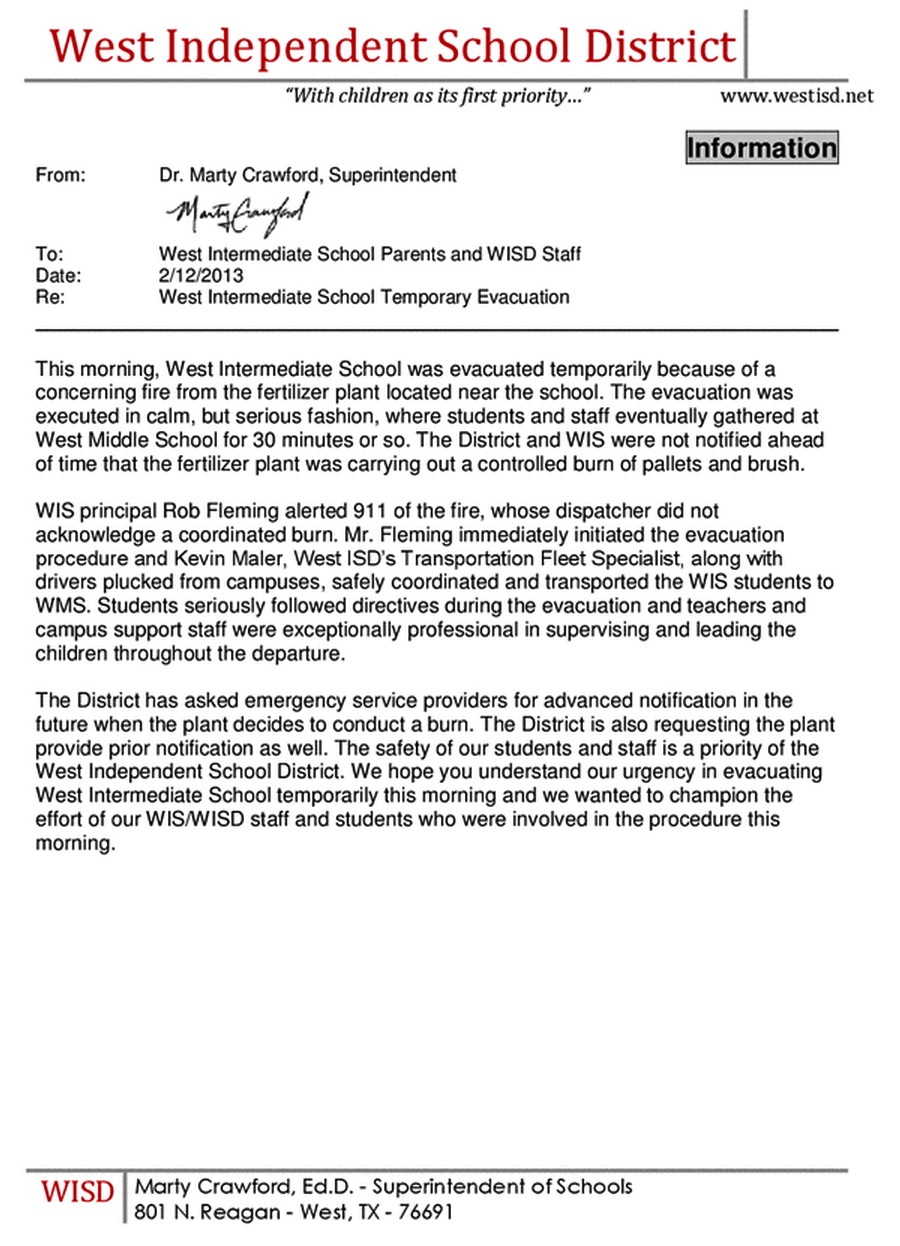
On 2/12/13 the Fertilizer facility conducted a controlled burn of waste pallets and brush. This caused such a scare at the nearby school, that the Intermediate School nearby began to evacuate. The school did not know the facility was conducting a controlled burn and when the school dialed 911, dispatch was not aware of a controlled burn. Here is the letter from the school district explaining their actions; think they were a bit uneasy being that close?
Friday, 4/26/13, UPDATE:
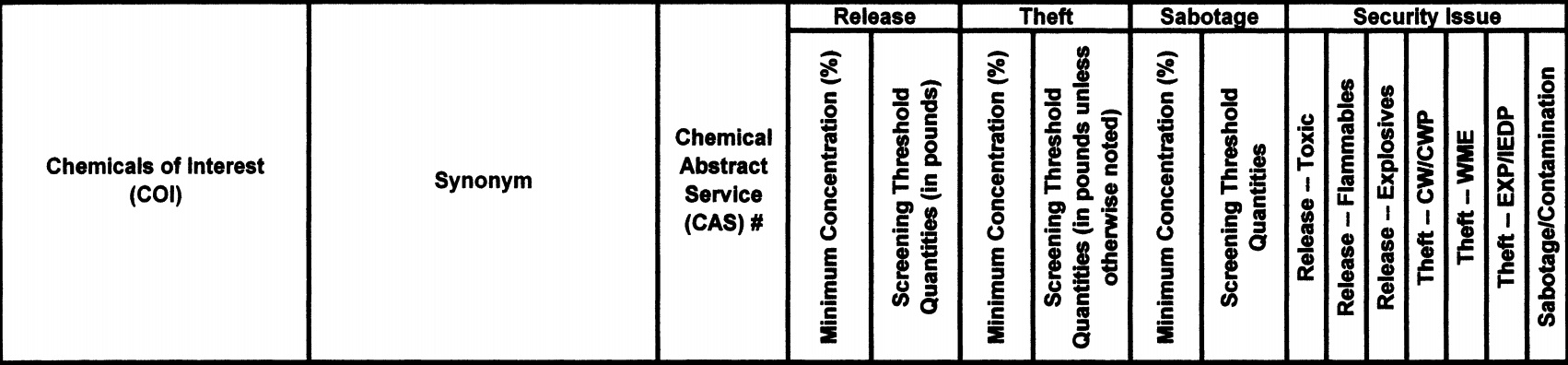
MEDIA CORRECTION: The reporting threshold for AN in the Department of Homeland Security’s Chemical Facility AntiTerrorism Standards (CFATS) is NOT 400 pounds, which seems to be the consensus among the media this week, but rather it is 2,000 pounds. The 400-pound threshold is for AN that has been mixed with a combustible which makes it a low-grade explosive. The fertilizer-grade AN (CAS# 6484-52-2) is what the facility reported having up to 270 tons on site and it’s reporting threshold is 2,000 pounds.
It should also be pointed out that the 54,000 pounds of Anhydrous Ammonia stored on site (reported in their RMP) ALSO tripped the DHS CFATS threshold of 10,000 pounds and they never reported that material either, at least not that I have seen or heard from any news agencies. They claimed the NH3 on site all the way back to 2006, which meant they should have reported the NH3 in 2006 and from what I can find they reported neither chemical.


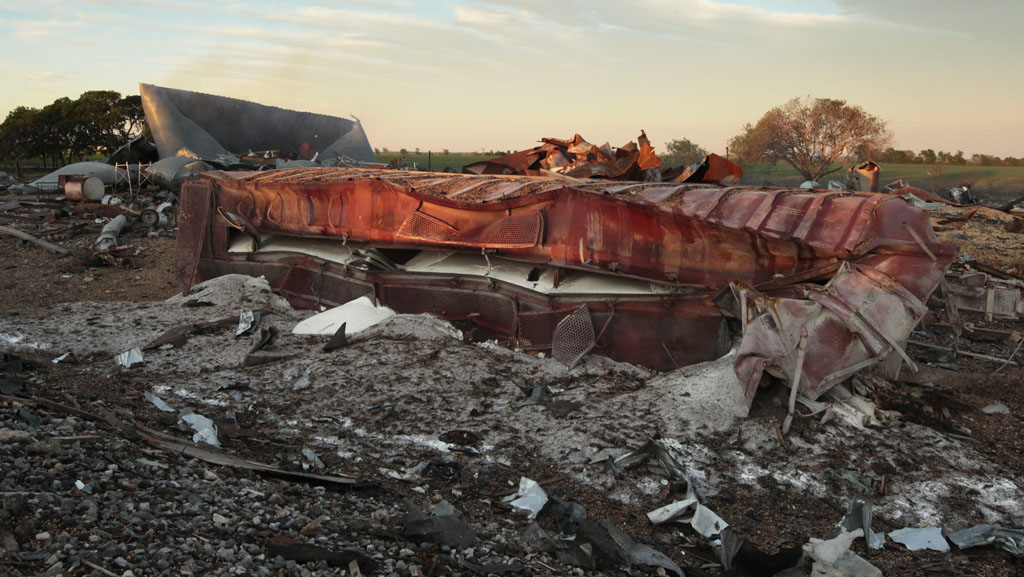
Proof that the Hopper Railcar on the site at the West, TX fertilizer distributor was NOT involved in this tragic accident. Notice the contents of the car and the lack of damage from an internal explosion of the car. It was merely a casualty of the explosion. Notice the end to the right, closest to the warehouse is heavily damaged as compared to the other end (left). More evidence that ground zero of the explosion was the warehouse that stored the AN. In the background, we can see the large grain bin that was blown off its foundation as shown in my other photos below. This grain bin originally was positioned directly behind this railcar (see photos below). The fact this railcar did not detonate shows us that it takes more than a blast wave to detonate AN fertilizer.
A new video from CBS news shows a different perspective of this tragic explosion. In the video below we can CLEARLY see there were TWO (2) explosions that occurred within less than one second, but it is clear there were TWO (2) explosions. We can even see the two separate blast waves originating from the origin. PLEASE KNOW, AN is NOT “Highly Explosive” as stated in the video. At best it is a “Low Grade” explosive once mixed with a fuel oil. It is a very strong OXIDIZER and shipped as a Class 5.1 Oxidizer, but it is NOT “Highly Explosive”. This video angle could be very helpful to investigators as one question on their minds is what caused ALL the AN to be utilized in an explosion if it was stored in multiple bins within the building. When AN is used in mining (see YOUTUBE videos) it is a mixture of AN and Fuel Oil (ANFO) and it is set up using blasting cord to initiate the AN reaction (e.g. explosion). Please keep in there was a Railcar of AN on the spur to the left of the building that was on fire. Officials have said that car was NOT involved in the explosion; however it was knocked over in the blast (as can be seen by the latest aerial photo of the scene shown below).
And by the way, we should ALL take the advice of the county EMA director! 85% of the FF’s in this nation are VOLUNTEERS! When everyone else is running away – they are running to the fire, often times for people they do not even know. ABSOLUTE DEDICATION and PASSION for serving others! Volunteers do it for the love of serving others; God Bless their souls in heaven.
Here is the FULL video that CBS used only used a portion. WARNING! Harsh language.
Thursday, 4/25/13 UPDATE:
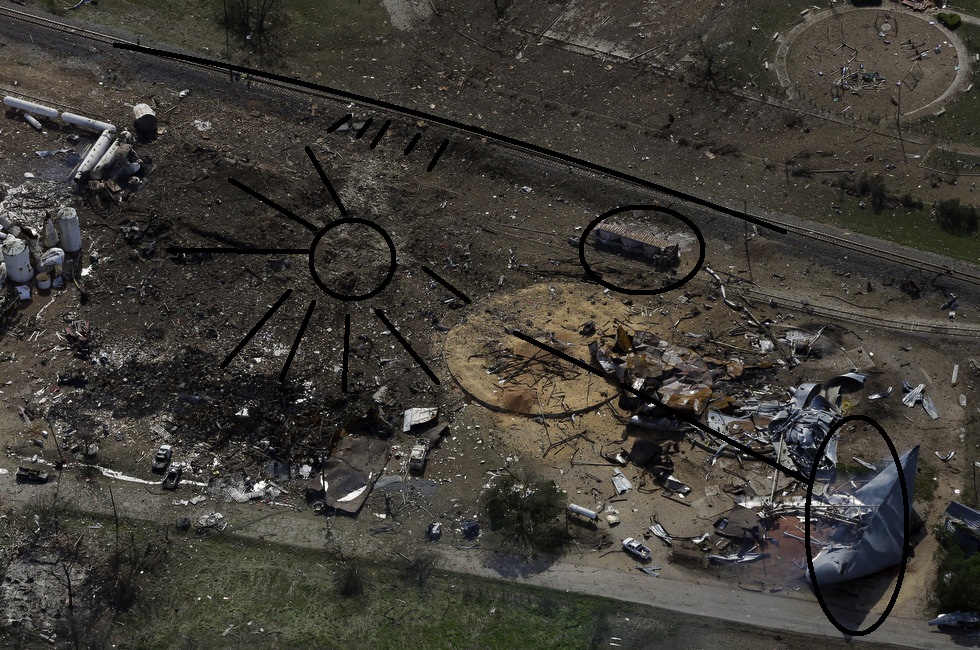
Sorry for the delay in updating this posting, but this week things are becoming much clearer as the investigation proceeds. Investigators this week ruled out a lightning strike as the cause of the fire, leaving the cause to be either accidental or intentional. They also have ruled out the explosion involved a railcar of Ammonium Nitrate (which I have circled in the latest aerial photo below). The fact this railcar did not detonate demonstrates how stable AN actually is and just how much of a “shock/blast” is needed to detonate AN when it is NOT exposed to high temperatures. The railcar was blown over by the blast wave; not sure where it was positioned at the time of the explosion, but it ended up on its side about 100-150′ away from the blast origin. You can actually see some of the AN on the ground next to the car. To also give us some idea of the origin and the blast wave resulting from the explosion I have shown the damage to the railroad tracks running along the side of the plant (not the plant rail spur – but the mainline). A close-up examination of this latest aerial shot shows the two rails becoming one for about 150-200′ (see the bent black line at the top of the photo just above the 10′ deep and 90′ diameter crater (depicted by my circle). Although investigators are being VERY CAUTIOUS with their remarks, they have yet to identify AN as the fuel for the explosion. Yet, unless the facility was storing some other highly energetic material on the site that they failed to report, AN is the only material in TIER II reporting that is capable of this. Add in the fact that when AN is exposed to high temperatures (i.e. fire) it becomes very unstable and rapidly decomposes leading to a detonation. We also now know they stored the AN inside the building within “bins” (e.g. confinement) which aid in the detonation of AN under high temperatures. This time of the year is most likely their busiest season (spring planting) and the chances of them having a large inventory of AN on hand is very good. How much did they have… I am sure the investigators would love to see shipments and sales receipt for the past couple of months or even last year’s spring planting season so that they can get some idea as to their inventory. I am also pretty sure they will be doing some blast modeling using the construction of the building, the size of the crater, and the distance where substantial damage has been found and sort of reverse engineer this explosion; this will get them in the ballpark of what the inventory was – once they rule out the other materials stored on site.
Here is an EXCELLENT video showing how AN (an oxidizer) can burn even in the absence of atmospheric oxygen. It is this principle that causes the AN to become so unstable when it is exposed to fire and confined.
Video of our EOD destroying AN recovered in Afghanistan. This was fertilizer grade detonated with blasting caps. Remember the post-explosion cloud that has become a favorite photo of the media… compare that could to this explosion.
Monday, 4/22/13 UPDATE:
There has been much said in the media about West Fertilizer being fined by PHMSA for $10,000. The fact is, they received TWO (2) citations and NEITHER had anything to do with their Ammonium Nitrate (AN) storage (most likely source of the explosion). The two citations were related to 1) 33 of their anhydrous ammonia nurse tanks not having nameplates, 35 were missing rear placards, 24 were missing their front placards and 2) the facility did not have a DOT security plan. BOTH of these citations were related to the facility’s anhydrous ammonia. CLICK HERE to see the citations, of which BOTH were corrected.
I would also like to point out that the facility’s Risk Management Plan is related solely to Anhydrous Ammonia and had ZERO to do with their 270 tons of AN storage. When the media reports the facility’s “worst case was a 10-minute release of ammonia” they are correct – EPA specifically REQUIRES the WCS for a Toxic liquid stored under pressure be a 10-minute release! This means EPA wants to know how far the facility’s NH3 would travel to its toxic endpoint when the pressure vessel cracks open like an egg and ALL 54,000 pounds goes to a gas in 10 minutes. The WCS for Anhydrous Ammonia stored as a liquid under pressure can be calculated using RMP Comp; which I have done using their RMP ARS data: Estimated distance to the toxic endpoint: 4.0 miles (6.4 kilometers). The media is also misreporting the facility claimed they had “no risk of fire or explosion” and noted they had “no sprinklers, water deluge or other safety mechanisms installed”. Again this is all based on their 54,000 pounds of anhydrous ammonia and NOT their AN storage. NH3 does not meet the RMP measure of a “fire or explosion” hazard. Sprinklers and water deluge are VERY RARELY utilized in NH3 storage and I would be shocked if one of these distributors had such vapor suppression systems (I am not saying they would not be a great asset, just that very few chemical facilities who handle 100X the amount of NH3 have sprinklers/misters/deluge systems over their storage tanks. And the fact the media is reporting they had no “other safety mechanisms installed” is just PLAIN WRONG. As we can see from their RMP, the facility listed Relief Valves and Excess Flow Valves as safety devices used in their NH3 storage. You can see their RMP submittal at the bottom of this posting to come to your own conclusions.
LET’s NOT LOOSE FOCUS ON WHAT HAPPENED IN WEST, TX! This accident did NOT involve NH3 so all of this attention the media is putting on PHMSA citations and EPA’s Risk Management Plan scenarios and their submittal will cause public opinion to be WRONG on what needs to change to help us reduce the risks of another such accident. Keep your eyes and ears on AMMONIUM NITRATE and the fact that OSHA, State Fire Marshal, nor EPA’s RMP rule cover this material!
Sunday, 4/21/13 UPDATE:
So sad the see the loss of such brave men who were simply doing what they loved to do and putting it all on the line! To see the families they leave behind is hard to read. A FACEBOOK community page has been set up in their honor, as well as memorial funds for their families. PLEASE visit their pages and pay our respects to these fallen heroes. https://www.facebook.com/WestFirefighters?fref=ts
Action Fire Pros has created an account for the Morris Bridges Family at Citizens National Bank of Texas, Box 717, Waxahachie, TX, 75168, Account No. 8571515.
Three accounts have been set up for the Perry Calvin family:
Navarro Mills VFD for Perry Calvin Fund, c/o First Bank & Trust of Dawson, 109 N. Main, Dawson, TX 76639.
First Baptist Church for Benefit of Perry Calvin Family, c/o Community National Bank & Trust of Texas, Box 624, Corsicana, TX 75151.
For the Calvin Family, c/o Navarro Mills Baptist Church, 1095 FM 667, Purdon, TX 76679.
As I get more info I will post and if anyone has more info please share with us.
Saturday, 4/20/13 UPDATE:
After spending most of the day Friday on the phone with several news agencies trying to help them understand what MAY have happened and what we know from video and photographic evidence (as I have laid out here) did NOT happen, the media still can not seem to find themselves to reports FACTS, much less spell my name correctly! What I have done since this tragedy occurred is try to DISPEL,based on the video and photographic evidence, much of what is being reported . I have in NO WAY attempted to do a root cause to establish what DID happen; that will be up to the professionals in the State FM office, ATF, and CSB (NOTE: we do know now that at least one employee died to help the FD so this may pull OSHA into the investigation; although it appears at this point the employee was there on his own, after hours, to help save his workplace and not under his official duties as an employee).
The investigators got into the site Friday and they have confirmed: 1) the business was storing AN (Tier II sheets show 270 tons and 2012 was their first year to have AN or at least have more than 10K lbs.), 2) the AN was stored in the building that exploded, and 3) none of the anhydrous ammonia tanks listed in the RMP were involved in the explosion (so QUIT focusing on the big ugly monster RMP chemical and look over there at that LESS regulated material called AN). The process of elimination has begun since unfortunately there is not much to physically analyze. I am sure their focus is on what caused the fire, as this WILL BE THE ROOT CAUSE! They will be wondering and trying to determine through interviews if the business was storing and handling the AN properly; were employees trained in the handling and storage of AN, was the building of proper design, was smoking prohibited, building properly ventilated for fire, etc. We do know the building was of “combustible construction” (i.e. at least the media is reporting customers interviewed by them have stated it was a wood frame building with a metal sheet covering).
I would also like to point out to those who wish to condemn me for posting the materials I have posted… THIS IS NOT THE FIRST TIME WE HAVE LOST FF’s to AN!!! In 1988 we lost SIX (6) FF’s in Kansas City, KS to an eerily similar situation involving AN (CLICK HEREfor the USFA report). I am not out to make AN the “bad guy” here, as I am sure there will be plenty of failures that led to this tragic accident. BUT ALL THE FAILURES LEAD TO ONE POINT… Ammonium Nitrate. To say this “fertilizer” played no role in this tragic accident is just foolish and will GUARANTEE yet another accident. Now I am NOT saying the reciprocal… that tighter regulations will guarantee no more accidents – that would be just as foolish to say. When the State FM, ATF, and CSB complete their investigation we will then have a much better idea of what failed us and I can bet you that CSB will call for better state or federal oversight of AN (for SAFETY – not DHS security!), but I am afraid we will be in the same boat as COMBUSTIBLE DUST!!! Let us hope we respond better to this tragedy!
Things are coming more into focus now… the fighters on the scene that stated “a tank blew up” may have been correct! The tank could have been AN storage bin inside the building???
They were fighting the building fire, not knowing what was in the bin(s)???
Did they not know about the 2012 Tier II report?
Did they get the report and think it was the same since 2006; not realizing that in 2012 they added 270 tons of AN to the report?
Did they think it was “just fertilizer”?
Was the bin(s) or maybe the building labeled as an oxidizer (OX)?
Did the label(s) burn off before the FD arrived on site?
Did the FD not notice the color of the smoke from this fire? The intensity of the flames?
Latest aerial photo of the tragic scene of the West, TX fertilizer plant. I have numbered the four pressure vessels showing they were NOT involved in the explosion, so this was NOT a BLEVE. The center square to the right of the vessels is where the building once stood (notice the crater in the upper right corner of the square), the two rectangles towards the top of the photo is the apartment complex (closest to the plant) and nursing home, and the circle in the bottom right is a vessel that was blown off its foundation (showing the origin of the explosion was the former building).
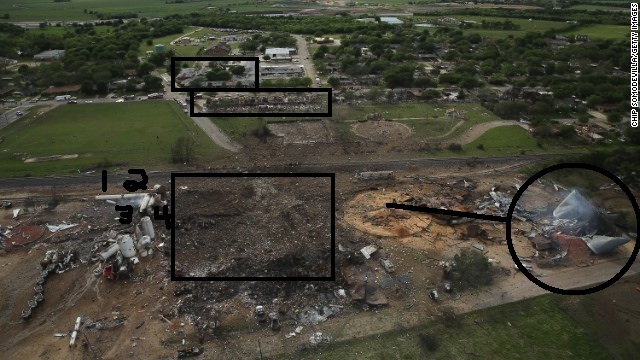
UPDATE 4/18/13 – video update @ 10 pm (EST) – Not sure how the Dallas news determined the building housed Ammonium Nitrate, but that is really the only plausible explanation for this magnitude of the explosion. NH3 just does not “explode” like that! At the very start of this day after video footage, we can still see the NH3 bullets fully intact and exactly where they were before the explosion. See my google map layout and the photos of the fire to see the location of these tanks before the explosion.
Video and breakdown…
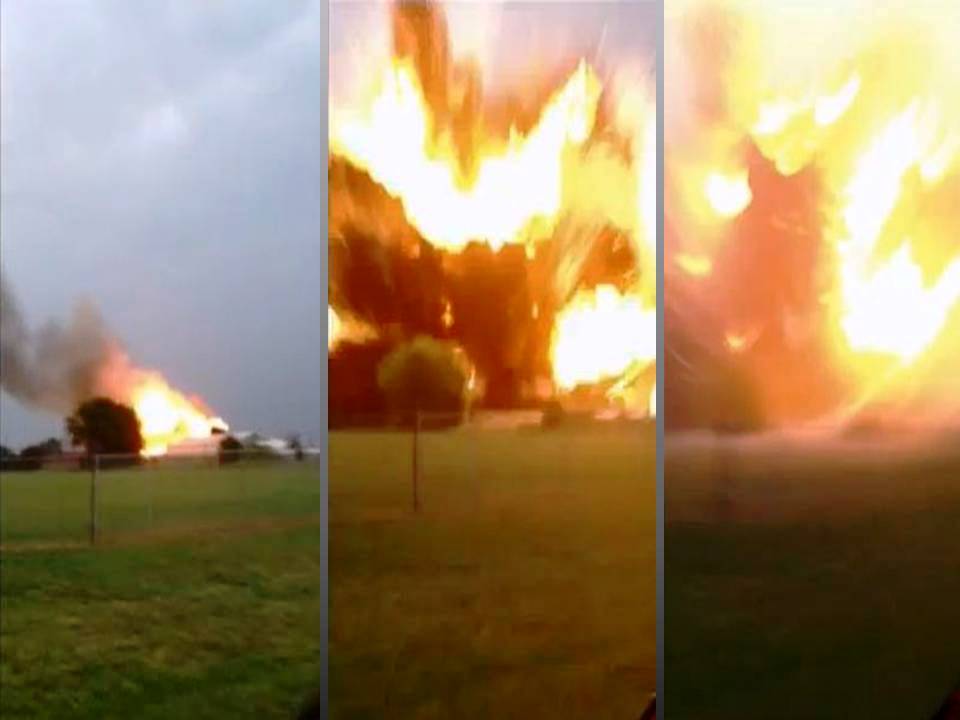
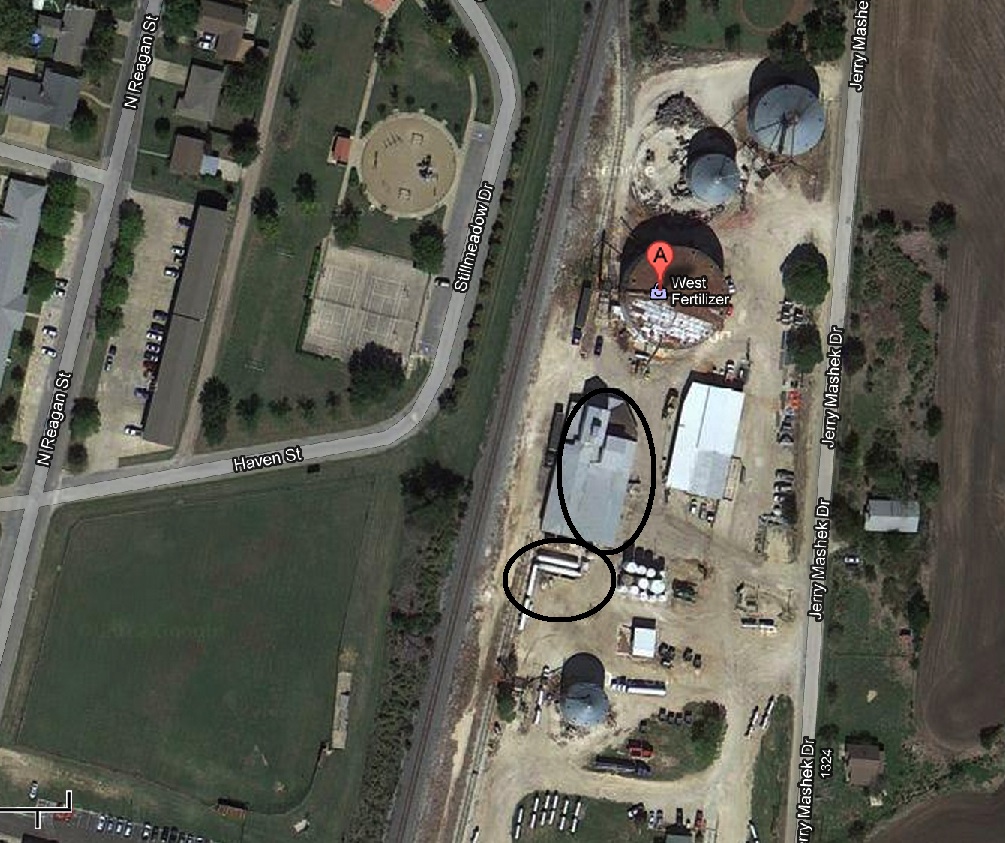
These are photos from my breakdown of the video(s). The first video is the frame just before the explosion and the second photo is the explosion. You can actually use the fence post in the photos to align up the before and after. I have drawn CIRCLE around the around where their fixed pressure vessels are located based on the most recent satellite images from MARPLOT and GOGGLE (last photo).
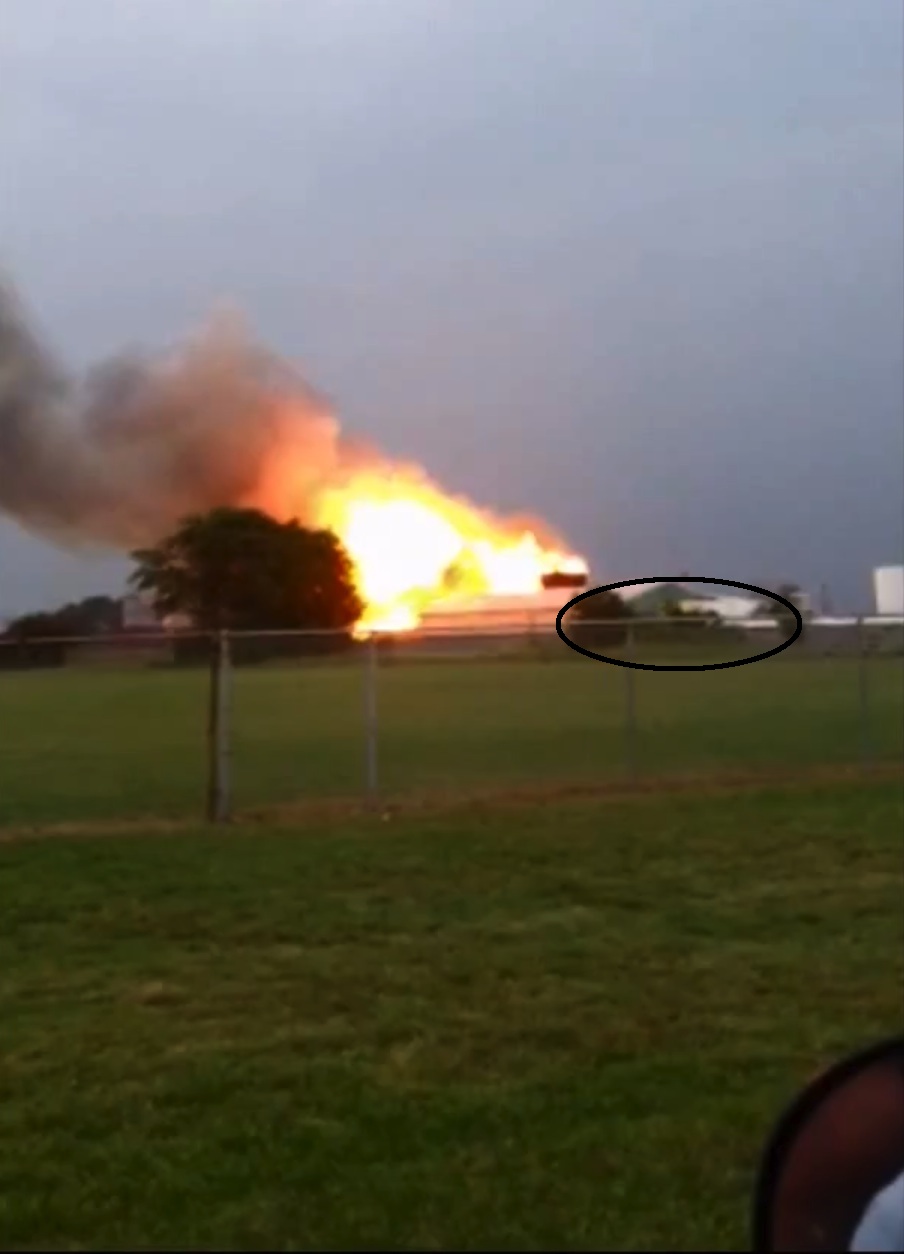
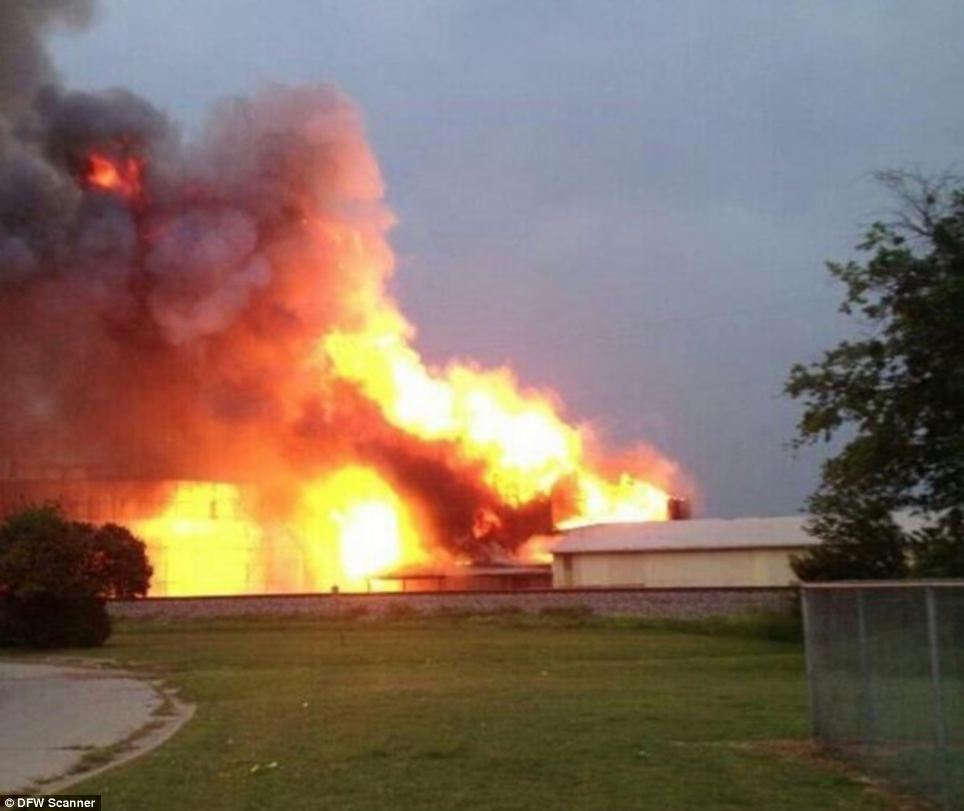
Another closer view and slightly different angle BEFORE the explosion
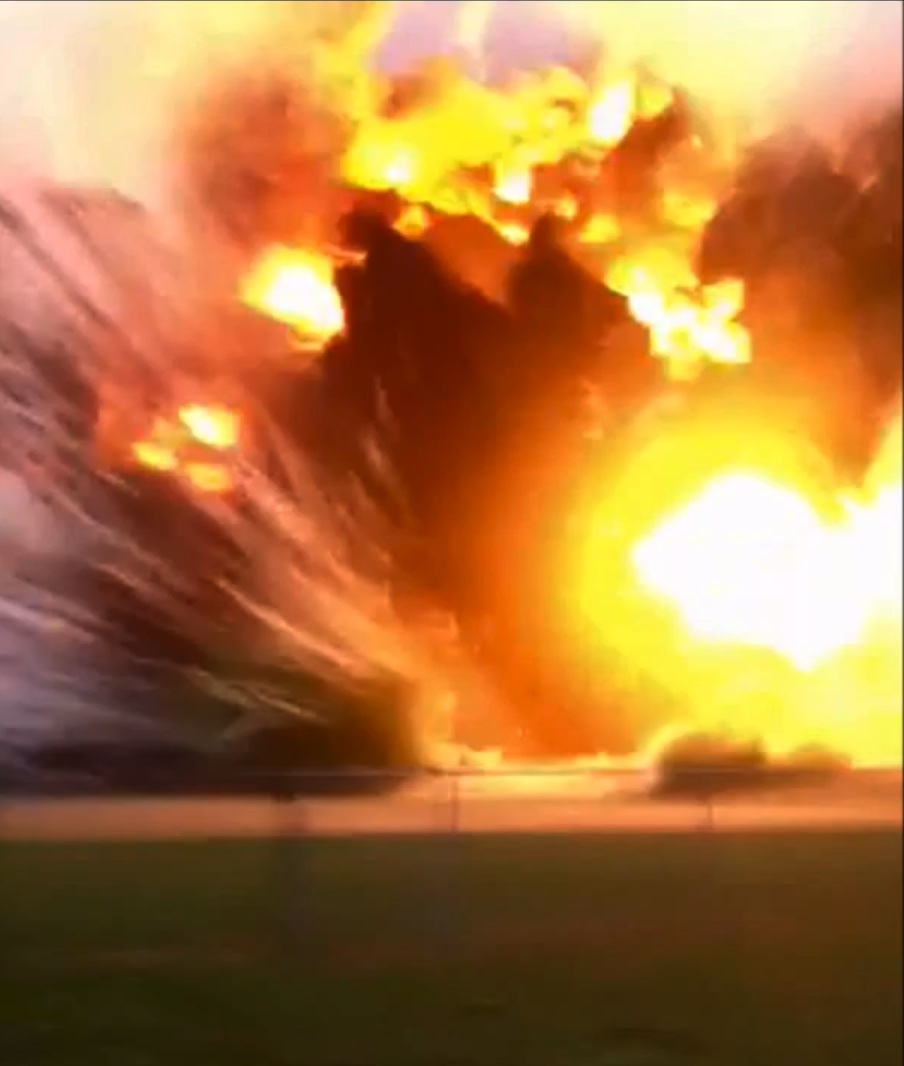
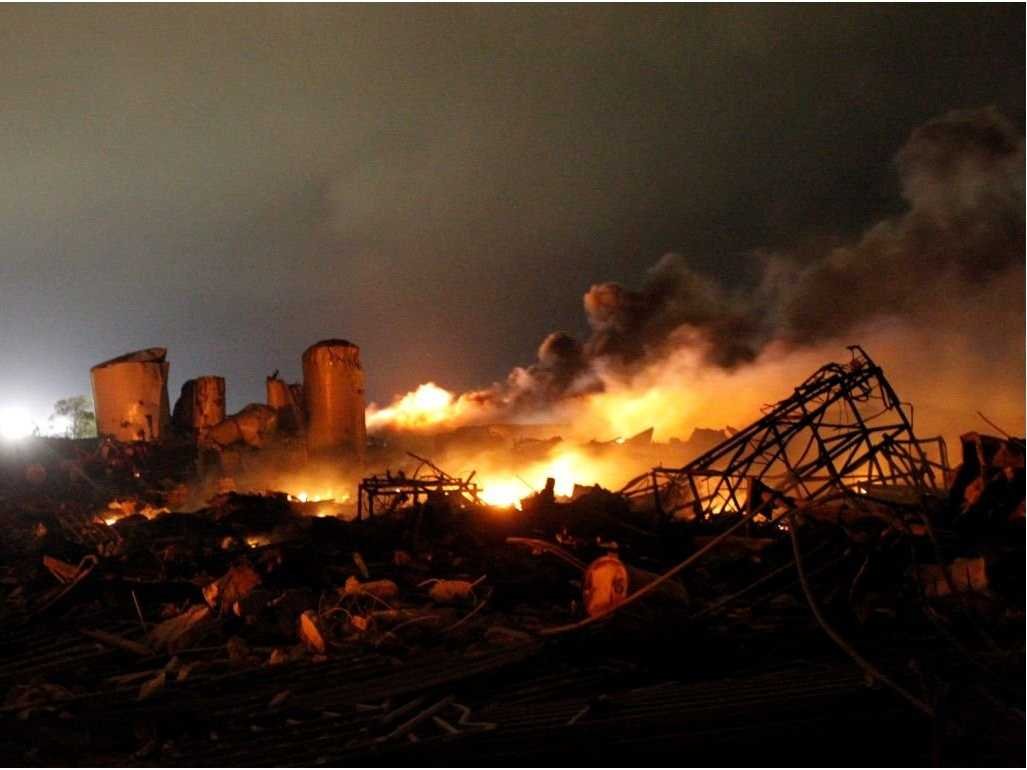
Here is another sample of video frames to show the explosion as it occurred. Notice the tree in relation to the building in the first frame and then again in the second frame. It is clearer that the explosion originated in the building and NOT at the NH3 bullets. As of this posting, I have no idea what they stored in the building. (We now know they stored up to 270 tons of Ammonium Nitrate (AN) in the building – see their 2012 Tier II reporting below). NH3 does NOT ignite and explode like this!!! Ammonium Nitrate DOES!
In the photo below I have circled the building that is seen in the PRE-explosion photo, as well as the pressure vessels.
Photos of the scene AFTER the explosion: Notice the FOUR (4) NH3 bullets in the photo above – then again you can see them still intact in the after explosion below.
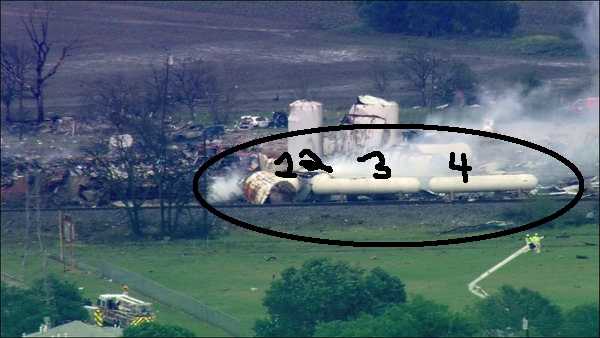
A better photo showing the condition of the 4 bullets POST-EXPLOSION. The building storing the AN just feet to the left of these bullets.
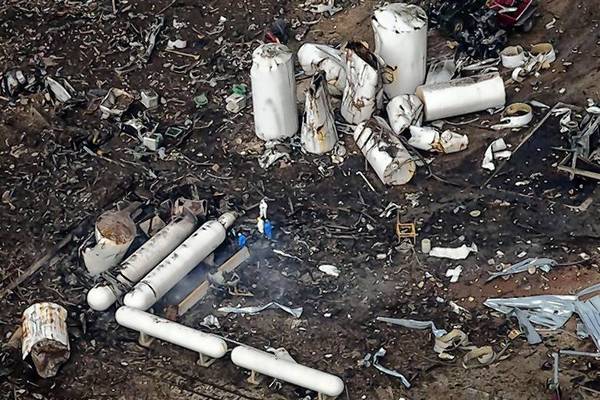
Notice the crater in the ground where the building once stood and all the debris scattered around the crater. This has all the makings of the blast origin but need an aerial photo to be more certain.
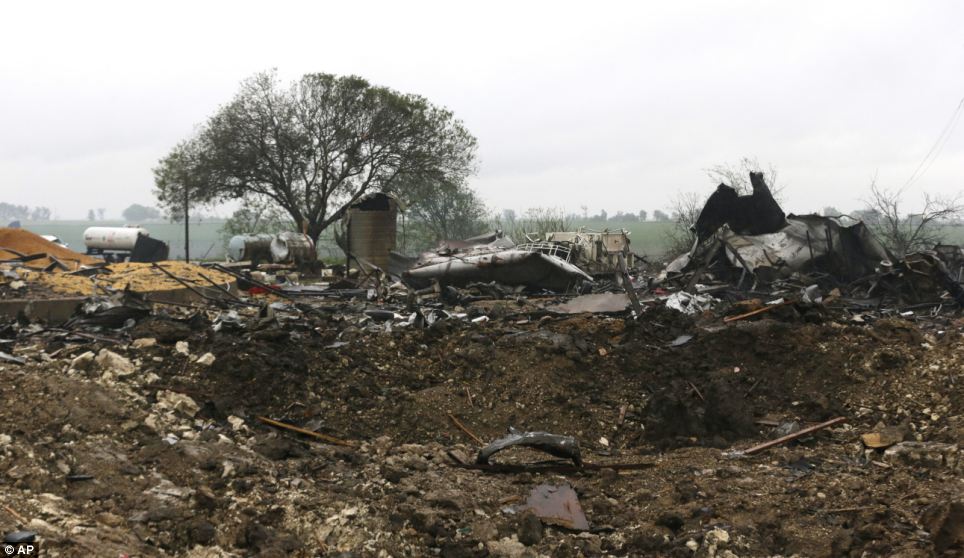
In the photo below you can see the crater from a different angle. Notice the steel structure in the foreground; assuming that is the roof of the building
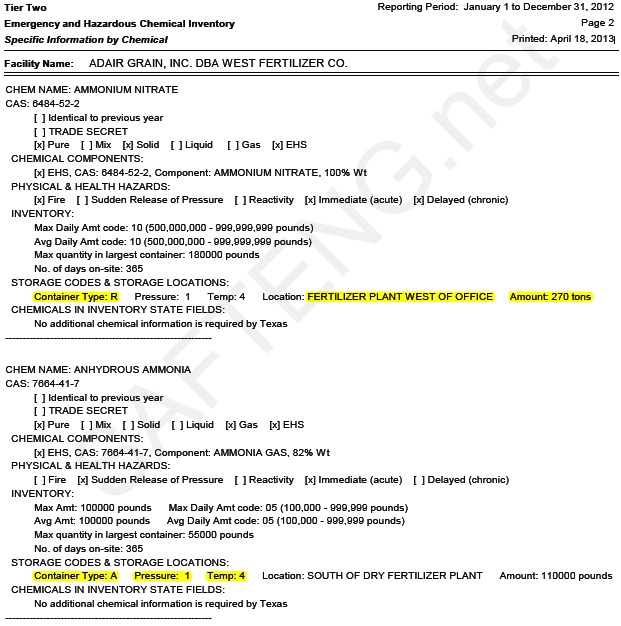
Here is the facility’s 2012 Tier II Sheets for their AN and NH3 (NOTE: I am only posting these two chemicals from their 2012 reporting as it is these two chemicals that are in play here (at least for now). A couple of “red flags” that as a former HAZMAT Coordinator I see right off the bat:
1) FF’s stated a tank exploded and they were worried the “other tank would explode” which led me to believe they were speaking of the NH3 bullets; when in fact they MAY have been talking about a AN storage bin inside the building. But their Tier II stated the storage of the 270 tons of the AN was in “other” storage (e.g. container type = R). They did state the building that exploded was the storage of AN.
2) although it appears that NH3 bullets had nothing to do with this tragic accident, there is still some errors in their reporting. It states that the NH3 is stored at Atmospheric Pressure (Pressure: 1) and Atmospheric Temperature (Temp: 4) which is physically IMPOSSIBLE.
If the system was working properly, the LEPC and/or FD should have flagged these changes/discrepancies and inquired to the facility for clarification. It is too early to know just what happened.
It is my belief in this day of electronic filing that the agencies requiring these filings could EASILY INCORPORATE an “instant check” of the data being submitted. For example, when the facility uploads their report, the system would have flagged the error with their NH3 reporting as it is impossible to have ammonia stored at std pressure and temp at the same time! We have seen RMP’s submitted where the facility claimed URBAN on one scenario and RURAL on their other scenario.
The facility’s Risk Management Plan data:
Facility #1 : WEST FERTILIZER CO.
| Basic Facility Info |
| Facility ID | 100000135597 |
| Facility Name | WEST FERTILIZER CO. |
| Street Address Line 1 | 1471 JERRY MASHEK DRIVE |
| City | WEST |
| State | TX |
| Congressional District | TX17 |
| Zip Code | 76691 |
| County FIPS Code | 48309 |
| County | McLennan County |
| Owner or Operator Name | GENERAL MANAGER |
| Latitude | 31.817778 |
| Longitude | -097.088611 |
| Number of RMP Submissions | 3 |
| Most Recent Submission Info |
| RMP ID | 1000022888 |
| Submission Type | revised submission for facility |
| Submission Date | 06/30/2011 |
| Reason For Submission | 5-year update (40 CFR 68.190(b)(1)) |
| Process Toxic Amount Total (lbs) | 54,000 |
| Process Flammable Amount Total (lbs) | 0 |
| Process Amount Total (lbs) | 54,000 |
| Number of Potential Offsite Consequence Processes | 1 |
| Potential Offsite Consequence Toxic Amount Total (lbs) | 54,000 |
| Potential Offsite Consequence Flammable Amount Total (lbs) | 0 |
| Potential Offsite Consequence Amount Total (lbs) | 54,000 |
| All Process NAICS | 42451 |
| Exec Summary Submission Date | 06/30/2011 |
| Submission Info | (Facility #1 : WEST FERTILIZER CO., RMP submission #1 : 2011-06-30) |
| RMP ID | 1000022888 |
| Submission Type | revised submission for facility |
| Receipt Date | 06/30/2011 |
| Reason For Submission | 5-year update (40 CFR 68.190(b)(1)) |
| Process Toxic Amount Total (lbs) | 54,000 |
| Process Flammable Amount Total (lbs) | 0 |
| Process Amount Total (lbs) | 54,000 |
| Number of Potential Offsite Consequence Processes | 1 |
| Potential Offsite Consequence Toxic Amount Total (lbs) | 54,000 |
| Potential Offsite Consequence Flammable Amount Total (lbs) | 0 |
| Potential Offsite Consequence Amount Total (lbs) | 54,000 |
| Submission – Basic Facility Info |
| Facility Name | WEST FERTILIZER CO. |
| Street Address Line 1 | 1471 JERRY MASHEK DRIVE |
| City | WEST |
| State | TX |
| Zip Code | 76691 |
| County FIPS Code | 48309 |
| County | McLennan County |
| Executive Summary | (Facility #1 : WEST FERTILIZER CO., executive summary: all) |
| Executive Summary |
| EXECUTIVE SUMMARY
WEST FERTILIZER CO. For further information contact General Manager Risk Management Plan – EXECUTIVE SUMMARY 1. The Facility Policy The owners, management, and employees of the WEST FERTILIZER CO. are committed to the prevention of any accidental releases of anhydrous ammonia. If an accidental release should occur, the facility is prepared to work with the local fire company, or other authorities, to mitigate any release and minimize the impact of the release to people and the environment. 2. Facility Information A The primary activity at the facility is the storage of fertilizers for sale to farmers. 3. The worst-case release scenario and the alternative release scenario. a. The worst-case release scenario would be the release of the total contents of a storage tank released as a gas over 10 minutes. 4. The accidental release prevention program The facility has implemented the provisions of “Safety Requirements for the Storage and Handling of Anhydrous Ammonia, Kk-611.1”, published by The American National Standards Institute, Inc., and the standards of the U.S. Occupational Safety and Health Administration (OSHA), 29 CFR 1910.111, “Storage and handling of Anhydrous Ammonia”. 5. The Five-year Accident History a. There have been no accidental releases of anhydrous ammonia in the past five years that: A Have caused any deaths, injuries, or significant property damage at the facility; nor 6. The Emergency Response Program The facility has: a. A written Emergency Action Plan, in accordance with OSHA standard, 29 CFR 1910.38; b. Provided state and local authorities the emergency c. A written emergency response program, in accordance with OSHA standard 29 CFR 1910.120, including pre-emergency planning and employee training. 7. Planned Changed to Improve Safety Safety improvement is an on-going process at the facility. Periodic evaluations are performed to assess the maintenance of safe conditions. There are no additional specific anhydrous ammonia safety recommendations for implementation at this time. |
| Submission – Other Facility Info |
| Owner or Operator Name | GENERAL MANAGER |
| Owner or Operator Address Line 1 | P.O. BOX 399 |
| Owner or Operator City | WEST |
| Owner or Operator State | TX |
| Owner or Operator Zip | 76691 |
| Parent Dun and Bradstreet Number | 0 |
| Second Parent Dun and Bradstreet Number | 0 |
| Number of Full-Time Employees | 7 |
| Number of FTE CBI Flag | No |
| Covered by OSHA PSM Standard | No |
| Covered by EPCRA Section 302 | Yes |
| Covered by CAA Title V | No |
| Last Safety Inspection Date | 06/22/2011 |
| Last Safety Inspection By | Craig Rogers, Security Truck Services,LLC |
| OSHA Star or Merit Ranking | No |
| LEPC Name | Mclennan County LEPC |
| Submission – Contact Info | (Facility #1 : WEST FERTILIZER CO., RMP submission #1 : 2011-06-30) |
| Owner or Operator Phone | 2548265309 |
| Facility Dun and Bradstreet Number | 0 |
| RMP Contact | GENERAL MANAGER |
| RMP Contact Title | GENERAL MANAGER |
| Submission – Additional Info |
| RMP Complete Flag | Yes |
| Predictive Filing | No |
| No RMP Accidents Last 5 Years | No |
| Complete Check Date | 06/30/2011 |
| Graphics Indicator | No |
| Attachment Indicator | No |
| Certification Received Flag | Yes |
| Submission Method | RMP*eSubmit |
| CBI Substantiation Flag | No |
| Electronic Waiver Flag | No |
| Postmark Date | 06/30/2011 |
| Anniversary Date | 06/30/2016 |
| Confidential Business Information | No |
| Unsanitized Version Provided | No |
| Software Version Number | 1.0 |
| Submission – Lat/Long Info | (Facility #1 : WEST FERTILIZER CO., RMP submission #1 : 2011-06-30) |
| Latitude | 31.817778 |
| Longitude | -097.088611 |
| Valid Lat/Long | Yes |
| Lat/Long Method | GPS – Unspecified |
| Lat/Long Location Type | Intake Pipe |
| Lat/Long Horizontal Accuracy | 15 |
| Lat/Long Horizontal Reference | 003 |
| FRS Latitude | 31.82 |
| FRS Longitude | -97.08 |
| FRS Lat/Long Description | PLANT ENTRANCE (GENERAL) |
| FRS Lat/Long Method | ADDRESS MATCHING-HOUSE NUMBER |
| Submission – Counts and Totals |
| Number of RMP Accidents | 0 |
| Number of Processes | 1 |
| Number of Process Chemicals | 0 |
| Number of Toxic Worst-case Scenarios | 1 |
| Number of Toxic Alternate Case Scenarios | 1 |
| Number of Flammable Worst-case Scenarios | 0 |
| Number of Flammable Alternate Case Scenarios | 0 |
| RMP Accident Flammable Total (lbs) | 0 |
| RMP Accident Toxic Total (lbs) | 0 |
| RMP Accident Amount Total (lbs) | 0 |
| Total RMP Accident Deaths | 0 |
| Total RMP Accident Injuries | 0 |
| Total RMP Accident Evacuated/Sheltering In Place | 0 |
| Total RMP Accident Property Damage | $0 |
| Processes | (Facility #1 : WEST FERTILIZER CO., RMP submission #1 : 2011-06-30, process #1 : ) |
| Process ID | 1000027947 |
| Program Level | 2 |
| Confidential Business Information | No |
| Toxic Amount Total (lbs) | 54,000 |
| Flammable Amount Total (lbs) | 0 |
| Process Amount Total (lbs) | 54,000 |
| Number of Process Chemicals | 0 |
| Number of Toxic Worst-Case Scenarios | 1 |
| Number of Toxic Alternate Scenarios | 1 |
| Number of Flammable Worst-Case Scenarios | 0 |
| Number of Flammable Alternate Scenarios | 0 |
| Process Chemicals |
| Process Chemical Record ID | 1000033407 |
| Process Chemical ID | Ammonia (anhydrous) |
| CAS number | 007664417 |
| Chemical Type | Toxic |
| Process Chemical Amount (lbs) | 54,000 |
| Confidential Business Information | No |
| Process Chemicals | (Facility #1 : WEST FERTILIZER CO., RMP submission #1 : 2011-06-30, process #1 : , process chemical #2) |
| Process Chemical Record ID | 1000533407 |
| Process Chemical ID | Public OCA Chemical |
| CAS number | 000000000 |
| Process Chemical Amount (lbs) | 0 |
| Confidential Business Information | No |
| Worst-Case Toxic Scenarios |
| Toxic Scenario ID | 1000023146 |
| Physical State | Gas liquified by pressure |
| Model Used | DEGADIS |
| Release Duration (minutes) | 10 |
| Wind Speed (meters/sec) | 1.5 |
| Atmospheric Stability Class | F |
| Topography | Rural |
| Passive Mitigation – Dikes | No |
| Passive Mitigation – Enclosures | No |
| Passive Mitigation – Berms | No |
| Passive Mitigation – Drains | No |
| Passive Mitigation – Sumps | No |
| Confidential Business Information | No |
| Alternate Case Toxic Scenarios | (Facility #1 : WEST FERTILIZER CO., RMP submission #1 : 2011-06-30, process #1 : , process chemical #2, alternate toxic scenario #1) |
| Toxic Scenario ID | 1000024891 |
| Physical State | Gas liquified by pressure |
| Model Used | DEGADIS |
| Wind Speed | 3 |
| Atmospheric Stability Class | D |
| Topography | Rural |
| Passive Mitigation – Dikes | No |
| Passive Mitigation – Enclosures | No |
| Passive Mitigation – Berms | No |
| Passive Mitigation – Drains | No |
| Passive Mitigation – Sumps | No |
| Active Mitigation – Sprinklers | No |
| Active Mitigation – Deluge Systems | No |
| Active Mitigation – Water Curtain | No |
| Active Mitigation – Neutralization | No |
| Active Mitigation – Excess Flow Valves | Yes |
| Active Mitigation – Flares | No |
| Active Mitigation – Scrubbers | No |
| Active Mitigation – Emergency Shutdown | No |
| Active Mitigation – Other | PRESSURE RELIEF VALVE, EXCESS FLOW VAVLES |
| Confidential Business Information | No |
| Process NAICS | (Facility #1 : WEST FERTILIZER CO., RMP submission #1 : 2011-06-30, process #1 : , process NAICS code #1 : 42451) |
| Process NAICS ID | 1000028248 |
| NAICS Code | 42451: Grain and Field Bean Merchant Wholesalers |
| Number of Prevention Program 2 Records | 1 |
| Number of Prevention Program 3 Records | 0 |
| Prevention Program 2 |
| Prevention Program ID | 1000019212 |
| Safety Regs – NFPA 58 | No |
| Safety Regs – OSHA (Ammonia) | Yes |
| Safety Regs – ASTM Standards | No |
| Safety Regs – ANSI Standards | Yes |
| Safety Regs – ASME Standards | No |
| Safety Regs – None | No |
| Hazard Identified – Toxic Release | Yes |
| Hazard Identified – Fire | No |
| Hazard Identified – Explosion | No |
| Hazard Identified – Runaway Reaction | No |
| Hazard Identified – Polymerization | No |
| Hazard Identified – Overpressure | Yes |
| Hazard Identified – Corrosion | Yes |
| Hazard Identified – Overfilling | Yes |
| Hazard Identified – Contamination | No |
| Hazard Identified – Equipment Failure | Yes |
| Hazard Identified – Cooling Loss | No |
| Hazard Identified – Earthquake | Yes |
| Hazard Identified – Flood | No |
| Hazard Identified – Tornado | Yes |
| Hazard Identified – Hurricane | No |
| Process Controls – Vents | No |
| Process Controls – Relief Valves | No |
| Process Controls – Check Valves | Yes |
| Process Controls – Scrubbers | No |
| Process Controls – Flares | No |
| Process Controls – Manual Shutoffs | Yes |
| Process Controls – Auto Shutoffs | No |
| Process Controls – Interlocks | No |
| Process Controls – Alarms | No |
| Process Controls – Keyed Bypass | No |
| Process Controls – Emergency Air | No |
| Process Controls – Emergency Power | No |
| Process Controls – Backup Pump | No |
| Process Controls – Grounding | No |
| Process Controls – Inhibitor Addition | No |
| Process Controls – Rupture Disks | No |
| Process Controls – Excess Flow Devices | Yes |
| Process Controls – Quench System | No |
| Process Controls – Purge System | No |
| Process Controls – None | No |
| Mitigation Systems – Sprinklers | No |
| Mitigation Systems – Dikes | No |
| Mitigation Systems – Fire Walls | No |
| Mitigation Systems – Blast Walls | No |
| Mitigation Systems – Deluge Systems | No |
| Mitigation Systems – Water Curtains | No |
| Mitigation Systems – Enclosure | No |
| Mitigation Systems – Neutralization | No |
| Mitigation Systems – None | Yes |
| Monitoring Systems – Process Area | No |
| Monitoring Systems – Perimeter | No |
| Monitoring Systems – None | Yes |
| Changes Since PHA – Reduced Inventory | No |
| Changes Since PHA – Increased Inventory | No |
| Changes Since PHA – Process Parameters | No |
| Changes Since PHA – Process Controls | No |
| Changes Since PHA – Process Detection | No |
| Changes Since PHA – Perimeter Monitoring | No |
| Changes Since PHA – Mitigation Systems | No |
| Changes Since PHA – None Recommended | No |
| Changes Since PHA – None | Yes |
| Type of Training – Classroom | No |
| Type of Training – On the Job | Yes |
| Competency Testing – Written Tests | No |
| Competency Testing – Oral Tests | No |
| Competency Testing – Demonstration | Yes |
| Competency Testing – Observation | Yes |
| Equipment Tested | ALL |
| Confidential Business Information | No |
| Prevention Program 2 Chemicals | (Facility #1 : WEST FERTILIZER CO., RMP submission #1 : 2011-06-30, process #1 : , process NAICS code #1 : 42451, prev. program 2 #1, prev. program 2 chemical: all) |
| Process Chemical Record ID |
| 1000033407 |
| Prevention Program 2 Text |
| Prevention Program Description |
| The company has implemented a prevention program that includes Safety Information, Hazard Review, Operating Procedures, Training, Compliance Audits and Incident Investigation. |
| Emergency Response Plan Info |
| Facility In Community Plan | Yes |
| Facility Own Response Plan | Yes |
| Specific Facility Response Plan | Yes |
| Inform. Procedures in Response Plan | Yes |
| Emergency Care in Response Plan | Yes |
| Plan Review Date | 06/07/2011 |
| Response Training Date | 06/07/2011 |
| Local Response Agency | FIRE DEPT |
| Local Response Agency Phone | 0000000911 |
| Subject To – OSHA EAP | Yes |
| Subject To – OSHA HAZWOPER | No |
| Subject To – CWA | No |
| Subject To – RCRA | No |
| Subject To – OPA | No |
| Subject To – State EPCRA | Yes |
| Submission Info | (Facility #1 : WEST FERTILIZER CO., RMP submission #2 : 2006-07-11) |
| RMP ID | 46073 |
| Submission Type | revised submission for facility |
| Receipt Date | 07/11/2006 |
| Reason For Submission | 5-year update (40 CFR 68.190(b)(1)) |
| Process Toxic Amount Total (lbs) | 54,000 |
| Process Flammable Amount Total (lbs) | 0 |
| Process Amount Total (lbs) | 54,000 |
| Number of Potential Offsite Consequence Processes | 1 |
| Potential Offsite Consequence Toxic Amount Total (lbs) | 54,000 |
| Potential Offsite Consequence Flammable Amount Total (lbs) | 0 |
| Potential Offsite Consequence Amount Total (lbs) | 54,000 |
| Submission – Basic Facility Info |
| Facility Name | WEST FERTILIZER CO. |
| Street Address Line 1 | 1471 JERRY MASHEK DRIVE |
| City | WEST |
| State | TX |
| Zip Code | 76691 |
| County FIPS Code | 48309 |
| County | McLennan County |
| Executive Summary | (Facility #1 : WEST FERTILIZER CO., executive summary: all) |
Executive SummaryEXECUTIVE SUMMARY
WEST CHEMICAL & FERTILIZER CO.
WEST, TX.
For further information contact General Manager
Risk Management Plan – EXECUTIVE SUMMARY
1. The Facility Policy
The owners, management, and employees of the WEST CHEMICAL & FERTILIZER CO. are committed to the prevention of any accidental releases of anhydrous ammonia. If an accidental release should occur, the facility is prepared to work with the local fire company, or other authorities, to mitigate any release and minimize the impact of the release to people and the environment.
2. Facility Information
The primary activity at the facility is the storage of fertilizers for sale to farmers.
Anhydrous ammonia is received, stored, and distributed for both direct
3. The worst-case release scenario and the alternative release scenario.
a. The worst-case release scenario would be the release of the total contents of a storage tank released as a gas over 10 minutes.
b. The alternative release scenario based on the most likely potential incident is a release from a break in a transfer hose.
4. The accidental release prevention program
The facility has implemented the provisions of “Safety Requirements for the Storage and Handling of Anhydrous Ammonia, Kk-611.1”, published by The American National Standards Institute, Inc., and the standards of the U.S. Occupational Safety and Health Administration (OSHA), 29 CFR 1910.111, “Storage and handling of Anhydrous Ammonia”.
5. The Five-year Accident History
a. There have been no accidental releases of anhydrous ammonia in the past five years that:
Have caused any deaths, injuries, or significant property damage at the facility; nor
To our knowledge, have resulted in offsite deaths, injuries, evacuations, sheltering in place, property damage, or environmental damage.
6. The Emergency Response Program
The facility has:
a. A written Emergency Action Plan, in accordance with OSHA standard, 29 CFR 1910.38;
b. Provided state and local authorities
Full-Time emergency planning and community right-to-know information as required under SARA Title III (EPCRA).
c. A written emergency response program, in accordance with OSHA standard 29 CFR 1910.120, including pre-emergency planning and employee training.
7. Planned Changed to Improve Safety
Safety improvement is an on-going process at the facility. Periodic evaluations are performed to assess the maintenance of safe conditions. There are no additional specific anhydrous ammonia safety recommendations for implementation at this time.
| Submission – Other Facility Info |
| Owner or Operator Name | GENERAL MANAGER |
| Owner or Operator Address Line 1 | P.O. BOX 8 |
| Owner or Operator City | WEST |
| Owner or Operator State | TX |
| Owner or Operator Zip | 76691 |
| Parent Dun and Bradstreet Number | 0 |
| Second Parent Dun and Bradstreet Number | 0 |
| NFull-TimeEmployees | 7 |
| Number of FTE CBI Flag | No |
| Covered by OSHA PSM Standard | No |
| Covered by EPCRA Section 302 | Yes |
| Covered by CAA Title V | No |
| Last Safety Inspection Date | 03/16/2006 |
| Last Safety Inspection By | EPA |
| OSHA Star or Merit Ranking | No |
| LEPC Name | Mclennan County LEPC |
| Submission – Contact Info | (Facility #1 : WEST FERTILIZER CO., RMP submission #2 : 2006-07-11) |
| Owner or Operator Phone | 2548265309 |
| Facility Dun and Bradstreet Number | 0 |
| RMP Contact | GENERAL MANAGER |
| RMP Contact Title | GENERAL MANAGER |
| RMP Preparer Name | THE TRIANGLE COMPANIES |
| RMP Preparer Address Line 1 | PO BOX 1189 |
| RMP Preparer Address Line 2 | 2821 N VAN BUREN |
| RMP Preparer City | ENID |
| RMP Preparer State | OK |
| RMP Preparer Zip | 73703 |
| RMP Preparer Phone | 5802374276 |
| Submission – Additional Info |
| RMP Description | West, TX |
| RMP Complete Flag | Yes |
| Predictive Filing | No |
| No RMP Accidents Last 5 Years | Yes |
| Complete Check Date | 07/12/2006 |
| Graphics Indicator | No |
| Attachment Indicator | No |
| Certification Received Flag | Yes |
| Submission Method | RMP*Submit |
| CBI Substantiation Flag | No |
| Electronic Waiver Flag | No |
| Postmark Date | 07/07/2006 |
| Anniversary Date | 07/07/2011 |
| Confidential Business Information | No |
| Unsanitized Version Provided | No |
| Software Version Number | 3.6 |
| Submission – Lat/Long Info | (Facility #1 : WEST FERTILIZER CO., RMP submission #2 : 2006-07-11) |
| Latitude | 31.817778 |
| Longitude | -097.088611 |
| Valid Lat/Long | Yes |
| Lat/Long Method | GPS – Unspecified |
| Lat/Long Location Type | Intake Pipe |
| Lat/Long Horizontal Accuracy | 15 |
| Lat/Long Horizontal Reference | 003 |
| FRS Latitude | 31.82 |
| FRS Longitude | -97.08 |
| FRS Lat/Long Description | PLANT ENTRANCE (GENERAL) |
| FRS Lat/Long Method | ADDRESS MATCHING-HOUSE NUMBER |
| Submission – Counts and Totals |
| Number of RMP Accidents | 0 |
| Number of Processes | 1 |
| Number of Process Chemicals | 1 |
| Number of Toxic Worst-case Scenarios | 1 |
| Number of Toxic Alternate Case Scenarios | 1 |
| Number of Flammable Worst-case Scenarios | 0 |
| Number of Flammable Alternate Case Scenarios | 0 |
| RMP Accident Flammable Total (lbs) | 0 |
| RMP Accident Toxic Total (lbs) | 0 |
| RMP Accident Amount Total (lbs) | 0 |
| Total RMP Accident Deaths | 0 |
| Total RMP Accident Injuries | 0 |
| Total RMP Accident Evacuated/Sheltering In Place | 0 |
| Total RMP Accident Property Damage | $0 |
| Processes | (Facility #1 : WEST FERTILIZER CO., RMP submission #2 : 2006-07-11, process #1 : ) |
| Process ID | 66659 |
| Program Level | 2 |
| Confidential Business Information | No |
| Toxic Amount Total (lbs) | 54,000 |
| Flammable Amount Total (lbs) | 0 |
| Process Amount Total (lbs) | 54,000 |
| Number of Process Chemicals | 1 |
| Number of Toxic Worst-Case Scenarios | 1 |
| Number of Toxic Alternate Scenarios | 1 |
| Number of Flammable Worst-Case Scenarios | 0 |
| Number of Flammable Alternate Scenarios | 0 |
| Process Chemicals |
| Process Chemical Record ID | 88325 |
| Process Chemical ID | Ammonia (anhydrous) |
| CAS number | 007664417 |
| Chemical Type | Toxic |
| Process Chemical Amount (lbs) | 54,000 |
| Confidential Business Information | No |
| Process Chemicals | (Facility #1 : WEST FERTILIZER CO., RMP submission #2 : 2006-07-11, process #1 : , process chemical #2) |
| Process Chemical Record ID | 588325 |
| Process Chemical ID | Public OCA Chemical |
| CAS number | 000000000 |
| Process Chemical Amount (lbs) | 0 |
| Confidential Business Information | No |
| Worst-Case Toxic Scenarios |
| Toxic Scenario ID | 43808 |
| Physical State | Gas liquified by pressure |
| Model Used | DEGADIS |
| Release Duration (minutes) | 10 |
| Wind Speed (meters/sec) | 1.5 |
| Atmospheric Stability Class | F |
| Topography | Rural |
| Passive Mitigation – Dikes | No |
| Passive Mitigation – Enclosures | No |
| Passive Mitigation – Berms | No |
| Passive Mitigation – Drains | No |
| Passive Mitigation – Sumps | No |
| Confidential Business Information | No |
| Alternate Case Toxic Scenarios | (Facility #1 : WEST FERTILIZER CO., RMP submission #2 : 2006-07-11, process #1 : , process chemical #2, alternate toxic scenario #1) |
| Toxic Scenario ID | 51655 |
| Physical State | Gas liquified by pressure |
| Model Used | DEGADIS |
| Wind Speed | 3 |
| Atmospheric Stability Class | D |
| Topography | Rural |
| Passive Mitigation – Dikes | No |
| Passive Mitigation – Enclosures | No |
| Passive Mitigation – Berms | No |
| Passive Mitigation – Drains | No |
| Passive Mitigation – Sumps | No |
| Active Mitigation – Sprinklers | No |
| Active Mitigation – Deluge Systems | No |
| Active Mitigation – Water Curtain | No |
| Active Mitigation – Neutralization | No |
| Active Mitigation – Excess Flow Valves | Yes |
| Active Mitigation – Flares | No |
| Active Mitigation – Scrubbers | No |
| Active Mitigation – Emergency Shutdown | No |
| Active Mitigation – Other | PRESSURE RELIEF VALVE, EXCESS FLOW VAVLES |
| Confidential Business Information | No |
| Process NAICS | (Facility #1 : WEST FERTILIZER CO., RMP submission #2 : 2006-07-11, process #1 : , process NAICS code #1 : 42451) |
| Process NAICS ID | 68248 |
| NAICS Code | 42451: Grain and Field Bean Merchant Wholesalers |
| Number of Prevention Program 2 Records | 1 |
| Number of Prevention Program 3 Records | 0 |
| Prevention Program 2 |
| Prevention Program ID | 24561 |
| Safety Regs – NFPA 58 | No |
| Safety Regs – OSHA (Ammonia) | Yes |
| Safety Regs – ASTM Standards | No |
| Safety Regs – ANSI Standards | Yes |
| Safety Regs – ASME Standards | No |
| Safety Regs – None | No |
| Hazard Identified – Toxic Release | Yes |
| Hazard Identified – Fire | No |
| Hazard Identified – Explosion | No |
| Hazard Identified – Runaway Reaction | No |
| Hazard Identified – Polymerization | No |
| Hazard Identified – Overpressure | Yes |
| Hazard Identified – Corrosion | Yes |
| Hazard Identified – Overfilling | Yes |
| Hazard Identified – Contamination | No |
| Hazard Identified – Equipment Failure | Yes |
| Hazard Identified – Cooling Loss | No |
| Hazard Identified – Earthquake | Yes |
| Hazard Identified – Flood | No |
| Hazard Identified – Tornado | Yes |
| Hazard Identified – Hurricane | No |
| Process Controls – Vents | No |
| Process Controls – Relief Valves | No |
| Process Controls – Check Valves | Yes |
| Process Controls – Scrubbers | No |
| Process Controls – Flares | No |
| Process Controls – Manual Shutoffs | Yes |
| Process Controls – Auto Shutoffs | No |
| Process Controls – Interlocks | No |
| Process Controls – Alarms | No |
| Process Controls – Keyed Bypass | No |
| Process Controls – Emergency Air | No |
| Process Controls – Emergency Power | No |
| Process Controls – Backup Pump | No |
| Process Controls – Grounding | No |
| Process Controls – Inhibitor Addition | No |
| Process Controls – Rupture Disks | No |
| Process Controls – Excess Flow Devices | Yes |
| Process Controls – Quench System | No |
| Process Controls – Purge System | No |
| Process Controls – None | No |
| Mitigation Systems – Sprinklers | No |
| Mitigation Systems – Dikes | No |
| Mitigation Systems – Fire Walls | No |
| Mitigation Systems – Blast Walls | No |
| Mitigation Systems – Deluge Systems | No |
| Mitigation Systems – Water Curtains | No |
| Mitigation Systems – Enclosure | No |
| Mitigation Systems – Neutralization | No |
| Mitigation Systems – None | Yes |
| Monitoring Systems – Process Area | No |
| Monitoring Systems – Perimeter | No |
| Monitoring Systems – None | Yes |
| Changes Since PHA – Reduced Inventory | No |
| Changes Since PHA – Increased Inventory | No |
| Changes Since PHA – Process Parameters | No |
| Changes Since PHA – Process Controls | No |
| Changes Since PHA – Process Detection | No |
| Changes Since PHA – Perimeter Monitoring | No |
| Changes Since PHA – Mitigation Systems | No |
| Changes Since PHA – None Recommended | No |
| Changes Since PHA – None | Yes |
| Type of Training – Classroom | No |
| Type of Training – On the Job | Yes |
| Competency Testing – Written Tests | No |
| Competency Testing – Oral Tests | No |
| Competency Testing – Demonstration | Yes |
| Competency Testing – Observation | Yes |
| Equipment Tested | ALL |
| Confidential Business Information | No |
| Prevention Program 2 Chemicals | (Facility #1 : WEST FERTILIZER CO., RMP submission #2 : 2006-07-11, process #1 : , process NAICS code #1 : 42451, prev. program 2 #1, prev. program 2 chemical: all) |
| Process Chemical Record ID |
| 88325 |
| Prevention Program 2 Text |
| Prevention Program Description |
| The company has implemented a prevention program that includes Safety Information, Hazard Review, Operating Procedures, Training, Compliance Audits and Incident Investigation. |
| Emergency Response Plan Info |
| Facility In Community Plan | Yes |
| Facility Own Response Plan | Yes |
| Specific Facility Response Plan | Yes |
| Inform. Procedures in Response Plan | Yes |
| Emergency Care in Response Plan | Yes |
| Plan Review Date | 07/05/2006 |
| Response Training Date | 10/10/2003 |
| Local Response Agency | FIRE DEPT |
| Local Response Agency Phone | 0000000911 |
| Subject To – OSHA EAP | Yes |
| Subject To – OSHA HAZWOPER | No |
| Subject To – CWA | No |
| Subject To – RCRA | No |
| Subject To – OPA | No |
| Subject To – State EPCRA | Yes |
| Submission Info | (Facility #1 : WEST FERTILIZER CO., RMP submission #3 : 1999-06-24) |
| RMP ID | 12733 |
| Submission Type | first submission for facility |
| Receipt Date | 06/24/1999 |
| Process Toxic Amount Total (lbs) | 210,120 |
| Process Flammable Amount Total (lbs) | 0 |
| Process Amount Total (lbs) | 210,120 |
| Number of Potential Offsite Consequence Processes | 1 |
| Potential Offsite Consequence Toxic Amount Total (lbs) | 210,120 |
| Potential Offsite Consequence Flammable Amount Total (lbs) | 0 |
| Potential Offsite Consequence Amount Total (lbs) | 210,120 |
| Submission – Basic Facility Info |
| Facility Name | WEST CHEMICAL & FERTILIZER CO. |
| Street Address Line 1 | 1471 JERRY MASEK DRIVE |
| City | WEST |
| State | TX |
| Zip Code | 76691 |
| County FIPS Code | 48309 |
| County | McLennan County |
| Executive Summary | (Facility #1 : WEST FERTILIZER CO., executive summary: all) |
| Executive Summary |
| EXECUTIVE SUMMARY
WEST CHEMICAL & FERTILIZER CO. For further information contact General Manager Risk Management Plan – EXECUTIVE SUMMARY 1. The Facility Policy The owners, management, and employees of the WEST CHEMICAL & FERTILIZER CO. are committed to the prevention of any accidental releases of anhydrous ammonia. If an accidental release should occur, the facility is prepared to work with the local fire company, or other authorities, to mitigate any release and minimize the impact of the release to people and the environment. 2. Facility Information 7 The primary activity at the facility is the storage of fertilizers for sale to farmers. 3. The worst-case release scenario and the alternative release scenario. a. The worst-case release scenario would be the release of the total contents of a storage tank released as a gas over 10 minutes. The maximum quantity released would be 105,060 pounds, which represents the volume of the largest storage tank at 85 percent capacity as limited by design standards. The distance to the endpoint (point of dispersion to 200 ppm) is 2.2 miles. 4. The accidental release prevention program The facility has implemented the provisions of “Safety Requirements for the Storage and Handling of Anhydrous Ammonia, Kk-611.1”, published by The American National Standards Institute, Inc., and the standards of the U.S. Occupational Safety and Health Administration (OSHA), 29 CFR 1910.111, “Storage and handling of Anhydrous Ammonia”. 5. The Five-year Accident History a. There have been no accidental releases of anhydrous ammonia in the past five years tha 7 Have caused any deaths, injuries, or significant property damage at the facility; nor 6. The Emergency Response Program The facility has: a. A written Emergency Action Plan, in accordance with OSHA standard, 29 CFR 1910.38; b. Provided state and local authorities the emergency planning and community right-to-know information as required under SARA Title III (EPCRA). c. A written emergency response program, in accordance with OSHA standard 29 CFR 1910.120, including pre-emergency planning and employee training. 7. Planned Changed to Improve Safety Safety improvement is an on-going process at the facility. Periodic evaluations are performed to assess the maintenance of safe conditions. There are no additional specific anhydrous ammonia safety recommendations for implementation at this time. |
| Submission – Other Facility Info |
| Owner or Operator Name | GENERAL MANAGER |
| Owner or Operator Address Line 1 | P.O. BOX 8 |
| Owner or Operator City | WEST |
| Owner or Operator State | TX |
| Owner or Operator Zip | 76691 |
| Parent Dun and Bradstreet Number | 0 |
| Second Parent Dun and Bradstreet Number | 0 |
| Number of Full Time Employees | 7 |
| Number of FTE CBI Flag | No |
| Covered by OSHA PSM Standard | No |
| Covered by EPCRA Section 302 | Yes |
| Covered by CAA Title V | No |
| Last Safety Inspection Date | 05/04/1999 |
| Last Safety Inspection By | State environmental agency |
| OSHA Star or Merit Ranking | No |
| LEPC Name | Mclennan County LEPC |
| Submission – Contact Info | (Facility #1 : WEST FERTILIZER CO., RMP submission #3 : 1999-06-24) |
| Owner or Operator Phone | 2548265309 |
| Facility Dun and Bradstreet Number | 0 |
| RMP Contact | GENERAL MANAGER |
| RMP Contact Title | GENERAL MANAGER |
| Submission – Additional Info |
| RMP Complete Flag | Yes |
| Predictive Filing | No |
| No RMP Accidents Last 5 Years | Yes |
| Complete Check Date | 07/15/1999 |
| Graphics Indicator | No |
| Attachment Indicator | No |
| Certification Received Flag | Yes |
| Submission Method | RMP*Submit |
| CBI Substantiation Flag | No |
| Electronic Waiver Flag | No |
| Postmark Date | 06/21/1999 |
| Anniversary Date | 06/21/2004 |
| Confidential Business Information | No |
| Unsanitized Version Provided | No |
| Software Version Number | 1.1.7 |
| Submission – Lat/Long Info | (Facility #1 : WEST FERTILIZER CO., RMP submission #3 : 1999-06-24) |
| Latitude | 31.817778 |
| Longitude | -97.088611 |
| Valid Lat/Long | Yes |
| Lat/Long Method | GPS – Unspecified |
| Lat/Long Location Type | Intake Pipe |
| FRS Latitude | 31.82 |
| FRS Longitude | -97.08 |
| FRS Lat/Long Description | PLANT ENTRANCE (GENERAL) |
| FRS Lat/Long Method | ADDRESS MATCHING-HOUSE NUMBER |
| Submission – Counts and Totals |
| Number of RMP Accidents | 0 |
| Number of Processes | 1 |
| Number of Process Chemicals | 1 |
| Number of Toxic Worst-case Scenarios | 1 |
| Number of Toxic Alternate Case Scenarios | 1 |
| Number of Flammable Worst-case Scenarios | 0 |
| Number of Flammable Alternate Case Scenarios | 0 |
| RMP Accident Flammable Total (lbs) | 0 |
| RMP Accident Toxic Total (lbs) | 0 |
| RMP Accident Amount Total (lbs) | 0 |
| Total RMP Accident Deaths | 0 |
| Total RMP Accident Injuries | 0 |
| Total RMP Accident Evacuated/Sheltering In Place | 0 |
| Total RMP Accident Property Damage | $0 |
| Processes | (Facility #1 : WEST FERTILIZER CO., RMP submission #3 : 1999-06-24, process #1 : ) |
| Process ID | 17048 |
| Program Level | 2 |
| Confidential Business Information | No |
| Toxic Amount Total (lbs) | 210,120 |
| Flammable Amount Total (lbs) | 0 |
| Process Amount Total (lbs) | 210,120 |
| Number of Process Chemicals | 1 |
| Number of Toxic Worst-Case Scenarios | 1 |
| Number of Toxic Alternate Scenarios | 1 |
| Number of Flammable Worst-Case Scenarios | 0 |
| Number of Flammable Alternate Scenarios | 0 |
| Process Chemicals |
| Process Chemical Record ID | 21287 |
| Process Chemical ID | Ammonia (anhydrous) |
| CAS number | 007664417 |
| Chemical Type | Toxic |
| Process Chemical Amount (lbs) | 210,120 |
| Confidential Business Information | No |
| Process Chemicals | (Facility #1 : WEST FERTILIZER CO., RMP submission #3 : 1999-06-24, process #1 : , process chemical #2) |
| Process Chemical Record ID | 521287 |
| Process Chemical ID | Public OCA Chemical |
| CAS number | 000000000 |
| Process Chemical Amount (lbs) | 0 |
| Confidential Business Information | No |
| Worst-Case Toxic Scenarios |
| Toxic Scenario ID | 11693 |
| Physical State | Gas liquified by pressure |
| Model Used | DEGADIS |
| Release Duration (minutes) | 10 |
| Wind Speed (meters/sec) | 1.5 |
| Atmospheric Stability Class | F |
| Topography | Rural |
| Passive Mitigation – Dikes | No |
| Passive Mitigation – Enclosures | No |
| Passive Mitigation – Berms | No |
| Passive Mitigation – Drains | No |
| Passive Mitigation – Sumps | No |
| Confidential Business Information | No |
| Alternate Case Toxic Scenarios | (Facility #1 : WEST FERTILIZER CO., RMP submission #3 : 1999-06-24, process #1 : , process chemical #2, alternate toxic scenario #1) |
| Toxic Scenario ID | 13409 |
| Physical State | Gas liquified by pressure |
| Model Used | DEGADIS |
| Wind Speed | 3 |
| Atmospheric Stability Class | D |
| Topography | Rural |
| Passive Mitigation – Dikes | No |
| Passive Mitigation – Enclosures | No |
| Passive Mitigation – Berms | No |
| Passive Mitigation – Drains | No |
| Passive Mitigation – Sumps | No |
| Active Mitigation – Sprinklers | No |
| Active Mitigation – Deluge Systems | No |
| Active Mitigation – Water Curtain | No |
| Active Mitigation – Neutralization | No |
| Active Mitigation – Excess Flow Valves | Yes |
| Active Mitigation – Flares | No |
| Active Mitigation – Scrubbers | No |
| Active Mitigation – Emergency Shutdown | No |
| Active Mitigation – Other | PRESSURE RELIEF VALVE |
| Confidential Business Information | No |
| Process NAICS | (Facility #1 : WEST FERTILIZER CO., RMP submission #3 : 1999-06-24, process #1 : , process NAICS code #1 : 42251) |
| Process NAICS ID | 17473 |
| NAICS Code | 42251: Grain and Field Bean Wholesalers |
| Number of Prevention Program 2 Records | 1 |
| Number of Prevention Program 3 Records | 0 |
| Prevention Program 2 |
| Prevention Program ID | 7124 |
| Safety Regs – NFPA 58 | No |
| Safety Regs – OSHA (Ammonia) | Yes |
| Safety Regs – ASTM Standards | No |
| Safety Regs – ANSI Standards | Yes |
| Safety Regs – ASME Standards | Yes |
| Safety Regs – None | No |
| Hazard Identified – Toxic Release | Yes |
| Hazard Identified – Fire | No |
| Hazard Identified – Explosion | No |
| Hazard Identified – Runaway Reaction | No |
| Hazard Identified – Polymerization | No |
| Hazard Identified – Overpressure | No |
| Hazard Identified – Corrosion | Yes |
| Hazard Identified – Overfilling | Yes |
| Hazard Identified – Contamination | Yes |
| Hazard Identified – Equipment Failure | No |
| Hazard Identified – Cooling Loss | No |
| Hazard Identified – Earthquake | No |
| Hazard Identified – Flood | No |
| Hazard Identified – Tornado | Yes |
| Hazard Identified – Hurricane | No |
| Process Controls – Vents | No |
| Process Controls – Relief Valves | Yes |
| Process Controls – Check Valves | No |
| Process Controls – Scrubbers | No |
| Process Controls – Flares | No |
| Process Controls – Manual Shutoffs | Yes |
| Process Controls – Auto Shutoffs | No |
| Process Controls – Interlocks | No |
| Process Controls – Alarms | No |
| Process Controls – Keyed Bypass | No |
| Process Controls – Emergency Air | No |
| Process Controls – Emergency Power | No |
| Process Controls – Backup Pump | No |
| Process Controls – Grounding | No |
| Process Controls – Inhibitor Addition | No |
| Process Controls – Rupture Disks | No |
| Process Controls – Excess Flow Devices | Yes |
| Process Controls – Quench System | No |
| Process Controls – Purge System | No |
| Process Controls – None | No |
| Mitigation Systems – Sprinklers | No |
| Mitigation Systems – Dikes | No |
| Mitigation Systems – Fire Walls | No |
| Mitigation Systems – Blast Walls | No |
| Mitigation Systems – Deluge Systems | No |
| Mitigation Systems – Water Curtains | No |
| Mitigation Systems – Enclosure | No |
| Mitigation Systems – Neutralization | No |
| Mitigation Systems – None | Yes |
| Monitoring Systems – Process Area | No |
| Monitoring Systems – Perimeter | No |
| Monitoring Systems – None | Yes |
| Changes Since PHA – Reduced Inventory | No |
| Changes Since PHA – Increased Inventory | No |
| Changes Since PHA – Process Parameters | No |
| Changes Since PHA – Process Controls | No |
| Changes Since PHA – Process Detection | No |
| Changes Since PHA – Perimeter Monitoring | No |
| Changes Since PHA – Mitigation Systems | No |
| Changes Since PHA – None Recommended | No |
| Changes Since PHA – None | Yes |
| Type of Training – Classroom | No |
| Type of Training – On the Job | Yes |
| Competency Testing – Written Tests | No |
| Competency Testing – Oral Tests | No |
| Competency Testing – Demonstration | Yes |
| Competency Testing – Observation | Yes |
| Equipment Tested | ALL |
| Confidential Business Information | No |
| Prevention Program 2 Chemicals | (Facility #1 : WEST FERTILIZER CO., RMP submission #3 : 1999-06-24, process #1 : , process NAICS code #1 : 42251, prev. program 2 #1, prev. program 2 chemical: all) |
| Process Chemical Record ID |
| 21287 |
| Prevention Program 2 Text |
| Prevention Program Description |
| THE COMPANY HAS IMPLIMENTED A PREVENTION PROGRAM THAT INCLUDES SAFETY INFORMATION, HAZARD REVIEW, OPERATING PROCEDURES, TRAINING, MAINTENANCE, COMPLIANCE AUDITS AND INCIDENT INVESTIGATION. |
| Emergency Response Plan Info |
| Facility In Community Plan | No |
| Facility Own Response Plan | Yes |
| Specific Facility Response Plan | Yes |
| Inform. Procedures in Response Plan | Yes |
| Emergency Care in Response Plan | Yes |
| Plan Review Date | 06/15/1999 |
| Response Training Date | 06/15/1999 |
| Local Response Agency | FIRE DEPT |
| Local Response Agency Phone | 0000000911 |
| Subject To – OSHA EAP | Yes |
| Subject To – OSHA HAZWOPER | No |
| Subject To – CWA | No |
| Subject To – RCRA | No |
| Subject To – OPA | No |
| Subject To – State EPCRA | Yes |
|
||||||||
*END OF REPORT*