
On March 23rd a worker at a seafood processing building/warehouse in Boston, MA was killed in a catastrophic release of anhydrous ammonia. Since then there has been much speculation as to how this tragedy occurred and whether or not the facility’s refrigeration process fell under OSHA’s PSM and EPA’s RMP standards. As it appears at the time of this writing, neither OSHA’s or EPA’s process safety standard(s) applied to this refrigeration process as the process appeared to be under the 10,000 pounds threshold(s). But the state of Massachusetts has it’s own version of Process Safety standards in the way of 527 CMR 33.00: HAZARDOUS MATERIAL PROCESS OR PROCESSING and this state code does indeed cover this refrigeration process and this fatal accident. The “purpose” of 527 CMR 33.00 was to set state requirements lower than OSHA PSM thresholds and to create local fire department permit requirements for facilities engaging in the processing of certain hazardous materials. The code is based on a classification system and requires disclosure and evaluation regarding a facility’s hazardous material operations. Here’s more on the state’s (Massachusetts) Hazardous Material Processing Code and how it would apply to this ammonia refrigeration process:
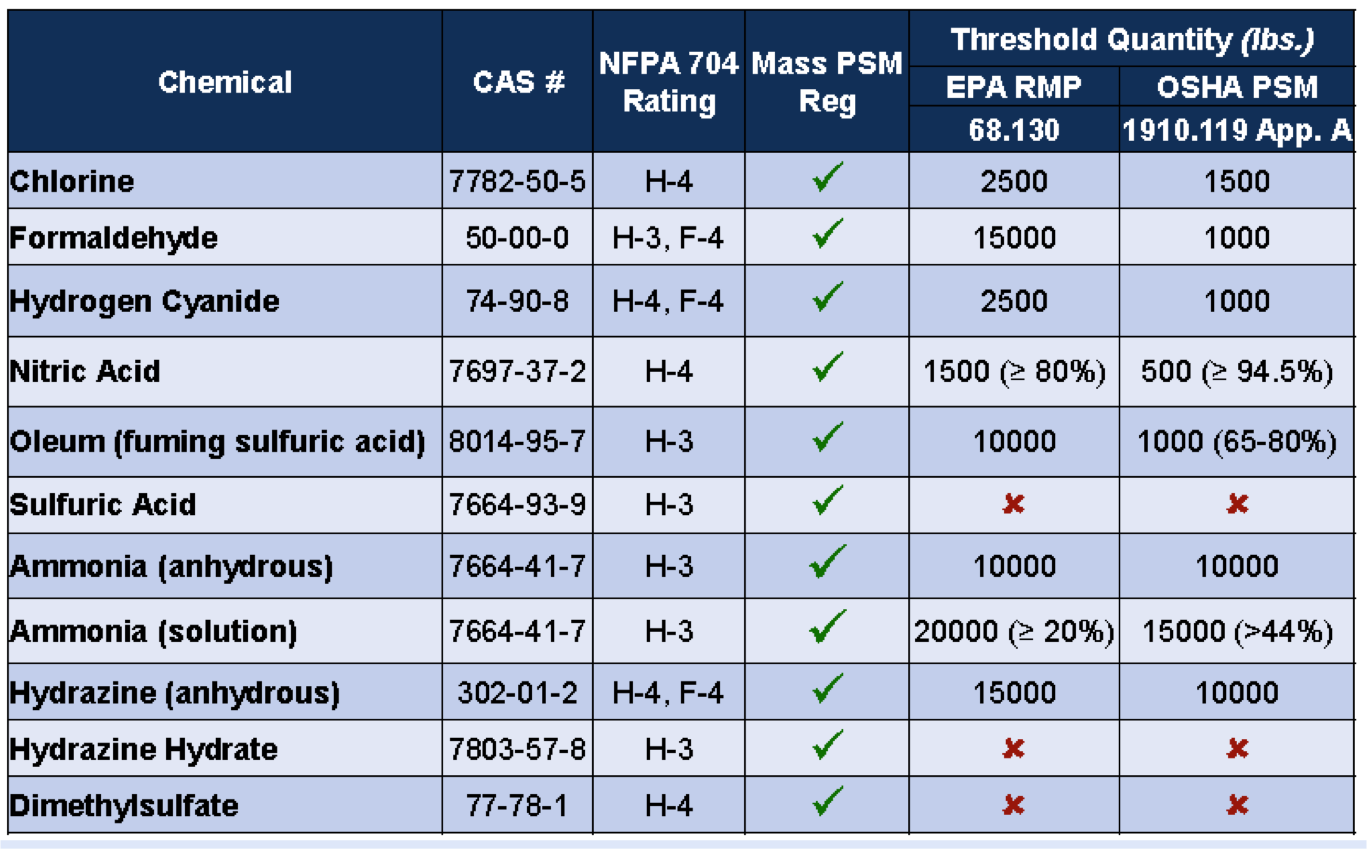
Table from State’s Training ppt
Since 2005, the state of Massachusetts suffered from several explosions in commercial facilities where a hazardous materials process or processing took place. 527 CMR 33.00 was developed as a result of these explosions that affected both the public and public safety officials. The Board of Fire Prevention Regulations began work on this regulation after the 2005 explosion in Leominster. A second large explosion took place in Danvers in 2006, and just prior to the implementation of 527 CMR 33.00: HAZARDOUS MATERIAL PROCESS OR PROCESSING, a third explosion took place in Middleton in March 2011. 527 CMR 33.00 (enacted in 2012) establishes categories of processes and there was a phased implementation of the permit requirement by category.
From what I know from PUBLICLY available sources, the refrigeration process in Boston is a “Category 4 Process”:
A process which involves or produces a Hazardous Material which occurs in a vessel with a capacity that is greater than 300 gallons and is not considered a Category 5 Process.
NOTE: a Category 5 Process is a process which involves or produces Hazardous Material which occurs in a vessel with a capacity that is equal or in excess of threshold quantities stated in 29 CFR 1910.119 or 40 CFR Part 68 and regulated by such standard.
The code has permit requirements for all Process Categories…
33.04: Permit Requirements (Fire Department Inspector’s Checklist I)
(1) No person shall engage in the Process or Processing of any Hazardous Material at any Facility identified in 527 CMR 33.00 as Category 2 through Category 5 unless said Facility is in compliance with the application or permit requirements of the provisions of 527 CMR 33.04(2). A permit holder shall apply for the renewal of said permit on an annual basis. The application shall contain such information and be in a form as prescribed by the Marshal.
(2) An applicant for the permit required by 527 CMR 33.04 shall submit an application for Permit to Process Hazardous Material to the Head of the Fire Department on a form prescribed by the Fire Marshal. A facility shall be deemed in compliance with the permit requirements of 527 CMR 33.04, if a completed application form, signed and attested by the applicant has been filed in accordance with the schedule stated in 527 CMR 33.04(3) and said application is pending review and approval by the head of the fire department.
(3)
(a) The application for permit to process hazardous materials shall be submitted in accordance with the following schedule:
1. January 1, 2013 Category 5 Hazardous Processes
2. June 1, 2013 Category 4 Hazardous Processes
3. January 1, 2014 Category 2 and Category 3 Hazardous Process
(b) For purposes of determining the permit standards and compliance deadline, the highest level of actual or possible Hazardous Processing activity shall determine the appropriate Hazardous Processing Category.
(4) As provided in M.G.L. c. 148, § 10A, the Head of the Fire Department may deny or withhold the issuance of a permit however ,such denial or withholding shall be in writing. Said notice of denial shall contain specifications of the alleged violation or deficiency together with their interpretation of 527 CMR 33.00. The Head of the Fire Department may require a person to engage a third party Competent Professional to evaluate the adequacy of Category 3 or Category 4 facility process safety conditions, programs, procedures, and practices undertaken at the facility but only after a notice of denial has been properly served upon the person making application. The report of the Competent Professional shall be submitted to the head of the fire department and shall include the findings, conclusions, and recommendations, if any, with respect to whether the facility is operating in compliance with the provisions of 527 CMR 33.00.
(5) Any person who has been permitted to engage in the Process or Processing of Hazardous Material at any Facility, shall, prior to engaging in any new or modified hazardous material process activity which results in a change to the highest process category authorized by the current permit, notify the Head of the Fire Department of such new change or modification and submit a new application to appropriately modify the existing permit.
(6) Unless specifically otherwise stated, a facility which possesses a current permit issued pursuant to 527 CMR 33.04, shall not exempt any person or facility from the requirement to obtain additional or other applicable permits, certifications or licenses under the provisions of 527 CMR, 780 CMR, or Massachusetts General Laws.
33.05: Compliance Requirements Based Upon Category Classification
(1) Facilities operating hazardous material process as defined by 527 CMR 33.03 shall maintain the following documents and procedures for each process conducted at their facility for the periodic inspection and review by the Head of the Fire Department and remain in compliance with 527 CMR 33.05.
Category 1 Process:
(a) Provide documentation that adequately demonstrates that the facility maintains and implements a policy in compliance with 29 CFR 1910.1200 and 29 CFR 1910.1450 as applicable, and
(b) Provide documentation that adequately demonstrates that the facility maintains and implements a policy in compliance with 527 CMR 14.00: Flammable and Combustible Liquids, Flammable Solids or Flammable Gases, as applicable, and
(c) Demonstrates compliance with 527 CMR 33.06.
Category 2 Process:
(a) Provide documentation that adequately demonstrates that the facility complies with the requirements for a Category 1 process in accordance with 527 CMR 33.05, and
(b) Provide documentation that adequately demonstrates that the facility has established an emergency response plan in accordance with 527 CMR 33.06. The floor plan does not need to be to scale, but should adequately show locations of utility and process shutoffs locations.
(c) Comply with the permitting requirements of 527 CMR 33.04.
Category 3 Process:
(a) Provide documentation that adequately demonstrates that the facility complies with the requirements for a Category 2 process in accordance with 527 CMR 33.05; and
(b) Completes a Category 3 Hazard Evaluation for each Category 3 process; and
(c) Ensures a Hazard Evaluation policy is in place and has been completed prior to conducting such process or activity modification thereto; and
(d) Implements appropriate process safety controls to mitigate the hazards associated with normal and abnormal operating conditions as identified in theCategory3 Hazard Evaluation.
(e) Comply with the Emergency Response provisions of 527 CMR 33.06.
(d) Complies with the permitting requirements of 527 CMR 33.04.
(f) Maintains a Category 3 Hazard Evaluation documents and records for review by the Head of the Fire Department or Marshal for a minimum of two years following issuance of a permit.
Category 4 Process:
(a) Provide documentation that adequately demonstrates that the facility complies with the requirements for a Category 3 process in accordance with 527 CMR 33.05, and
(b) Completes a Category 4 Limited Process Safety Program for each Category 4 process.
(c) Ensure a Category 4 Limited Process Safety Program policy is in place and has been completed prior to each process or being modified.
A “Category 4 Limited Process Safety Program” is an evaluation performed, policy or required procedure to ensure compliance with the following:
(a) Process information including, but not limited to: MSDS for the chemicals and products being processed, process chemistry, piping and instrumentation diagram, safety relief design, process control safety alarms and interlocks; and
(b) Facility suitability including, but not limited to: building code compliance, electrical hazard (Check article 500) classification, ventilation design, fire alarm and fire protection, spill containment and control; and
(c) A process hazard safety analysis including but not limited to: effects in the event of failure, suitable administrative and engineering controls to minimize failure and to control unanticipated releases, and emergency responses to safeguard life and property; and
(d) Written procedures, including routine operating and maintenance, as well as precautionary, shut-down and emergency response measures; and
(e) A written training program for operating and maintenance personnel and outside contractors whose work or activity may affect process safety; and
(f) A written records management protocol which tracks any changes, including but not limited to changes to chemicals, equipment, operating procedures training program. Such records shall include the date of such change and the name of the manager responsible for such change; and
(g) An internal review at a maximum every three years
(d) Implement appropriate process safety controls to mitigate the hazards associated with normal and abnormal operating conditions as identified in the Category 4 process limited safety program.
(e) Comply with the permitting requirements of 527 CMR 33.04.
(f) Comply with the Emergency Response provisions of 527 CMR 33.06.
(g) Maintain Category 4 Limited Safety Program documents and records for review by the Head of the Fire Department or Marshal for a minimum of two years following issuance of a permit.
SPECIAL NOTE: By all news accounts and information publicly shared by the BFD, the process involved in the fatality is a “Category 4 Process”.
Category 5 Process:
(a) Implement and self-certify compliance with 29 CFR 1910.119 Process Safety Management of Highly Hazardous Chemicals program or with 40 CFR Part 60 Chemical
Accident Prevention Provisions.
(b) Comply with the permitting requirements of 527 CMR 33.04.
(c) Comply with the requirements of 527 CMR 33.06.
(d) Maintain Hazard Evaluation documents and records for review by the Head of the Fire Department or Marshal for a minimum of two years following issuance of a permit.
33.06: Emergency Response Planning
(1) Each facility that processes hazardous materials shall establish, submit to the Head of the Fire Department or to the Marshal, and retain a copy of, a written emergency response program that includes the following items:
(a) Identification of all Emergency Coordinators which will either be on the premises or on call and available to respond to an emergencywithin one hour of an emergency situation; and
(b) An updated list containing the names, addresses, and the office, home and/or mobile telephone number(s) of all designated Emergency Coordinators and the times of their availability. If for a particular period more than one individual is listed, the primary Emergency Coordinator shall be identified and others shall be listed in the order in which they will assume responsibility to fulfill the requirements of this role; and
(c) A facility floor plan, not to scale, showing the locations of the hazardous material stored, the typical volumes, location of additional emergency equipment (pads, booms, etc.)
(d) Facilities covered by Category 3, Category 4 and Category 5 shall have their Emergency Coordinator communicate to the local fire department any concerns and establish a protocol in conjunction with the local fire department on the shutdown of any of the process that would pose a risk to the public in the event of loss of any controls. This protocol shall include a facility liaison to meet with the Incident Commander upon arrival to ensure a safe shutdown if necessary.
(2) The facility shall notify the Head of the Fire Department or the Marshal of any material changes, to the Emergency Response Plan, including the name of the primary Emergency Coordinator, within 14 calendar days of the change.
33.07: Post-incident Analysis
Post-incident analysis shall be applicable to Category 3 and Category 4 processes. For a Category 5 process a copy of the report submitted in accordance with the OSHA or EPA Risk Management Standard shall be considered acceptable.
(1) In the event of an incident involving a process in which there is fire department, EMS response, or a reportable release of a hazardous material, a written post incident analysis must be initiated within 48 hours. Upon completion of the analysis, the Head of the Fire Department shall be given a duplicate copy of the analysis.
(2) A completed post-incident written analysis report shall be completed within 45 days, unless an extension is provided by the Head of the Fire Department for just reason.
(3) The post-incident analysis report shall provide the following information:
(a) A summary of the cause of the incident and contributing factors;
(b) Recommendations to prevent a future recurrence;
(c) A summary of the dates of implementation of the post-incident analysis recommendations and corrective actions;
(d) A reassessment and confirmation of the category under which the facility is operating or application for a new permit as part of the report.
NOTE: And those wondering if a mechanical refrigeration process is “exempt” from this state code, it is NOT. In fact, mechanical refrigeration processes that utilize ammonia (and LPG) are specifically covered; other refrigerants are exempt, but NOT NH3 or LPG.
(3) The provisions of 527 CMR 33.00 shall not apply to the following:
…
(f) Refrigeration systems which employ a refrigerant other than ammonia or LPG;
…
(k) The processing of hazardous materials and their byproducts which have hazard ratings of two or less, according to criteria of NFPA 704;
So we will have to wait and see if the State Fire Marshal will be enforcing this code after this tragedy, but the state of Massachusetts has been very proactive since there three (3) major fires/explosions in the early 2000’s. For those working in the state of MA and want to learn more about this state code:
2MB

BOTTOM LINE: know the codes and standards of your local, state and federal agencies and how they apply to your business. I have no idea if the business involved in this tragedy had a permit or was complying with this state code or even if compliance with the code would have specifically prevented the failure that led to the release; but I do know that State Codes are often times a GREAT STARTING POINT to establish evidence that our process was built to a recognized code/practice. State Codes are NOT the end of our journey, just the beginning.
If your business needs help to understand your compliance requirements that extend beyond OSHA and EPA compliance, contact SAFTENG personnel to discuss your needs or concerns.