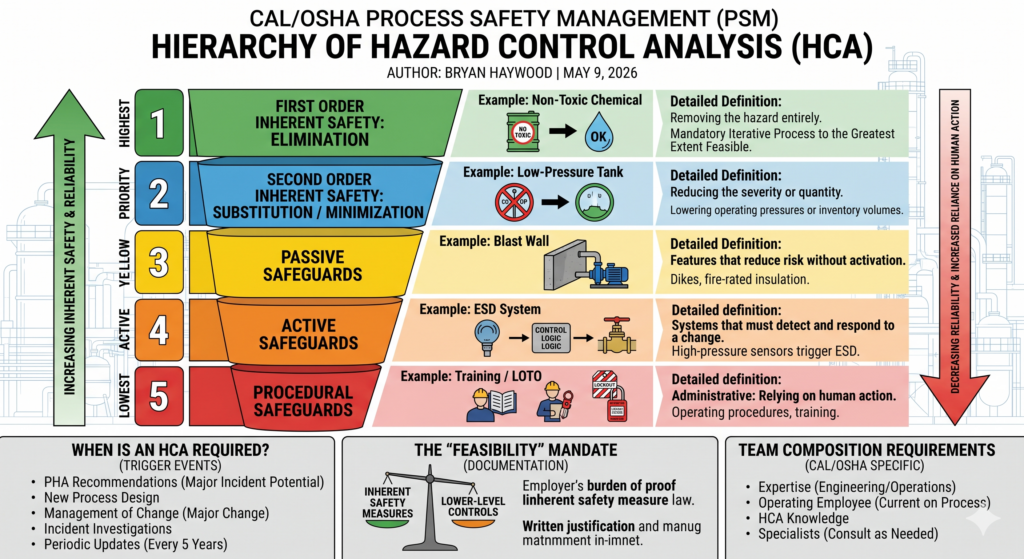
Under Cal/OSHA’s Process Safety Management (PSM) standards (specifically Title 8 §5189.1 for refineries and §5110.16 for other facilities), the Hierarchy of Hazard Control Analysis (HCA) is a formal, documented requirement that goes significantly beyond the traditional OSHA “inverted pyramid.”
While standard safety protocols often treat the hierarchy as a suggestion, Cal/OSHA makes it a mandatory iterative process for reducing risk to the “greatest extent feasible.”
The Five Levels of an HCA
Cal/OSHA redefines the hierarchy into five (5) specific categories, prioritizing Inherent Safety above all else.
| Priority | Level | Definition & Examples |
| 1 (Highest) | First Order Inherent Safety | Elimination: Removing the hazard entirely. Example: Replacing a toxic chemical with a non-toxic one. |
| 2 | Second Order Inherent Safety | Substitution/Minimization: Reducing the severity or quantity. Example: Lowering operating pressures or inventory volumes. |
| 3 | Passive Safeguards | Features that reduce risk without needing to be activated. Example: Blast walls, dikes, or fire-rated insulation. |
| 4 | Active Safeguards | Systems that must detect and respond to a change. Example: High-pressure sensors that trigger an emergency shutdown (ESD). |
| 5 (Lowest) | Procedural Safeguards | Administrative: Relying on human action or “soft” controls. Example: Operating procedures, training, or LOTO. |
When is an HCA Required?
An HCA is not a one-time document. It is triggered by specific “high-stakes” events in a facility’s lifecycle:
- PHA Recommendations: Whenever a Process Hazard Analysis (PHA) identifies a scenario with the potential for a Major Incident.
- Design of New Processes: Must be performed during the design phase of new units or facilities.
- Management of Change (MOC): Required when a “major change” is proposed.
- Incident Investigations: If a major incident occurs, an HCA must be conducted on the recommendations of the investigation report.
- Periodic Updates: All HCAs must be updated at least every five years.
The “Feasibility” Mandate
The most rigorous part of the Cal/OSHA HCA is the documentation of feasibility.
- The HCA team must identify and analyze inherent safety measures to reduce hazards to the greatest extent feasible.
- If a facility chooses a lower-level control (like a procedural safeguard) over a higher-level one (like elimination), they must provide a written justification explaining why the higher-level control was not “feasible.”
- “Feasibility” includes technical, operational, and economic considerations, but the burden of proof is on the employer to show they couldn’t go higher up the hierarchy.
Team Composition Requirements
Cal/OSHA is very specific about who must perform the HCA to ensure it isn’t just a “desk exercise”:
- Expertise: The team must have expertise in engineering and process operations.
- Operating Employee: At least one member must be an operating employee who currently works on the specific process.
- HCA Knowledge: At least one member must be knowledgeable in the specific HCA methodology being used.
- Specialists: As needed, the team must consult with experts in damage mechanisms, chemistry, or control systems.