
Most safety pros live by the LOTO standard daily, or at least weekly! If not, you may need to re-evaluate where you are spending your time! As there is no other standard that impacts manufacturing businesses and brings more value to our safety efforts than does LOTO (IMPO). So this question gets to the heart of how far down the rabbit hole we take the details of energy isolation.
We all know the following definitions by heart:
Energy isolating device. A mechanical device that physically prevents the transmission or release of energy, including but not limited to the following: A manually operated electrical circuit breaker; a disconnect switch; a manually operated switch by which the conductors of a circuit can be disconnected from all ungrounded supply conductors, and, in addition, no pole can be operated independently; a line valve; a block; and any similar device used to block or isolate energy. Push buttons, selector switches and other control circuit type devices are not energy isolating devices.

Lockout device. A device that utilizes a positive means such as a lock, either key or combination type, to hold an energy isolating device in a safe position and prevent the energizing of a machine or equipment. Included are blank flanges and bolted slip blinds.
Let’s focus on the definition of “Lockout Device”. Most will agree that the definition includes LO locks. But how many consider the cover/contraption/chain/cable that actually secures the isolation device in the SAFE position to be part of the “Lockout Device”? Many times, when these covers/contraptions are placed on the isolation device, the LO lock is applied to the cover/contraption and NOT directly to the isolation device. Later in the standard, we see the following:
1910.147(c)(5)(ii)(C)(1) Lockout devices.
Lockout devices shall be substantial enough to prevent removal without the use of excessive force or unusual techniques, such as with the use of bolt cutters or other metal cutting tools.
Is OSHA ONLY talking about LO locks, or do we consider the covers/contraptions that we place the LO lock to fall under this requirement?
We also see the following in relation to “Lockout Devices”:
1910.147(c)(5)(ii)(B) Standardized.
Lockout and tagout devices shall be standardized within the facility in at least one of the following criteria: Color; shape; or size; and additionally, in the case of tagout devices, print and format shall be standardized.
Have we standardized these covers/contraptions by color, shape, or size? It would be hard to standardize them by shape or size, but we always standardized by color, just like we did with our locks.
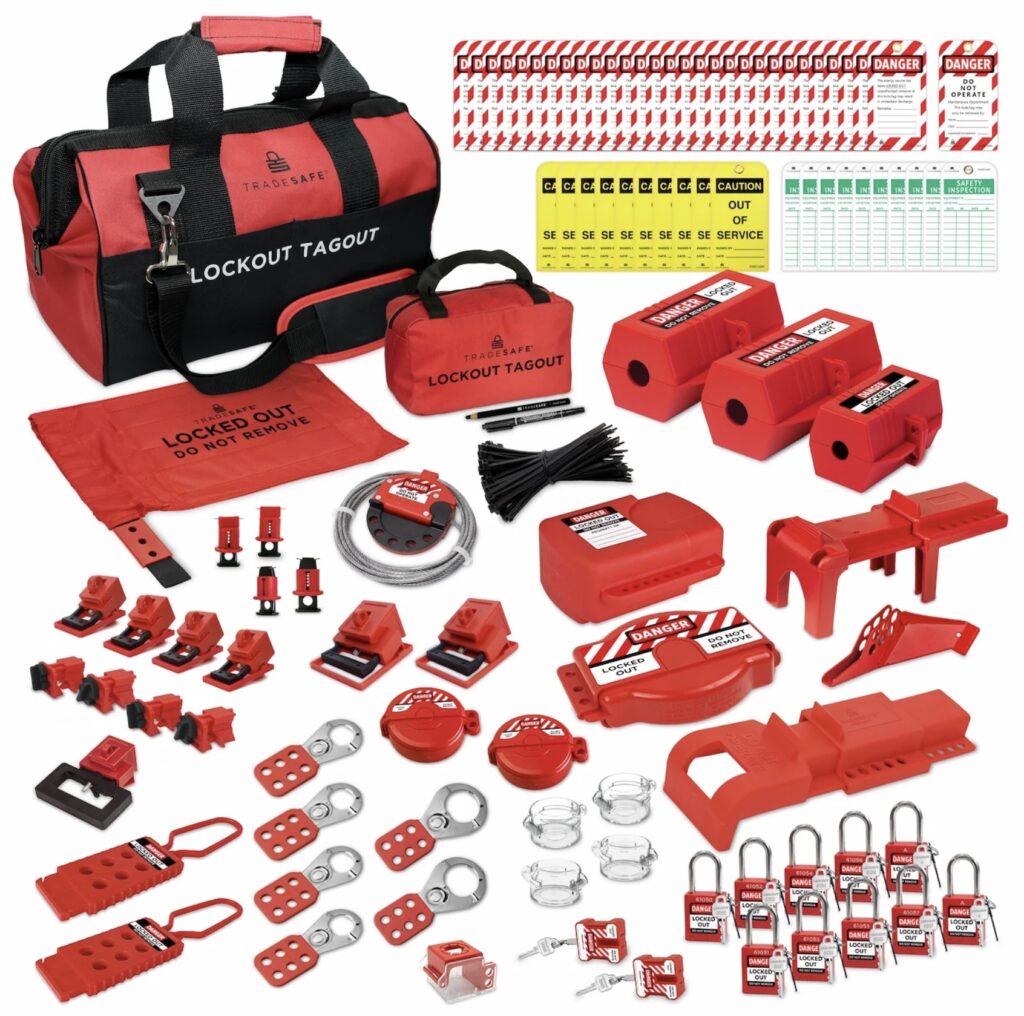
Just how far do you go to standardize these life-safety devices? What if you found some other color, such as yellow, be used with a red LO Lock? An issue or just fine since the lock was Red (LO Lock color)?