
In my last several Process Safety courses, I had several requests for “code requirements” surrounding Relief Valve “maintenance” (e.g., inspection, replacement, and rebuild frequencies). In general, there is the “at least every five years” interval that is ever so popular, and the vast majority of manufacturers will REQUIRE their RV(s) the be changed/rebuilt/certified “at least” every five (5) years. The path/option an employer chooses to take will be based on many factors, which I will not get into in this article. But when it comes to establishing a frequency for our RV maintenance, this frequency will be established based on the actual service the RV is in. The actual service can vastly shorten the “frequencies” that we establish!!!
We turn to the National Board Inspection Code (NB-23) Part 2 – Inspection for the best guidance, as this Recognized And Generally Accepted Good Engineering Practice (RAGAGEP) provides us with all the tools necessary to establish frequencies and to perform an analysis on those valves we have to establish our own frequencies (should be rarely done!). In this RAGAGEP, we find the “5-year” window and some surprises on other RV frequencies.
NBIC Part 2, 2.5.8 paragraph (f) contains the recommended testing frequency for Pressure Relieving Devices (PRDs) on most of our UNFIRED pressure vessels.
Note 1: Fired Pressure vessels like boilers and hot water heaters have their own sections and requirements.
Note 2: PLEASE read OSHA’s 2015 LOI on how to interpret “shall” and “should” language in published codes, standards, published technical reports, recommended practices (RP) or similar document
emphasis added by me
(f) Pressure Vessels and Piping
The frequency of test and inspection of pressure relief devices for pressure vessel and piping service is greatly dependent on the nature of the contents and operation of the system, and ONLY general recommendations can be given. Inspection frequency should be based on PREVIOUS inspection history. If valves are found to be defective or damaged by system contents during an inspection, intervals should be SHORTENED until acceptable inspection results are obtained. Where test records and/or inspection history are NOT available, the inspection frequencies in Table 2.5.8 are suggested.
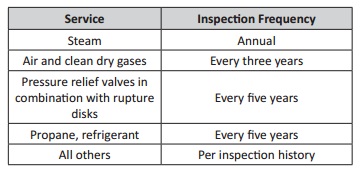
Source: NB-23, 2015
Where a recommended test frequency is NOT listed by the manufacturer or the table above, the valve USER and Inspector MUST determine AND AGREE on a suitable interval for inspection and test. Some items to be considered in making this determination are:
- Jurisdictional requirements (i.e. state code requirements);
- Records of test data and inspections from similar processes and similar devices in operation at that facility;
- Recommendations from the device manufacturer. In particular, when the valve includes a non-metallic part such as a diaphragm, periodic replacement of those parts may be specified;
- Operating history of the system. Systems with frequent upsets where a valve has actuated require MORE FREQUENT inspection;
- Results of visual inspection of the device and installation conditions. Signs of valve leakage, corrosion or damaged parts all indicate MORE FREQUENT operational inspections;
- Installation of a valve in a system with a COMMON DISCHARGE HEADER. Valves discharging into a common collection pipe may be affected by the discharge of other valves by the corrosion of parts in the outlet portion of the valve or the buildup of products discharged from those valves;
- Ability to coordinate with planned system shutdowns. The shutdown of a system for other maintenance or inspection activities is an ideal time for the operational inspection and test of a pressure relief valve;
- Critical nature of the system. Systems that are critical to plant operation or where the effects of the discharge of fluids from the system are particularly detrimental due to fire hazard, environmental damage, or toxicity concerns all call for MORE FREQUENT inspection intervals to ensure devices are operating properly; and
- Where the effects of corrosion, blockage by system fluid, or the ability of the valve to operate under given service conditions are UNKNOWN (such as in a NEW process or installation), a relatively short inspection interval, NOT TO EXCEED ONE (1) YEAR or the first planned shutdown, whichever is shorter, shall be established. At that time, the device shall be visually inspected and tested. If unacceptable test results are obtained, the inspection interval shall be reduced by 50% until suitable results are obtained.
The above intervals are guidelines for periodic inspection and testing. Typically if there are no adverse findings, a pressure relief valve would be placed back in service until the next inspection. Any unacceptable conditions that are found by the inspection shall be corrected immediately by repair or replacement of the device. If the valve is serviced, a complete disassembly, internal inspection, and repair, as necessary, such that the valve’s condition and performance are restored to a like-new condition, should be done by an organization accredited by the National Board.
Service records with test results and findings should be maintained for all overpressure protection devices. A service interval of no more than three inspection intervals or ten years, whichever is less, is recommended to maintain device condition. Results of the internal inspection and maintenance findings can then be used to establish future service intervals.
For those of you managing a PSM/RMP program, I would strongly suggest spending the $ and purchasing NBIC-23, Parts 1-3, but especially Part 2 – Inspection. It will be the best $350 you can spend for useful documents!