
One of the most common questions I used to get on emergency response scenes is:
“How do you determine when we can stop wearing SCBAs and begin wearing Air Purifying Respirators”?
The decision is often a heated debate due to the user’s lack of knowledge. The scary part is that these are trained HAZMAT Technicians who should know better. But, after a quick survey of some clients and SAFTENG members, I found there are a lot of folks out there who may not fully understand the decision logic behind the type of respiratory protection that is needed. So here we go…
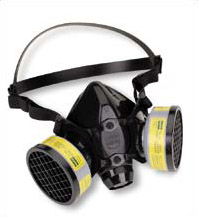
First, let’s look at OSHA’s Assigned Protection Factors (APF) and how these play a major role in respiratory protection. An APF basically tells us the level of contamination the respirator will protect us from. The easiest way to explain this is that a 1/2 Face Air Purifying Respirator (APR) has an APF of 10, which means we can wear this respirator in an atmosphere 10X’s the PEL of the chemical.
Technically speaking, OSHA defines the APF as
the workplace level of respiratory protection that a respirator or class of respirators is expected to provide to employees when the employer implements a continuing, effective respiratory protection program as specified by this section.
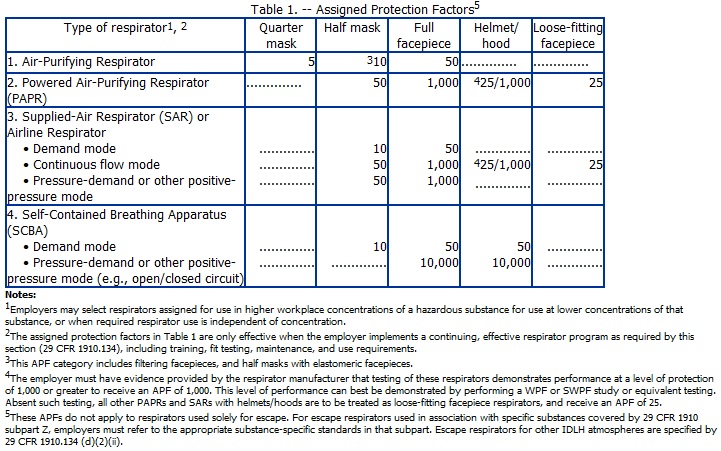
Here are OSHA’s APFs from 29 CFR 1910.134
To keep this simple, let’s look at the three most common types of respirators:
- 1/2-Face Air Purifying Respirator (APR)
- Full-Face Air-Purifying Respirator (APR)
- Self-Contained Breathing Apparatus (SCBA)
So, a 1/2 Face APR has an APF of 10, which means I can wear this type of respirator in an atmosphere up to 10 times the chemical’s PEL. However, this is ONLY true when the atmosphere is NOT an Immediately Dangerous to Life and Health (IDLH) atmosphere, AND we know at least three other data points. More on this later, but NEVER EVER LOOSE SIGHT of IDLH when wearing a respirator!!
A Full-Face APR has an APF of 50, which means I can wear this type of respirator in an atmosphere up to 50 times the chemical’s PEL. However, this is ONLY true when the atmosphere is NOT an Immediately Dangerous to Life and Health (IDLH) atmosphere, AND we know at least three other data points. More on this later, but NEVER EVER LOOSE SIGHT of IDLH when wearing a respirator!!
A Self-Contained Breathing Apparatus in the pressure-demand mode provides us with the highest protection factor of any class of respirator. Its APF is 10,000, but ONLY in the pressure-demand mode – which is the POSITIVE PRESSURE mode. This is the ONLY type of respirator that can be worn in ANY IDLH atmosphere, and it MUST BE in the pressure-demand mode when in the IDLH atmosphere*. I say this last bit because I have seen some of the older model SCBAs that are still in service and that are equipped with a manual switch that allows the user to switch back and forth between “demand mode” and “pressure-demand mode.” The demand mode creates a NEGATIVE pressure (e.g., vacuum) in the face piece, which is why an SCBA in the “demand mode” has the same APF as a Full-Face Air Purifying Respirator (i.e., APF of 50)!!!
So now that we have the APFs assigned, let’s discuss the “Maximum User Concentration” (MUC) equation and how these two work together. The MUC equation is:
Maximum User Concentration (MUC) = Assigned Protection Factor (APF) X Permissible Exposure Limit (PEL)
NOTE: I like using ACGIH’s TLVs instead of OSHA’s PELs, as they are almost always more protective!
This part is CRITICALLY IMPORTANT! Once we KNOW the following information, we can then determine the type of respirator the user can SAFELY wear in the work environment, but we MUST KNOW the following four (4) pieces of data:
- the chemical involved
- the concentration of the chemical
- the IDLH level of the chemical
- the Oxygen concentration in the work environment
Once we have ALL four pieces of this data, we can work with the MUC equation to determine the level of respiratory protection required to protect the user. Let’s be VERY CLEAR here… if we do NOT know ALL four pieces of this data, the atmosphere is an UNKNOWN Atmosphere and thus, by default, it is an IDLH atmosphere, AND the ONLY respirator that can be worn in an IDLH atmosphere is an SCBA in the pressure-demand mode*.
But once we know the chemical involved, the concentration of the chemical, AND that the concentration is LESS THAN the IDLH for the chemical, and we have more than 19.5% Oxygen, then we use this data in the equation. So here’s a hypothetical situation:
The chemical is Anhydrous Ammonia, which has a PEL of 50 ppm. The concentration in the room is 150 ppm (measured with a calibrated direct-reading instrument and compared with the fixed ammonia sensors in the room). The meter also indicated that oxygen levels are at 20.7%.
150 ppm (concentration in the room) = APF X 50 ppm (PEL of NH3)
Using the APF for a 1/2-Face APR of 10, we see that 10 X 50 = 500, and since 500 is larger than 150, a 1/2-Face APR is acceptable for RESPIRATORY PROTECTION – but there is a SERIOUS FLAW with this equation! Although a 1/2-Face protects our respiratory system adequately, it does NOTHING for our eyes, and Ammonia can cause severe eye damage!!! So ALWAYS REMEMBER that this equation is ONLY for respiratory protection and NOTHING ELSE!
Using the APF for a Full-Face APR of 50, we see that 50 X 50 = 2,500, and since 2,500 is larger than 150, a full-face APR is acceptable for this environment.
Using the APF for an SCBA of 10,000, we see that 10,000 X 50 = 500,000, and since 500,000 is larger than 150, an SCBA is acceptable for this environment.
I MUST WARN us again that this equation works ONLY when the exposure is NOT in an IDLH atmosphere (chemical or oxygen-deficient) and is to be used to determine the level of RESPIRATORY PROTECTION ONLY!
Here is another working example, BUT be careful; I may try and trick you on this one!
The chemical is Chlorine, which has a PEL of 1 ppm. The chlorine concentration in the room is 20 ppm (measured with a calibrated direct-reading instrument and compared with the fixed chlorine sensors in the room). The meter also indicated that oxygen levels are at 20.7%.
20 ppm = APF X 1 ppm (PEL of Cl2)
Using the APF for a 1/2-Face APR of 10, we see that 10 X 1 = 10, and since 10 is smaller than 20, a 1/2-Face APR is NOT acceptable for RESPIRATORY PROTECTION in the concentration! PLEASE NOTE… This was a trick question; you need not even use the MUC equation to determine the 1/2-Face APR is not acceptable. See the next item below…
Using the APF for a Full-Face APR of 50, we see that 50 X 1 = 50, and since 50 is larger than 20… – Is a full-face APR an acceptable respirator for this environment? If you said yes, you may want to think twice before using an APR in this environment. WHY? What piece of data did I not provide that I said was an ABSOLUTE MUST-HAVE piece of data when determining respiratory protection? The IDLH of the chemical!!! The IDLH of Chlorine is 10 ppm. So at 10 ppm the ONLY respirator we can wear in this environment is a SCBA in the pressure-demand mode REGARDLESS of what this MUC formula says.
Let’s apply all of this to an emergency situation. We have a leak, can see a cloud, and know the chemical, but what do we NOT KNOW? We do not know the CONCENTRATION of the chemical, nor do we know what the OXYGEN LEVEL in the hot and warm zones is. So without knowing EVERYTHING we need to know, we have an “UNKNOWN ATMOSPHERE,” and an unknown atmosphere is the same as an IDLH atmosphere. The ONLY respirator that can be worn in an IDLH atmosphere is a SCBA in the pressure-demand mode*.
This is what OSHA means when they state in their HAZWOPER standards, 1910.120(q)(3)(iv)…
Employees engaged in emergency response and exposed to hazardous substances presenting an inhalation hazard or potential inhalation hazard shall wear positive pressure self-contained breathing apparatus while engaged in emergency response, until such time that the individual in charge of the ICS determines through the use of air monitoring that a decreased level of respiratory protection will not result in hazardous exposures to employees.
So now you know how the decision is made to change the level of respiratory protection once the user (or the IC during emergencies) has all the data they need to assess the level of protection needed accurately. I want to remind us all once again to NEVER EVER LOOSE SIGHT of IDLH atmospheres when using respirators, because the MUC equation does NOT work in IDLH atmospheres. As I demonstrated above, the equation can trick us into wearing the WRONG respirator in an IDLH atmosphere if we are not careful. The ONLY respirator we can use in an IDLH atmosphere is an SCBA in the pressure-demand mode (e.g., positive pressure).*
If you have questions or concerns about this material, please contact me (e-mail) or (513) 238-8747, your local OSHA area office, NIOSH @ 800-232-4636, or a consultant who is QUALIFIED to answer your respiratory questions. If you seek more technical information on the MUC equation and APF’s and how they are used, you can read OSHA’s Assigned Protection Factors for the Revised Respiratory Protection Standard (pdf).
*I have stated several times that an IDLH atmosphere requires a SCBA, but the truth of the matter is that we could also wear an air-line respirator, which is a “Supplied Air Respirator” much like the SCBA. However, when we use an air-line respirator we MUST ALSO USE an auxiliary SCBA of sufficient duration to permit escape to safety if the air-line supply is interrupted. An auxiliary unit means that the SAR unit includes a separate air bottle to provide a reserve source of air should the airline become damaged. The auxiliary unit shares the same mask and regulator and enables the SAR to function as an SCBA if needed. We MUST have this auxiliary bottle in order to achieve the APF of 10,000 if we plan to use the air-line respirator in an IDLH atmosphere.
Where did OSHA derive the Assigned Protection Factors?
This is from the Federal Register regarding OSHA’s 1998 update to 1910.134 and explains how they went about assigning the APF’s. As you can see it was done over a couple of years and actually took longer to get them agreed upon than the rest of the standard!!!
On November 15, 1994, OSHA published the proposed rule to revise 29 CFR 1910.134, and provided notice of an informal public hearing on the proposal (59 FR 58884). The Agency convened the informal public hearing on June 6, 1995. In response to the comments OSHA received on the proposal, the Agency proceeded to develop APFs. On June 15, 1995, as part of the public hearing, OSHA held a one-day panel discussion by respirator experts on APFs. The discussion included measuring respirator performance in WPF and SWPF studies, the variability of data from these studies, and setting APFs for various types of respirators that protect employees across a wide variety of workplaces and exposure conditions.
OSHA also reopened the rulemaking record for the revised Respiratory Protection Standard on November 7, 1995 (60 FR 56127), requesting comments on a study performed for OSHA by Dr. Mark Nicas titled “The Analysis of Workplace Protection Factor Data and Derivation of Assigned Protection Factors” (Ex. 1-156). This study, which the Agency placed in the rulemaking docket on September 20, 1995, addressed the use of statistical modeling for determining respirator APFs. OSHA received 12 comments on the Nicas report. This report, and the comments received in response to it, convinced OSHA that more information would be necessary before the Agency could resolve the complex issues regarding how to establish APFs, including what methodology to use in analyzing existing protection factor studies. (See Section IV. Methodology for Developing Assigned Protection Factors in the June 6, 2003 NPRM, 68 FR 34044, for a detailed discussion of the Nicas report and the comments OSHA received.)
OSHA published the final, revised Respiratory Protection Standard, 29 CFR 1910.134, on January 8, 1998 (63 FR 1152). The standard contains worksite-specific requirements for program administration, procedures for respirator selection, employee training, fit testing, medical evaluation, respirator use, and other provisions. However, OSHA reserved the sections of the final standard related to APFs and MUCs pending further rulemaking (see 63 FR 1182 and 1203). The Agency stated that, until a future rulemaking on APFs is completed:
[Employers must] take the best available information into account in selecting respirators. As it did under the previous [Respiratory Protection] standard, OSHA itself will continue to refer to the [APFs in the 1987 NIOSH RDL] in cases where it has not made a different determination in a substance specific standard. (63 FR 1163)
The Agency subsequently established a separate docket (i.e., H049C) for the APF rulemaking. This docket includes copies of material related to APFs that previously were placed in the docket (H049) for the revised Respiratory Protection Standard. The APF rulemaking docket also contains other APF-related materials, studies, and data that OSHA obtained after it promulgated the final Respiratory Protection Standard in 1998.
On June 6, 2003, the Agency published in the Federal Register an NPRM titled “Assigned Protection Factors; Proposed Rule” (68 FR 34036) that contained proposed definitions for APFs and MUCs, a proposed Table 1 with APFs for the various respirator classes, and proposed revisions to the APF provisions and tables in OSHA’s substance-specific standards. The NPRM announced that OSHA would be holding an informal public hearing in Washington, DC on the proposal. The public hearings were held over three days, from January 28-30, 2004. OSHA received extensive pre-hearing comments (Exs. 9-1 through 9-43 and 10-1 through 10-60), written hearing testimony (Exs. 16-1 through 16-25), post-hearing comments (Exs. 17-1 through 17-12), and post-hearing briefs (Exs. 18-1 through 18-9 and 19-1 through 19-8). Transcripts of the public hearings also were made and added to the APF Docket (Exs. 16-23-1, 16-23-2, and 16-23-3). It is from these public comments, exhibits, hearing transcript, and post-hearing submissions that OSHA has prepared these final APF and MUC provisions and revisions to substance-specific standards.
UPDATED 7/12/12
Here is an OSHA LOI issued in May 2012 that discusses how an employer is to determine the level of respiratory protection based on worker exposoure. Although not officially required (as stated in this LOI), personal or area air sampling is BY FAR the most reliable way to establish exposures, which is an ABSOLUTE MUST when determining the level of respiratory protection.