
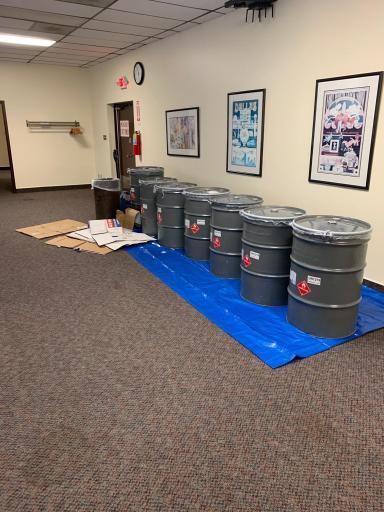
Well, we knew it would just be a matter of time until someone did this. Again, the fear of contracting a virus has apparently overridden all rational thinking. This picture was shared this morning in one of my favorite Facebook Groups Fire Inspectors With No Borders. We do not know the background of the picture, but in this pandemic, we (group members) assumed it was more make-shift hand sanitizer production. In Part I and II, I focused on containers and portable tanks but did not cover “office occupancies”. In this post, I will cover the office occupancy requirements/prohibitions.
OSHA defines “office occupancy” as:
1910.106(a)(24)
Office occupancy shall mean the occupancy or use of a building or structure or any portion thereof for the transaction of business, or the rendering or receiving of professional services.
And in this “occupancy” setting, OSHA essentially PROHIBITS storage of flammable liquids, EXCEPT for incidental storage “which is required for maintenance and operation of building and operation of equipment“.
(emphasis by me)
1910.106(d)(5)(iii) “Office occupancies.”
Storage shall be PROHIBITED except that which is required for maintenance and operation of building and operation of equipment. Such storage shall be kept in closed metal containers stored IN A STORAGE CABINET or IN SAFETY CANS or IN AN INSIDE STORAGE ROOM not having a door that opens into that portion of the building used by the public.
In the picture we can see a number of concerns:
- It is clearly an office occupancy; regardless of what is on the other side of the wall! A building can have (and should) have different occupancies within its confines.
- The area does not appear to be sprinkled.
- The area does not appear to be built as a HAZLOC (e.g. Class I, Div. 1/2, Group D)
- The drums have no secondary containment.
- I hope they are just sitting there, waiting to be moved to an area designed for them to be stored, but NEVER use plastic around flammable liquids! The plastic tarp (as well as the carpet) are BOTH insulators to ground AND static generators. If these drums are to be opened and the transfer takes place in this setting – this would be about as bad as we could imagine! Maybe smoking while doing it would be worse, but not much else would make this a worse set up.
- Too close to the EXIT!!
For mere discussion, let’s say this was in a warehouse. Would this be an acceptable “pile”? Here is Table H-14 Indoor Container Storage from 1910.106…
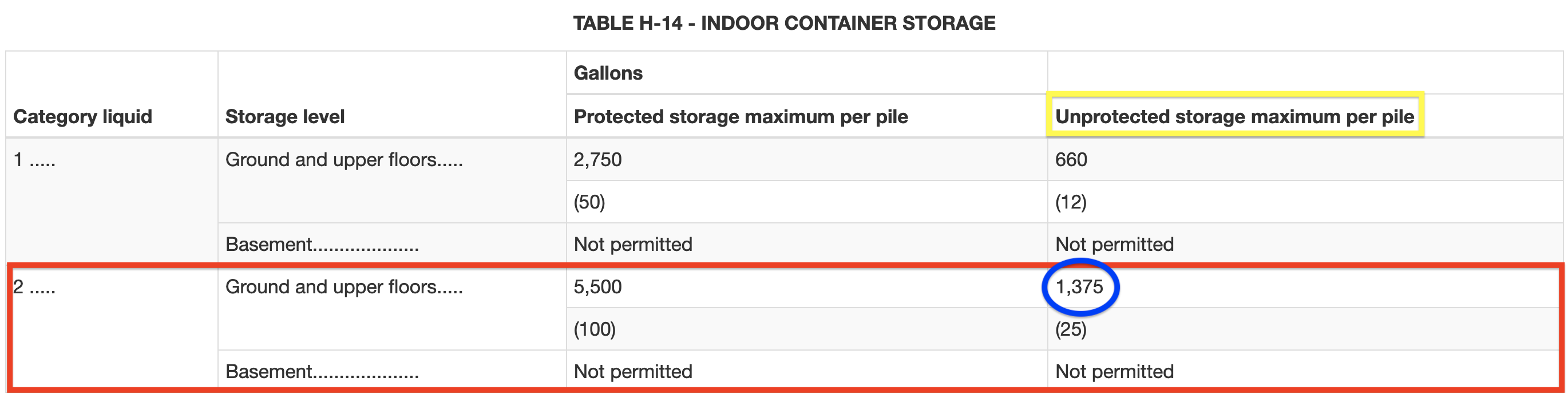
We can see in the blue circle that we can have 1,375 gallons of a CAT 2 Flammable Liquid in a “pile” when the area is “unprotected” (i.e. no sprinkler). The picture shows seven (7) 55-gallon drums, which is 385 gallons, or 12 drums. So if this were an area DESIGNED for flammable liquid storage we would be OK in respect to the quantities shown; however, this is an OFFICE OCCUPANCY and what we see is NOT OK!
PLEASE NOTE: I am not sure what is in the drums shown in the picture. We can not make out any other labels, other than the DOT Label which indicates the contents are flammable, but DOT and OSHA flammable definitions differ. It also appears there is a plastic liner inside the drums, and this would not be typical of an Ethanol Drum. I just used the picture as a point of discussion as if these were Ethanol drums.