
Have you ever been going down a flight of stairs and like the safety minded person you are you are using the handrail during your descent (or ascent) and as you travel along your hand strikes something forcing you to remove your hand from the railing? Have you ever wondered if that was an issue? Maybe you have seen an injury from an employee pinching their finger between the railing and the fixed object. Bottom line, this is a safety issue, as well as a compliance issue! With slips, trips, and falls being the #1 type of injury incident in all types of workplaces – there is a reason why OSHA has a standard to address this unsafe condition…
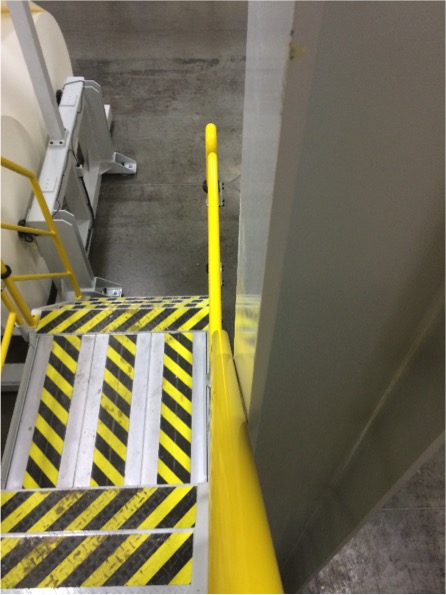
1910.23(e)(5)(iii) The size of handrails shall be: When of hardwood, at least 2 inches in diameter; when of metal pipe, at least 1 1/2 inches in diameter. The length of brackets shall be such as will give a clearance between handrail and wall or any projection thereon of at least 3 inches. The spacing of brackets shall not exceed 8 feet.
…
1910.23(e)(6) All handrails and railings shall be provided with a clearance of not less than 3 inches between the handrail or railing and any other object.
In 1978 OSHA issued OSHA Instruction STD 1-1.6 which allows all handrails and railings to have a clearance of at least one and one-half (1.5) inches between the handrail or railing and any other object. This also brought the OSHA standard in line with many building and fire protection codes.
So whether you use 3″ or 1.5″ as your clearnace guide for handrails on stairs, bottom line is that anyone should be able to maintain contact with the railing ALL the way down (and up) the railing as they travel the stairs. Our fingers, no matter how big should easily pass between the railing and any obbstruction.