A little different photo of the week!!!
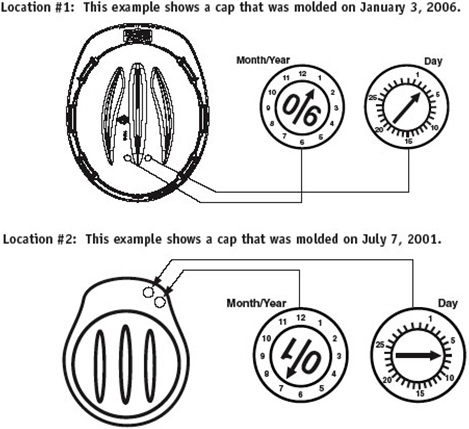
The date code indicates when the hat was molded. Date codes are molded into the hat shell and they specify the following:
- Day
- Month, and
- Year the hat or cap was molded
The large arrow inside the “Month / Year” circle points to the month, and the two digits inside that inner circle indicate the year. The arrow inside of the “Day” circle points to day of month. Depending on what model hard hat / cap you have you may find the date code in one of two locations on the hat, on the inside of the shell or the underside front brim of the hat / cap.
UPDATED on 2/21/12
Replacement schedules recommended by some of the major hardhat manufacturers:
Bullard
When should I replace my hard hat?
Users of industrial head protection devices must realize that these products do not have an indefinite useful life. Bullard recommends that a regular head protection replacement program be conducted by employers as a responsive solution to the task of addressing service life of hard hats/caps.
Since the details of such a program must be developed based on work conditions at each job site, it is impossible to provide a specific time frame for cap replacement. As a general guideline, many large corporations replace all employees’ caps every five years, regardless of the cap’s outward appearance.
Where user environments are known to include higher exposure to temperature extremes, sunlight or chemicals, hard hats/caps should be replaced automatically after two years of use. This is based on information and cap samples returned to Bullard after exposure to such conditions. In certain rare instances, a cap may need to be replaced within less than two years.
If a cap has been struck by a forcible blow of any magnitude, both the hard hat shell and suspension should be replaced immediately, even if no damage is visible.
The following is a simple field test that can be performed by an employee or supervisor to determine possible degradation of polyethylene shells:
Compress the shell inward from the sides about 1” (2.5 cm) with both hands and then release the pressure without dropping the shell. The shell should quickly return to its original shape, exhibiting elasticity. Compare the elasticity of the sample with that of a new shell. If the sample does not exhibit elasticity similar to that of a new shell, or if it cracks due to brittleness, it should be replaced immediately.
MSA
What is the service life of my V-Gard helmet?
The V-Gard helmet was designed with high quality, wear-resistant materials but it WILL NOT last forever. The protective properties of the helmet WILL be degraded by exposure to many common work environments, such as temperature extremes, chemical exposure, sunlight and normal daily wear and tear. MSA recommends the following replacement schedule:
Suspension—replace after NO MORE THAN 12 months; Entire Helmet—replace after NO MORE THAN 5 years
Remember that these are MAXIMUM useful service life guidelines. Wear or damage noticed during a regular inspection MUST be the determining factor for possible earlier replacement. In any case, ALWAYS replace the helmet after it has withstood impact or penetration.