
So I asked Google Gemni + to calculate the pressure wave in a room that is 40′ X 40′ X 20′ tall with a 5,000-gallon pressure vessel 85% full of liquid NH3, and it catastrophically fails. How much of a pressure wave will this event create in psig? I promise you this… No Engine Room I have ever been in could withstand this event! Google Gemini + equated it to TNT!
Calculating the pressure wave (overpressure) from a catastrophic vessel failure involves determining the total energy released when the compressed contents expand to atmospheric pressure. In this scenario, the energy comes from both the compressed vapor space and the instantaneous “flashing” of the liquid anhydrous ammonia (NH3).
Energy Release Calculation
To find the overpressure in psig, we first determine the expansion energy ($E$). For a vessel containing a liquefied gas like anhydrous ammonia, the energy release is primarily driven by the rapid phase change of the liquid into vapor when the pressure drops to ambient.
- Vessel Volume: 5,000 gallons = approx 668.4 ft3
- Liquid Volume (85%): 4,250 gallons = approx 568.1 ft3
- Vapor Volume (15%): 750 gallons = approx 100.3 ft3
The energy released (E) is typically calculated using the Brode equation or the Isentropic Expansion method. For NH3 at standard storage pressures (approx. 114 psig at 70°F), the liquid is superheated relative to its atmospheric boiling point (-28°F).
Upon failure, a portion of the liquid instantly flashes to vapor. The expansion energy of 5,000 gallons of NH3 is roughly equivalent to several hundred pounds of TNT, depending on the exact temperature and pressure at the moment of rupture.
Determining Peak Overpressure (Ps)
The pressure wave at a specific distance is found using the scaled distance (Z), where:
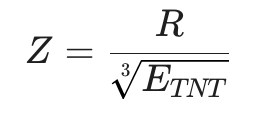
- R: Distance from the source
- ETNT: Equivalent mass of TNT
In a closed room of 40′ x 40′ x 20′ (32,000 ft³), the pressure wave will behave differently than an open-air explosion due to reflection. When the shockwave hits the walls, the pressure can increase by a factor of 2 to 8 times the initial incident pressure.
Estimated Results
For a catastrophic failure of this magnitude in a confined space of that size:
- Initial Shockwave: The incident overpressure would likely exceed 20–50 psig almost instantly throughout the room.
- Reflected Pressure: Because the walls are only 20–40 feet away, the reflected pressure waves would likely reach >100 psig.
Structural Implications
| Overpressure (psig) | Expected Damage |
| 0.5 – 1.0 | Windows shatter, minor structural damage. |
| 5.0 – 10.0 | Total destruction of standard brick or wood-frame buildings. |
| 20.0+ | Total destruction of reinforced concrete structures; heavy machinery moved/damaged. |
In a room of this volume, a failure of a 5,000-gallon NH3 vessel is a total loss event. The overpressure would far exceed the structural capacity of any standard industrial building, likely resulting in the immediate leveling of the structure and a massive secondary toxic release.
For precise safety modeling, tools like PHAST or FLACS are typically used to account for the specific thermodynamic path of the ammonia and the complex reflections within the room geometry.
Source: me and Google Gemini +