
As I have written many times, our bulk chemical transfer hoses MUST be part of an Inspection and Testing Program. These tests follow the same logic as pressure testing piping, and Hydrostatic Testing is far safer than pneumatic testing. So I asked Google Gemini+ to show me the difference in failure energies to demonstrate this point. NOTE: This scenario also applies to our Fire Hose annual testing!
Hint: a 20′ long, 3″ chemical hose generates 13 grams of TNT during its annual pressure testing at 250 psig!
A 13-gram charge of TNT creates a supersonic shockwave. The damage to the human body and structures depends entirely on distance:
At 6 inches (0.15m): The overpressure is massive (hundreds of psi). This is enough to cause traumatic amputation of fingers or a hand if the person is holding the object when it fails.

At 2 feet (0.6m): The pressure wave is still roughly 5–10 psig. This is the threshold for eardrum rupture and is sufficient to shatter reinforced glass or knock down interior partition walls.

At 5 feet (1.5m): The wave drops to about 1–2 psig. While unlikely to cause major structural collapse, it can still cause "blast lung" (internal bruising) and throw a person backward.
To calculate the pressure wave generated by a hose failure during testing, we first have to distinguish between hydrostatic (water) and pneumatic (air/gas) testing. Since “chemical hose” testing is almost always hydrostatic for safety reasons, the energy release is significantly lower—but if air is trapped or used, the results can be explosive.
Scenario 1: Hydrostatic Testing (Water)
If the hose is 100% full of water at 250 psig, the stored energy is extremely low because water is virtually incompressible.
- Energy Release: Upon failure, the water simply drops to the floor. There is no “pressure wave” through the air.
- The Danger: The hazard here is “Whiplash.” If the hose separates from a fitting, the stored elastic energy in the hose carcass can cause it to whip violently, causing physical trauma.
- Overpressure: 0 psig (No atmospheric pressure wave).
Scenario 2: Pneumatic Testing (Air/Gas)
If the hose contains air at 250 psig, the calculation changes drastically. Compressed air stores energy like a spring.
1. Volume Calculation:
A 3″ diameter hose, 20′ long, has an internal volume of:
V = pi X r2 X L = pi X (1.5/12)2 X 20 = 0.98 ft3
2. Stored Energy (Isentropic Expansion):
Using the formula for stored energy in a compressed gas (E):
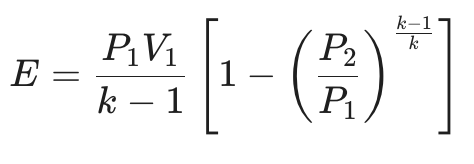
- At 250 psig (264.7 psia), this 20′ hose contains approximately 55,000 Joules of energy.
- This is roughly equivalent to 13 grams of TNT.
3. The Pressure Wave (Overpressure):
We calculate the “Peak Overpressure” at a specific distance (e.g., 5 feet away):
- At 2 feet: ~2.5 to 3.0 psig (Enough to burst eardrums and throw a person).
- At 5 feet: ~0.5 to 1.0 psig (Enough to knock a person down and shatter glass).
Summary of Hazards
| Factor | Hydrostatic (Water) | Pneumatic (Air) |
| Pressure Wave | None | Significant (Shockwave) |
| Primary Risk | Hose Whip / Fluid Injection | Blast Overpressure / Projectiles |
| TNT Equivalent | ~0 grams | ~13 grams |
| Safe Distance | Immediate vicinity of hose | Per ASME PCC-2 (usually ~15–20+ ft) |
Safety Recommendation
As you noted in your SAFTENG “cheat sheet” for ASME PCC-2, Mandatory Appendix 501-III, even a small volume like a 3″ hose requires a calculated safe distance if tested pneumatically. If there is any air trapped in a hydrostatic test, that air “bubble” will act like a pneumatic charge, potentially turning a standard leak into a catastrophic whip or blast.
Does this hose have a specific liner (e.g., PTFE) that might affect your volume or “Design Pressure” calculations for the test?
Source: me and Gemini+