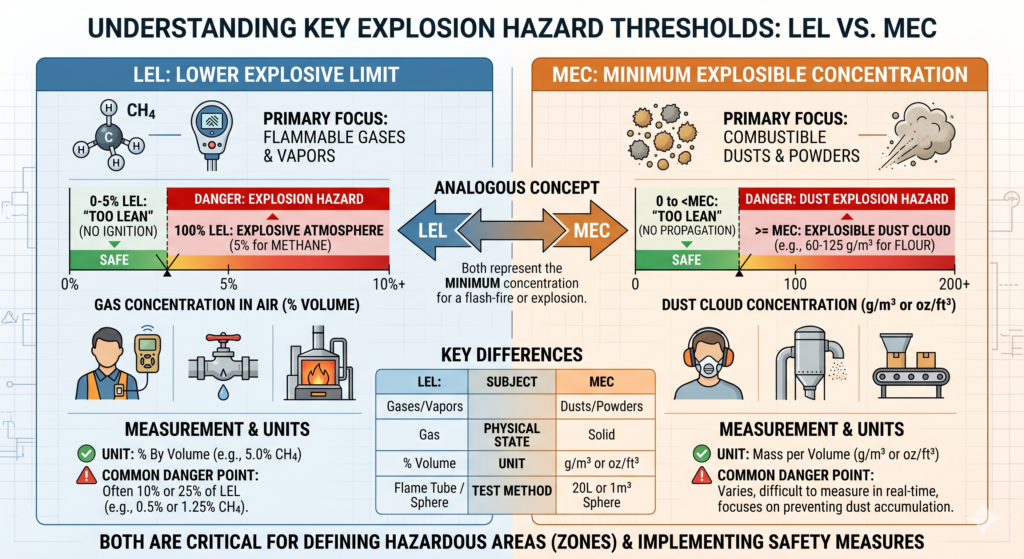
Yes, both terms essentially mean the same thing, but they refer to very different hazardous atmospheres. LEL, or Lower Explosive Limit, applies to gases and Vapors. MEC, which is Minimum Explosive Concentration, deals with Combustible Dusts. Here are some other differences:
| Term | Full Name | Applies To | Units | Typical Values | Analogy |
|---|---|---|---|---|---|
| LEL | Lower Explosive Limit (or Lower Flammable Limit – LFL) | Gases & Vapors | % by volume (% vol) | Propane: 2.1%, Methane: 5%, Methanol vapor: ~6% | “Too lean to burn” |
| MEC | Minimum Explosible Concentration | Combustible Dusts | g/m³ (or oz/ft³) | Sugar dust: 30–60 g/m³ Coal dust: 30–100 g/m³ Aluminum dust: 30–50 g/m³ | Same concept as LEL but for dust clouds |
Key Differences
- LEL (Gases/Vapors)
- Measures the lowest concentration of flammable gas or vapor in air
- Below the LEL, the mixture is too lean (not enough fuel)
- Above the UEL (Upper Explosive Limit), the mixture is too rich (not enough oxygen)
- Monitored with gas detectors (LEL meters) that read in % LEL (0–100% of the LEL value)
- MEC (Combustible Dusts)
- Measures the lowest concentration of airborne combustible dust that can form an explosive cloud
- There is generally no true Upper Explosible Limit for dusts (they behave differently from gases)
- Tested in a 20-L explosion sphere per standards like ASTM E1515
- Dust must be suspended (airborne) — settled dust on surfaces is a secondary explosion hazard
Image created by Gemini Plus