
 |
 |
|
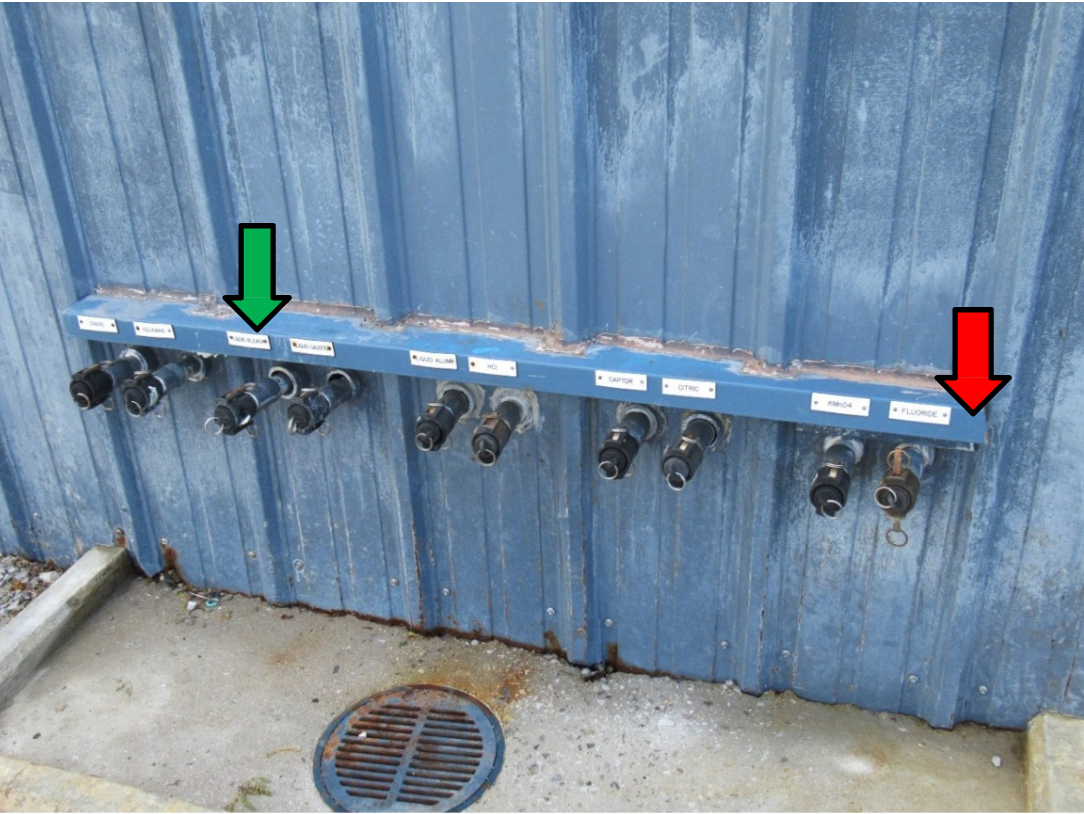
The photograph shows the fill line hookups at TCWTP. All connections and fittings were identical, and the hoses used by ADC could be hooked up to any of the fill lines pictured. There was also no color coding of the lines or prominent labeling other than plain black text on a white background. The fill lines were not locked when not in use to prevent accidental hookups. The FSA hookup is indicated by the red arrow and the bleach hookup is indicated by the green arrow. A truck driver mistakenly hooked up the bleach hose (leading to the bleach tote on ADC’s delivery truck) to the FSA fill line |
|
A 52-year-old male employee died as a result of being exposed to a hazardous atmosphere of chlorine gas (Cl2). A chemical transfer hose for Sodium Hypochlorite (bleach) was accidentally hooked up to the fill line for Hydrofluorosilicic Acid; when the chemicals combined it created chlorine gas. Approximately 5 gallons of bleach were accidentally pumped into a 100-gallon fluoride tank containing approximately 50 gallons of fluoride creating the gas.
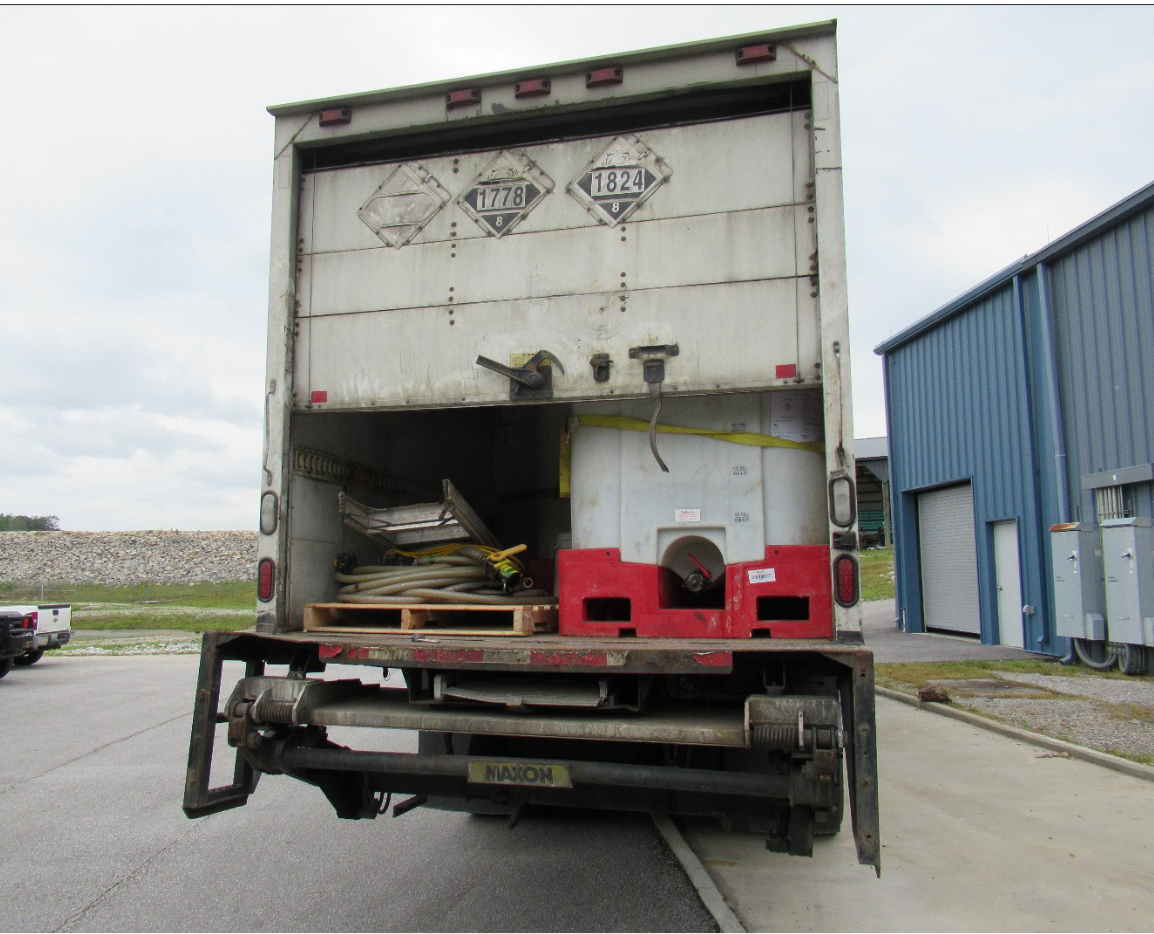
The victim and another employee arrived at the Tracy City Water Treatment Plant at approximately 5:45 am. On the way in the gate, they discussed what chemicals they had to pump at this location. It was noted that a dog (a device made of PVC piping) would have to be used to pump the chemicals. The dog is used to bleed the fill line into a bucket so there is no air in the line. They decided to pump Sodium Hypochlorite (bleach) first.
The victim grabbed a water hose from inside the facility and washed out the plastic bucket and dog because the bucket had some residual fluoride in it from the last time it was used to bleed a line. The two men donned their PPE (latex gloves, face shield, and a Dupont Tyvek 400 jacket) in addition to the uniforms they were already wearing-short sleeve work shirts and shorts.
The victim hooked up the dog at the Hydrofluorosilicic Acid fill line at the building-presumably thinking he was hooked up to the bleach fill line-and came up to the other employee in the truck at that tank and said:
“bleach?”; “yes, bleach” was the reply
The victim then hooked up the bleach hose to the dog. He went inside and came back out and told the other employee to start the transfer. The pump was turned on and the transfer began. After a short time, the second employee heard the pump change tunes like it was dead-heading, most likely because the victim cut off the flow of bleach from inside the facility by turning a valve at the fill line where it came inside the building.
Shortly thereafter, the victim came running out of the plant door and said to turn the pump off and that he messed up-indicating that he realized he had hooked up the bleach hose to the Hydrofluorosilicic Acid fill line. The pump was unplugged and the valve for the pump at the bleach tote was cut off.
The victim was observed going back into the facility through the plant door. At this time, a green gas that was low to the ground was observed to be coming out of the facility. The victim went through the plant and back to where the TCWTP operator was working in the water quality lab and asked him if the exhaust fans were on. The victim had walked through the area of the facility where the chemical reaction was occurring two additional times after exiting through the plant door initially to initially notify his partner of the reaction.
It is unknown why the victim chose to reenter the hazardous atmosphere rather than going around the outside of the building to the door on the south wall to notify the TCWTP operator. Based on observations, measurements, and interviews obtained during the inspection, a factor that contributed to the fatality was the lack of an appropriate procedure for hooking up the equipment to make a chemical delivery. There was unrestricted access to all fill lines at all times, all fittings were the same size and shape, there was not a color-coding system for the fill lines, and there was no verification that the correct hose was attached to the correct fill line.
TCWTP left ADC unsupervised when making their deliveries, they simply unlocked the facility and went back to what they were working on.
Additionally, the hook up by ADC was made by two different employees, one employee hooked up the hose and pump to the tote in the truck and the other employee hooked up the hose to the fill line on the building.
There was no verification by either employee or the TCWTP operator that the hose had been hooked up to the right connections on both ends.
Citation 1 Item 1
Type of Violation: Serious; $4,000
TCA 50-3- 105(1): The employer did not furnish employment and a place of employment that were free from recognized hazards that were causing or likely to cause death or serious physical harm to employees:
In that effective engineering controls, administrative controls, and work practice controls were not implemented to prevent inadvertent chemical mixing when employees conducted hazardous chemical transfer operations exposing employees to toxic chemical inhalation hazards. On 5/22/20, an employee was exposed to toxic chemical atmosphere resulting from the inadvertent transfer of sodium hypochlorite to a container of Hydrofluorosilicic acid.
Citation 1 Item 2
Type of Violation: Serious; $2,100
29 CFR 1910.37(a)(2): Exit routes were not arranged so that employees did not have to travel toward a high hazard area, unless the path of travel was effectively shielded from the high hazard area by suitable partitions or other physical barriers.
The employer did not ensure that employees did not have to travel towards a high hazard area when utilizing the southwest exit of the Tracy City Water Treatment Plant, as the exit discharged underneath the vents for two chemical tanks-Sodium Hypochlorite and Hydrofluorosilicic Acid.
Citation 1 Item 3a
Type of Violation: Serious; $1,800
29 CFR 1910.132(e): The employer did not remove from service defective or damaged personal protective equipment.
Citation 1 Item 6b
Type of Violation: Serious; Grouped
29 CFR 1910.1200(h)(3)(ii): Employees were not trained on the physical, health, simple asphyxiation, combustible dust, and pyrophoric gas hazards, as well as hazards not otherwise classified, of the chemicals in the work area.
The employer did not ensure employees were aware of the hazards of using water to clean out a tank where a chemical mixture had occurred.
Citation 1 Item 6c
Type of Violation: Serious; Grouped
29 CFR 1910.1200(h)(3)(iii): Employee training did not include the measures employees can take to protect themselves from chemical hazards, including specific procedures the employer had implemented to protect employees from exposure to hazardous chemicals, such as appropriate work practices, emergency procedures and personal protective equipment to be used.
The employer did not ensure employees were trained on emergency procedures, work practices, and appropriate PPE to be used in the event of an emergency, such as a chemical mixture.
Citation 2 Item 1
Type of Violation: Repeat-Serious; $3,600
29 CFR 1910.132(a): Protective equipment, including personal protective equipment for eyes, face, head, and extremities, protective clothing, respiratory devices, and protective shields and barriers, were not provided, used, and maintained in a sanitary and reliable condition wherever it is necessary by reason of hazards of processes or environment, chemical hazards, radiological hazards, or mechanical irritants encountered in a manner capable of causing injury or impairment in the function of any part of the body through absorption, inhalation or physical contact.
The employer did not ensure employees’ arms and legs were protected from contact with corrosive chemicals in the following instances:
A) Employees making deliveries of corrosive chemicals to customers’ sites were not protected from skin contact with corrosive chemicals.
B) Service employees who responded to a mixture of corrosive chemicals were not protected from skin contact with those corrosive chemicals.
American Development Corporation of Tennessee, Inc. was previously cited for a violation of this occupational safety and health standard or its equivalent standard (1910.132(a)), which was contained in TOSHA inspection number 1333762, citation number 1, item number 1a and was affirmed as a final order on November 4, 2018, with respect to a workplace located at 821 William D Jones Blvd Fayetteville, TN 37334
CLICK HERE for the TNOSHA file