Can you spot the “compliance issue” in OSHA’s Ammonia PSM photo? I had this photo presented to me as evidence that OSHA does not require “something”, can you spot what is missing in this photo? Can you cite the RAGAGEP that this photo violates? CLICK HERE for a hint.
CORRECT ANSWER is that the vessel nor its “sight glass” has protection.
- ASHRAE 15-2010, 11.1 General Restrictions-Safeguards. Means shall be taken to adequately safeguard piping, controls, and other refrigerating equipment to minimize possible accidental damage or rupture by external sources. Some will point to section 9.11.2 that exempts “Liquid-level-gage glasses of the bulls-eye type” as permission to leave this device unprotected. Bad idea, sure you may be able to point to an exemption to get you out of one citation AFTER you have just shut down your plant and potentially impacted your community in a negative way!!
- ANSI/IIAR 2-2008 Equipment, Design, and Installation of Closed-Circuit Ammonia Mechanical Refrigerating Systems, Section 12 – Components and Controls, 12.1 Visual Liquid Level Indicators: Bull’s-Eyes, tubular glass and flat “armored glass” linear sight glasses/sight columns 12.1.1 All visual liquid level indicators used to observe the refrigerant level, such as in a vessel or heat exchanger, shall be installed in such a manner that they are protected from physical damage.
-
IIAR BULLETIN 109 – MINIMUM SAFETY CRITERIA FOR A SAFE AMMONIA REFRIGERATION SYSTEM, 4.6 Visual Liquid Level Indicators (Bulls Eyes, Tubular Glass and Flat “Armored Glass” Linear Sight Columns/Sight Glasses), 4.6.1 All visual liquid level indicators used to observe the refrigerant level, for example: in a vessel, heat exchanger; should be installed in such a manner that they are protected from possible physical damage through traffic hazards, for example forklifts.
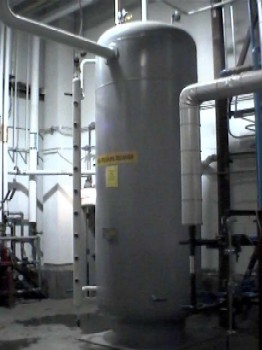
Source: https://www.osha.gov/SLTC/etools/ammonia_refrigeration/receiving/storage.html
1/31/14 UPDATE: Here is what a receiver should look like… Now, do you see the difference?
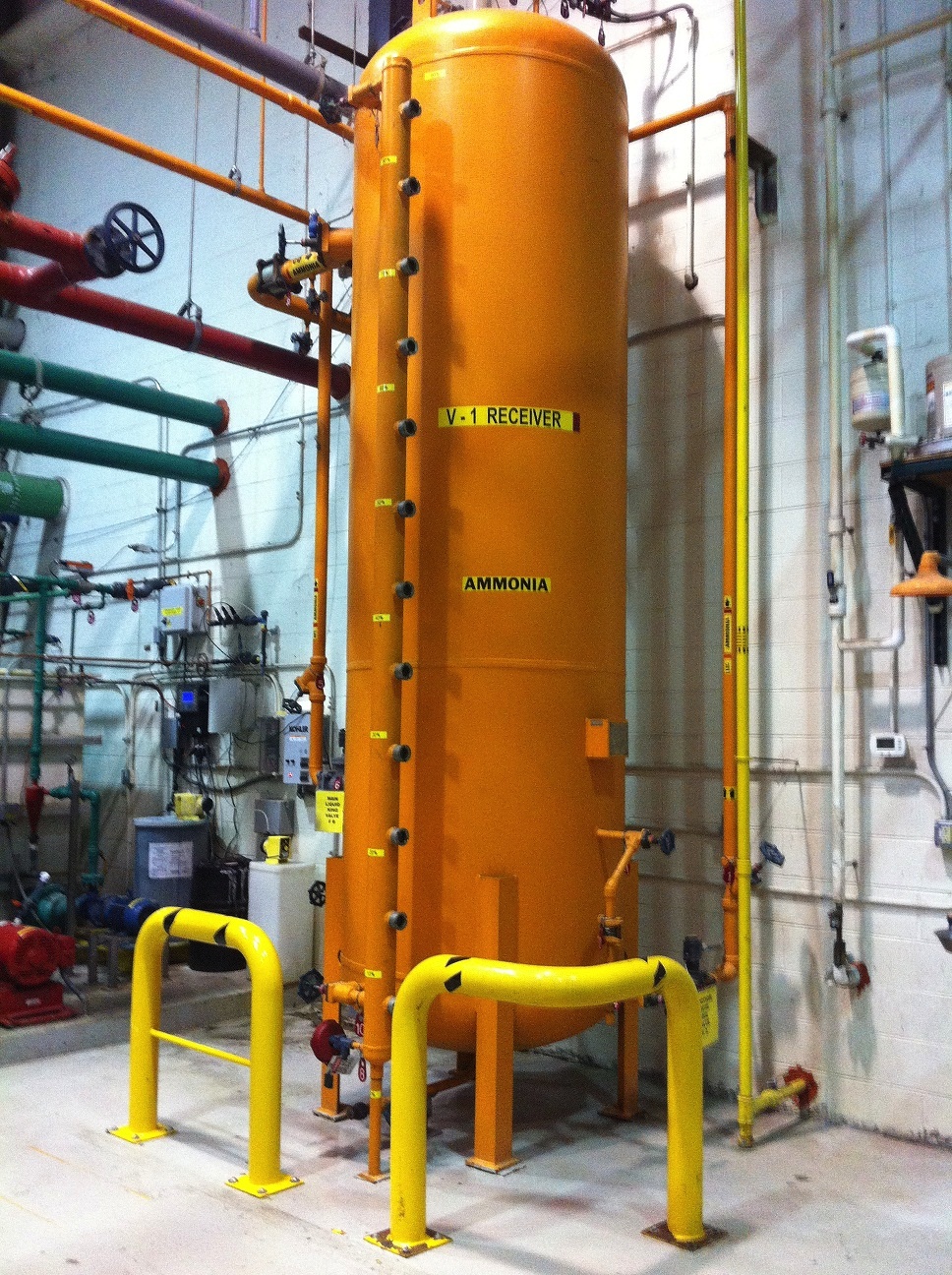
PLEASE NOTE: although the effort is obvious, this protection falls short of actually meeting the proper vehicle impact protection as the post are merely bolted to the floor rather than the floor being bored out to 15″ and 3′ deep and the posts being filled with concrete and being far enough away from the object they intend to protect that they would NOT come into contact with the vessel or sight glass if they are struck. PLEASE see my numerous posts on Bollards and their design.