
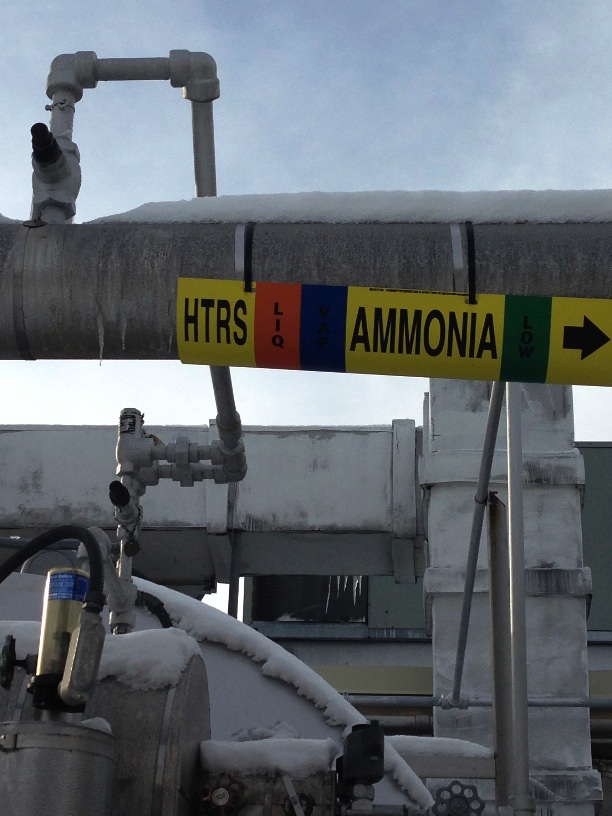
 PLEASE NOTE: this posting is about pressure vessel RVs discharing back into the process and not Hydrostatic RVs or pump RVs.
Scenario: Process is shutdown using the emergency stop (e-stop) systems because the building is on fire. On the roof of the building/plant sit a number of vessels that have a “flooded system” which contains a “surge tank” that holds the EHS/HHC for the flooded system. These surge tanks are ASME coded vessels and are protected by pressure relief valves, which discharge back into a “suction line”.
I am hopeful that most can see where I am going with this. Although technically allowed by some groups in some process specific applications, this design is one that should NEVER be considered without some very detailed discussions and understanding of its limitations and here’s why…
When we have pressure vessels that have their RVs discharging back into a “suction line”, or any closed system for that argument, it is IMPERATIVE that we study all likely scenarios and ensure that the relief system will NOT be compromised under ALL operating conditions, including emergency shutdown. The scenario I described above is one of those scenarios and too often we find relief system designs that do NOT take these process conditions into consideration. Too often we find RV’s discharging into “suction lines” that are thought to ALWAYS be under vacuum nor they would EVER isolated.
We have to consider that when the process is down for maintenance and the suction line is “isolated” per the company’s LOTO procedure what will this do to the RV system protecting the pressure vessel (and in some cases multiple pressure vessels). In this scenario we would be BLOCKING our RV discharge which is only allowed under very STRICT CONTROLS when the pressure vessel is in service (i.e. has it contents).
We also have to consider the scenario I laid out in the beginning… operator hits the e-stop button as he is running out the door because the plant has a working fire within its structure. As he/she hits this e-stop, the process is brought down to an idle state which entails pumps/compressors stopping and some valves closing. We now have a process that is isolated, the “suction line” goes POSITIVE from the remaining HHC/EHS that is now blocked in the line/system, which in turn applies back pressure to the “surge tank” RVs. The fire spreads and now is compromising these roof top pressure vessels; the same roof top vessels that have their RV discharge blocked in and quite a bit of back pressure on their RVs.
Do either of these likely RV design basis sound like they are acceptable? How confident are we that those RVs that discharge back into the process will function as we hope they will? Does our “design basis” documentation (in our PSI) explain how this set-up will function and how these concerns have been mitigated? In discussing this with many process engineers in different industries it has become clear that these maintenance and emergency shutdown scenarios are NOT being considered in the RV Design Basis. We seem to be “assuming” that the “suction line” will never be isolated for maintenance purposes so there are no administrative controls either in the LOTO program/procedure or in a car seal program that would include all the valves in the “suction line”. We also seem to design these closed RV systems with the mind set that
1) the process will never be exposed to a fire,
2) that we will never use the e-stop system, and
3) there is absolutely no way both a fire and e-stop scenario will ever occur at the same time.
Sure there are some codes/standards (e.g. RAGAGEPs) that may permit this type of RV design; however, this type of RV design needs to be done by a highly qualified individual who fully understands the process deviations that may arise that would call the RVs into action. I have only discussed two (2) such scenarios here, but I know there are others. It is OUR RESPONSIBILITY to ensure that our FINAL LAYER of protection is NEVER compromised when we least expect it!