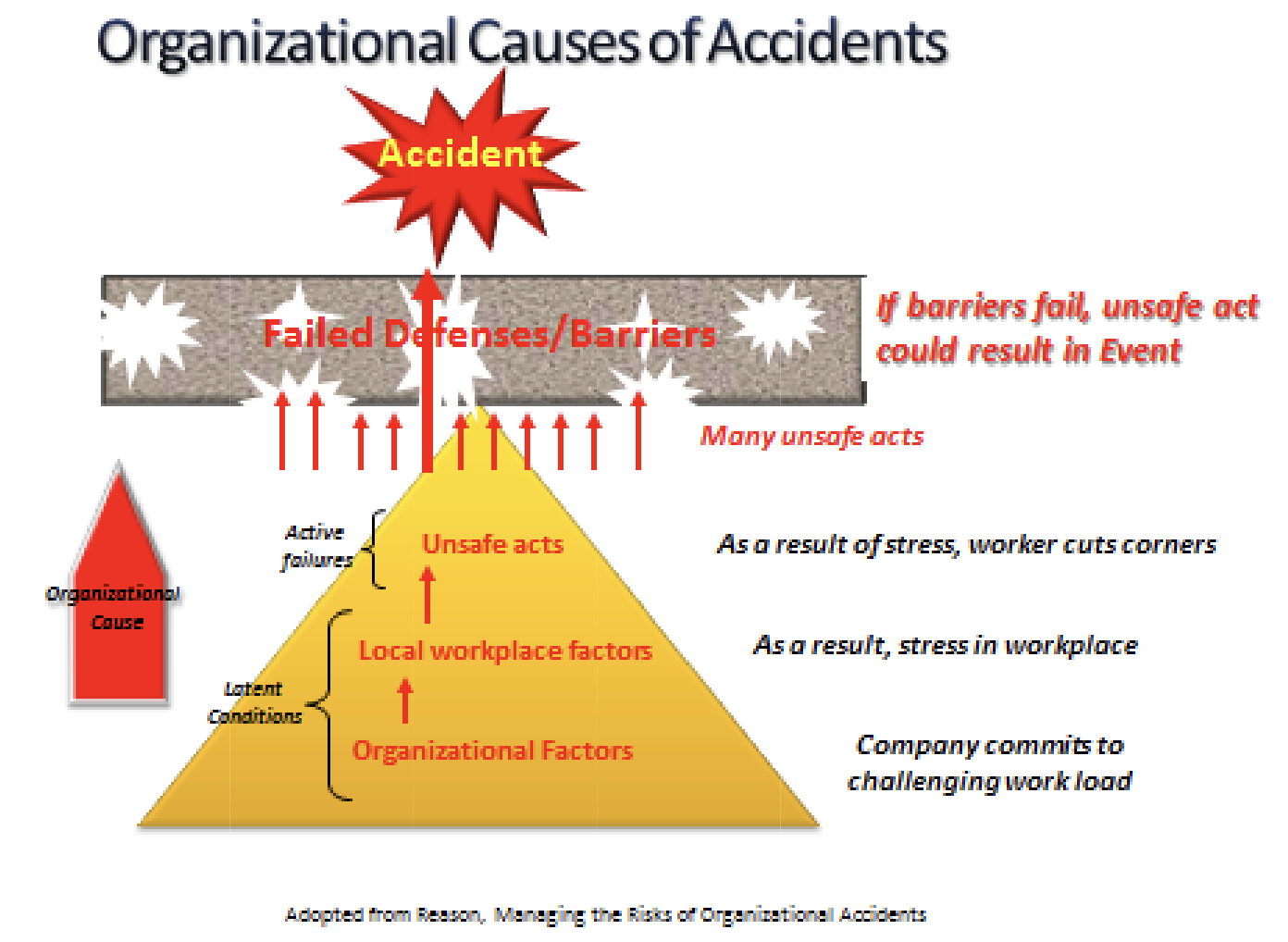
This is a simple, linear cause-and-effect model where accidents are seen as the natural culmination of a series of events or circumstances that occur in a specific and recognizable order. The model is often represented by a chain with a weak link or a series of falling dominoes. In this model, accidents are prevented by fixing or eliminating the weak link, by removing a domino, or by placing a barrier between two dominos to interrupt the series of events. The Domino Theory of Accident Causation, developed by H.W. Heinrich in 1931, is an example of a sequence-of-events model.
The sequential model is not limited to a simple series and may utilize multiple sequences or hierarchies such as event trees, fault trees, or critical path models. Sequential models are attractive because they encourage thinking in causal series, which is easier to represent graphically and easier to understand. In this model, an unexpected event initiates a sequence of consequences culminating in an unwanted outcome. The unexpected event is typically considered unsafe, with human error as the predominant cause.
The sequential model is also limited because it requires strong cause-and-effect relationships that typically do not exist outside the technical or mechanistic aspect of the accident. In other words, genuine cause-and-effect relationships can be found when analyzing equipment failures. Still, causal relationships are extremely weak when addressing the human or organizational aspect of the accident. For example: While it is easy to assert that “time pressure caused workers to take shortcuts,” it is also apparent that workers do not always take shortcuts when under time pressure.
In response to large-scale industrial accidents in the 1970’s and 1980’s, epidemiological models were developed that viewed an accident as the outcome of a combination of factors, some active and some latent, that existed together at the time of the accident. [Hollnagel, 2004]
Source: DOE HANDBOOK, Accident and Operational Safety Analysis, Volume I: Accident Analysis Techniques