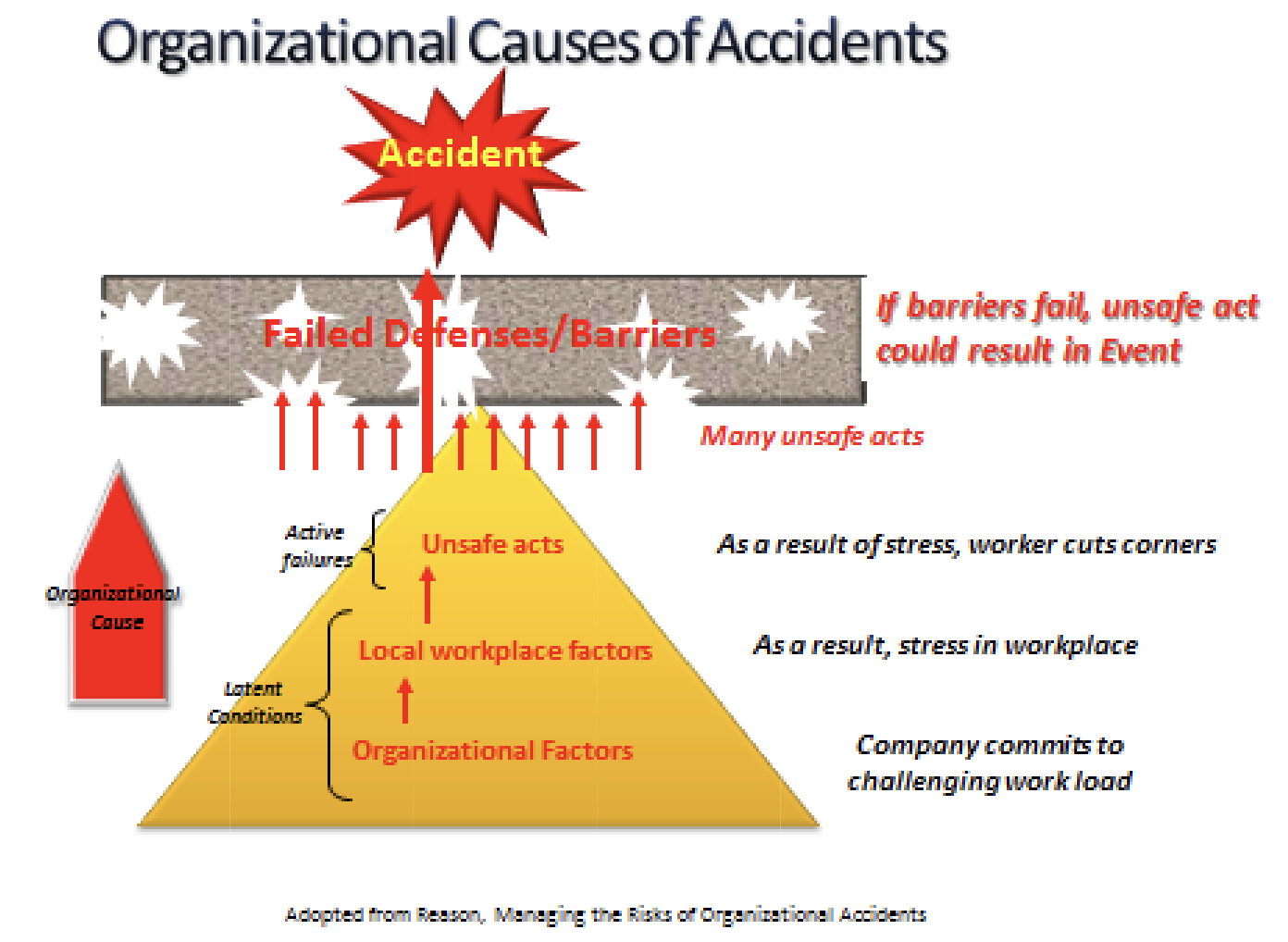
An organizational event-causal story developed by James Reason starts with the organizational factors:
- Strategic decisions,
- Generic organizational processes – forecasting, budgeting, allocating resources, planning, scheduling, communicating, managing, auditing, etc.
These processes are colored and shaped by the corporate culture, unspoken attitudes, and unwritten rules concerning how the organization carries out its business. [Reason, 1997]
These factors result in biases in the management decision process that create “latent conditions” that are always present in complex systems. The quality of both production and protection systems depend on the same underlying organizational decision processes; hence, latent conditions cannot be eliminated from the management systems since they are an inevitable product of the cultural biases in strategic decisions. [Reason, p. 36, 1997]
The figure below illustrates an example of latent conditions produced from the pressures of commitment to a heavy workload as an organizational factor at the pyramid’s base. This passes into the organization as a local workplace factor in the form of stress in the workplace. This latent condition is a precursor or contributing factor to the worker cutting corners (the active failure of the safety system).
A distinction between active failures and latent conditions rests on two differences.
- The first difference is the time taken to have an adverse impact. Active failures usually have immediate and relatively short-lived effects. Latent conditions can lie dormant, doing no particular harm, until they interact with local circumstances to defeat the systems’ defenses.
- The second difference is the location within the organization of the human instigators.
Those commit active failures at the human-system interface, the front-line activities, or the “sharp-end” personnel.
On the other hand, Latent conditions are spawned in the organization’s upper echelons and within related manufacturing, contracting, regulatory and governmental agencies that are not directly interfacing with the system failures.
The consequences of these latent conditions permeate the organization to local workplaces—control rooms, work areas, maintenance facilities, etc. —where they reveal themselves as workplace factors likely to promote unsafe acts (moving up the pyramid in Figure). These local workplace factors include undue time pressure, inadequate tools, and equipment, poor human-machine interfaces, insufficient training, under-manning, poor supervisor-worker ratios, low pay, low morale, low status, macho culture, unworkable or ambiguous procedures, and poor communications.
Within the workplace, these local workplace factors can combine with natural human performance tendencies such as limited attention, habit patterns, assumptions, complacency, or mental shortcuts. These combinations produce unintentional errors and intentional violations — collectively termed “adaptive acts”—committed by individuals and teams at the “sharp end,”” or the direct human-system interface (active error).
Large numbers of these adaptive acts will happen (small red arrows in Figure), but very few will align with the holes in the defenses (holes are created by the latent conditions deep within the organization). Defense-in-depth providing a multi-barrier defense takes multiple human performance errors to breach the multiple defenses. However, accidents can occur when defenses have become sufficiently flawed and organizational behavior consistently drifts from desired behavior. In such events, causes are multiple, and only the most superficial analysis would suggest otherwise.