One of the more widely found complaints regarding safety professionals is that “they don’t talk about safety in terms that management can understand/embrace.” Personally, as a safety professional, I find that an easy excuse not to embrace safety MANAGEMENT, but I may be a bit biased since I am a safety professional and I have never had a management group accuse me of such nonsense. But as a consultant, I have heard that phrase many times; hence why I refer to my SMS as a “Safety Process.” In 1996, I learned all about Statistical Process Control (SPC), which was the mother of Six Sigma, which I fully embraced and eventually became a Black Belt in Six Sigma. This tool was a perfect fit for making safety part of a daily function within everything at a facility. The Six Sigma model is DMAIC:
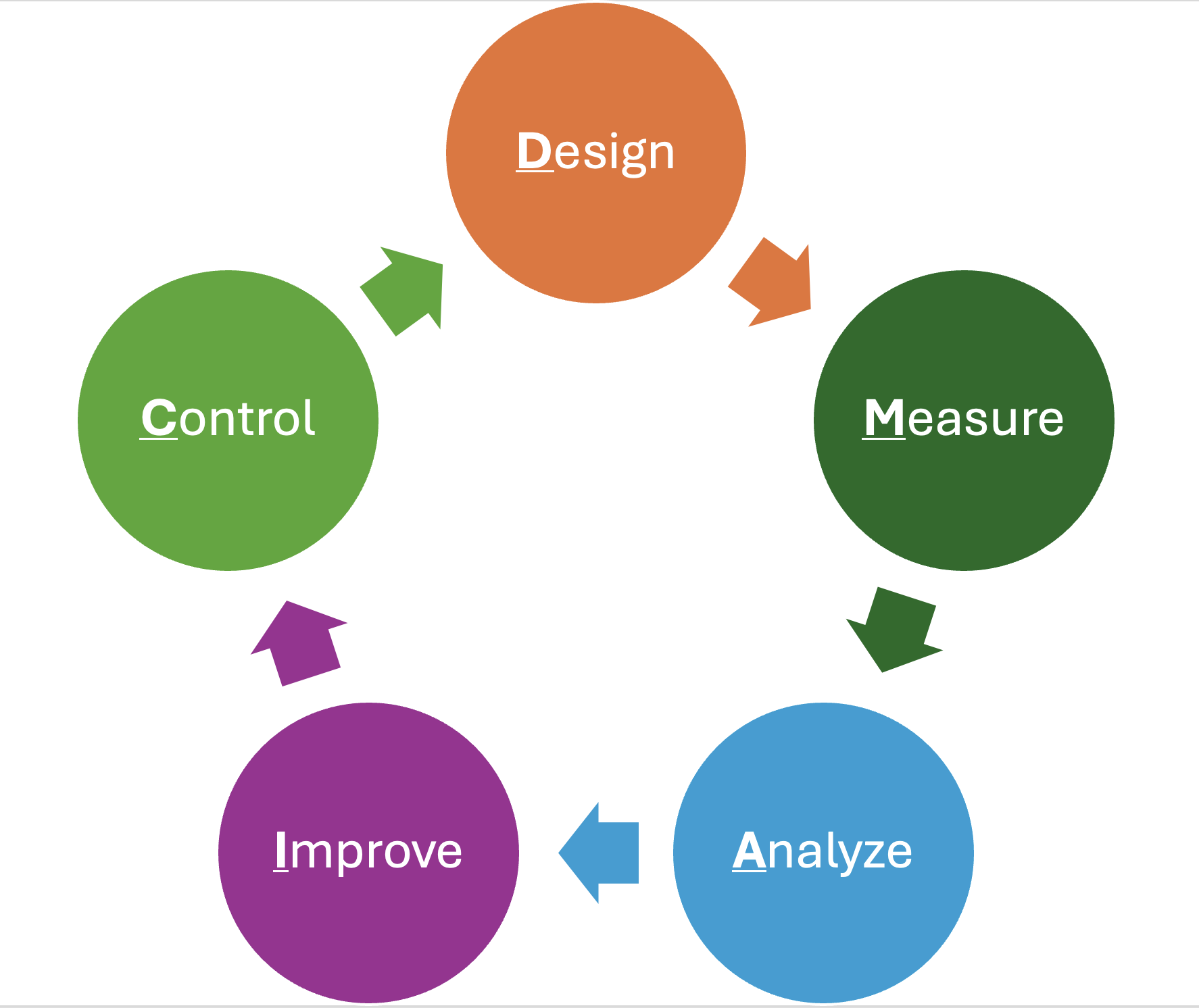
This model/approach can be a significant first step toward LEADING INDICATORS. The model is exactly what each stage says:
Design
We Design the Safety Process/SMS for the risks present at the facility. In the early days, we built one (1) Safety Process/SMS; however, as the business matures in safety management, we can revise the process/SMS to be more department/unit-specific to align more with the risks present in that department/unit. Remember that 60-75% of the safety process/SMS will remain the same across all the variations in the different departments/units.
This step MUST involve Safety SMEs, Management, and the workers doing the dirty and dangerous work. This design stage is literally establishing the elements of a functioning SMS, much like OSHA’s Process Safety Management standard did with its 14 elements. And just like PSM and EPA’s Risk Management Plan (RMP) require, we need to state WHO, WHAT, WHEN, WHERE and HOW each element will be managed.
Measure
Now that we have the safety process/SMS DEFINED, we are ready to establish a means to MEASURE its effectiveness. And this is where we venture into LEADING INDICATORS. The true means to measure the effectiveness of the safety process/SMS is via reducing risks and injuries/illnesses. But if we wait to measure only these lagging indicators, we have failed to effectively manage the process/SMS. Each element of the safety/SMS will have activities that will bring management, safety, and workers together to achieve a common goal… improved safety. We need to measure these activities AND their outcomes, as we are relying on these activities (i.e., controls) to reduce risks and incidents. I like to start off with 7-10 measurements such as:
How many Hazard ID exercises will be done Weekly?
How many Hazard Analyses will be done Weekly?
How many Risk Analyses will be done Weekly?
How many Risk Mitigation/Corrective Action Plans will be developed Weekly?
How many incidents do we want to be reported Weekly?
How many RCAs will be performed Weekly?
You can see the pattern. There are a lot of activities inside a safety process/SMS, and measuring their FREQUENCY as well as their QUALITY is taking us down the path to LEADING INDICATORS.
Analyze
This stage is where we look at all of our safety data points and trend them to see if we are meeting the objectives of the safety process/SMS. This analysis MUST include the Sr. Management as they are the ones who control the WHOs, WHENs, and WHATs. If the frequency of the activities is NOT meeting the established goals, this needs to be addressed by Sr. Management. if the numbers are on target but the QUALITY of the activities is NOT meeting expectations, this may require further analysis to understand WHY.
Improve
After we have analyzed our data from the safety process/SMS, we then EMBRACE the idea of continuous improvement. For any metric that fell short of our expectations in either frequency or quality, we need to TAKE ACTION (formally documented action(s)) to get that element/activity back on track. As we should all recognize, if this failure to meet expectations continues, the end result/lagging indicators will be disappointing.
Control
Once we have the safety process/SMS DEFINED and QUANTIFIED we now work to control it. Based on the data analysis AND the results, we put improvements in place, and these improvements need to be VERIFIED/VALIDATED as being effective. So, the control function involves a lot of auditing, inspecting, and interviewing personnel to ensure the activities are being done at their prescribed frequencies and the quality of those activities meets expectations.
SAFTENG members can read my many other articles on the DMAIC and download my presentations on the topic from the Document Library.