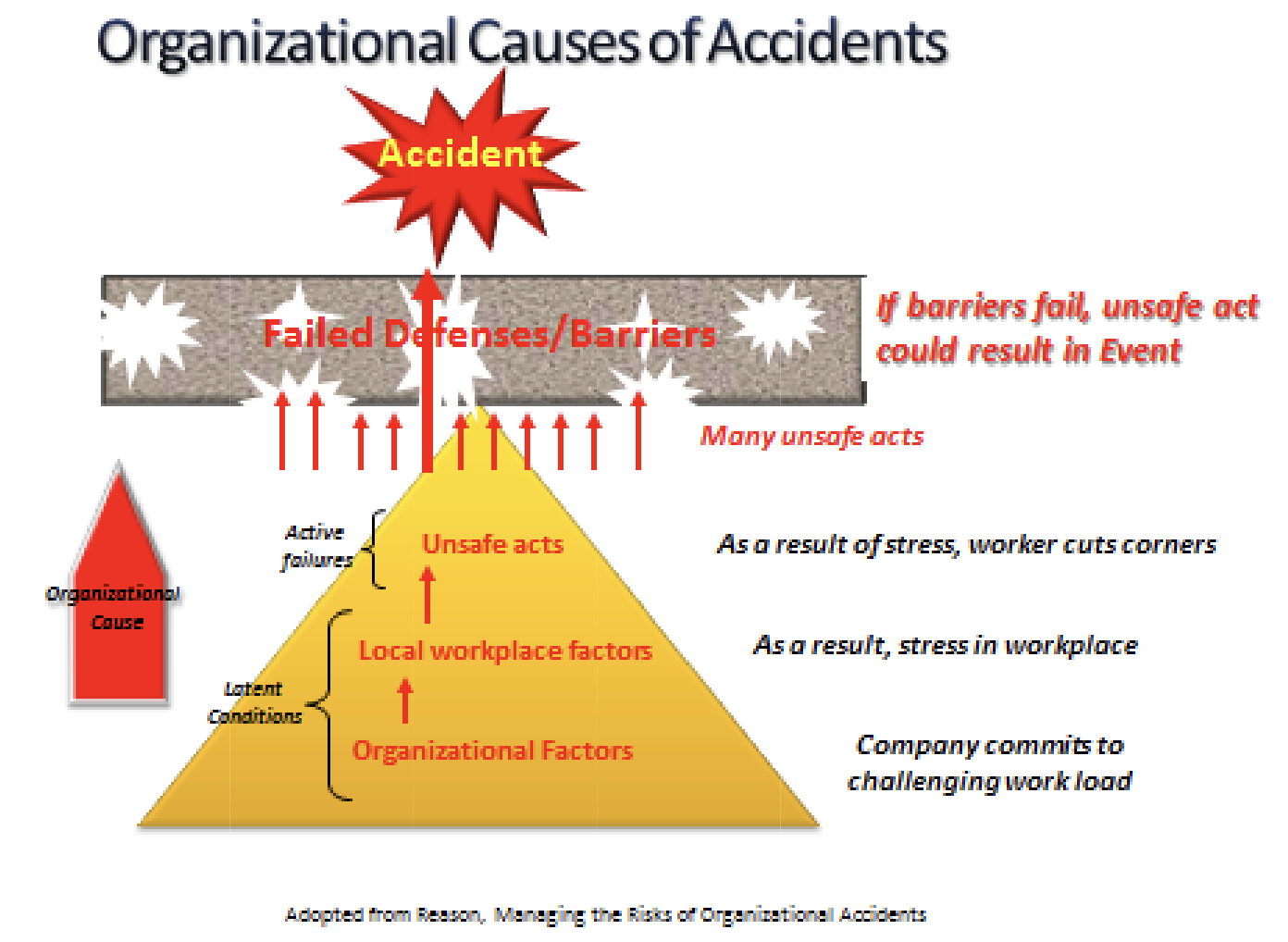
Yes, I am betting this same drum again. I believe in Reason’s SMS model, especially his Human Failure model of Errors, Mistakes, and Violations. This recent incident is a perfect example of management’s lack of understanding of SMS fundamentals and how LATENT ORGANIZATIONAL FAILURES result in horrible outcomes. Essentially, this is what happened:
An LOPC event occurred, resulting in a Reportable Release, which requires a written follow-up to EPA on the cause(s) and what will be done to address the event. This LOPC event occurred because an operator made a “mistake” due to the IMPROPER LABELING of a valve. But this was a critical mistake that sent the process into immediate upset conditions and the lifting of a PRD. The Emergency Shutdown procedure instructed the operators to close a Manual Shutoff Valve, which had they been able to do would have certainly reduced the release amount well below the RQ of the chemical involved. However, this Manual Shutoff Valve was about 20′ in the air, and access to this valve was not “readily available.”
Since this release would be “public knowledge” because it exceeded the chemical Reportable Quantity (RQ), the legal team felt the business needed to take swift and firm action against those involved in the event. This way, they could show they were serious about process safety to the “regulators” by taking these disciplinary actions. However, during our PSM/RMP audit about a year later, we came across this incident and all the compliance failures that went with it, and we were shocked to learn that two operators were suspended for 3 and 5 days without pay for “failure to follow procedures.”
Here is the back story of the LATENT ORGANIZATIONAL FAILURES…
#1 The location of this Emergency Manual Shutoff Valve was identified in three (3) previous PHAs as being a “concern.” This translates into 15 years of knowledge that this Emergency Manual Shutoff Valve was not accessible, as required by the facility’s adopted RAGAGEP. The solution to this PHA recommendation was that the workers would utilize the site’s “aerial boom lift” to access the Emergency Valve. A few problems with this “corrective action”:
- None of the workers on shift at the time of the event had ever been trained in the operation of the lift.
- The lift was out-of-service at the time of the event and had been for 2+ years as management had decided they would rent lifts when necessary.
- The HHC/EHS gas involved in this event is one that is Extremely Flammable, prohibiting a lift from SAFELY operating in the release area.
#2 The Emergency Shutdown SOP annual reviews for the past ten (10) years (as far as they had records) mentioned this Emergency Manual Shutoff Valve is not accessible. A total of 13 operators and supervisors (e.g., management) over ten (10) years had made note of this in their walk-down of the SOP. Management fell back on the “aerial lift” plan from the PHA corrective action, even though the aerial lift was no longer an option for the last two years of SOP reviews. But don’t worry; the SOP was never “certified” for those last two years.
#3 The facility was behind by two (2) training cycles on their SOPs. The event occurred in 2022; however, the two (2) suspended operators had not been trained on any SOPs for nearly seven (7) years.
NOTE: don’t forget the valve that was labeled wrong, which was the initiating failure in this event!!
So, as you can see, it was a bit hypocritical to discipline the two (2) workers for “not following procedures.” The items listed above are classic examples of LATENT ORGANIZATIONAL FAILURES and how they influence and impact ACTIVE FAILURES made by workers.
This was indeed a sore topic at the daily close-out with management. They were more concerned about how this was an “audit item” than actually LEARNING from their mistakes. When we explained the event uncovered at least nine (9) deficiencies over 15 years within their management of process safety, they were shocked at how this could be. Luckily, the Plant Manager was so mad he asked us to prove it – we only got halfway through the failures/findings, and he and his team had heard enough. But they walked away, understanding the difference between ACTIVE FAILURES and LATENT ORGANZIATIONAL FAILURES.
But my proudest moment was when the plant manager informed everyone on our 2-week audit follow-up call that the two operators had their records wiped clean and received back pay for the days they were suspended. And the facility was fully embracing our findings, especially around that event and their misguided actions. A MOC had been initiated, and funding requests to move the emergency shut-off valve or to make the valve remotely activated were in the works.
And remember, AUDITING is a TEACHING opportunity. Don’t just write a finding; understand WHAT and WHY that failure occurred. We never write corrective actions for clients, but we are ALWAYS trying to influence their direction in addressing the AUDIT (and PHA) findings.