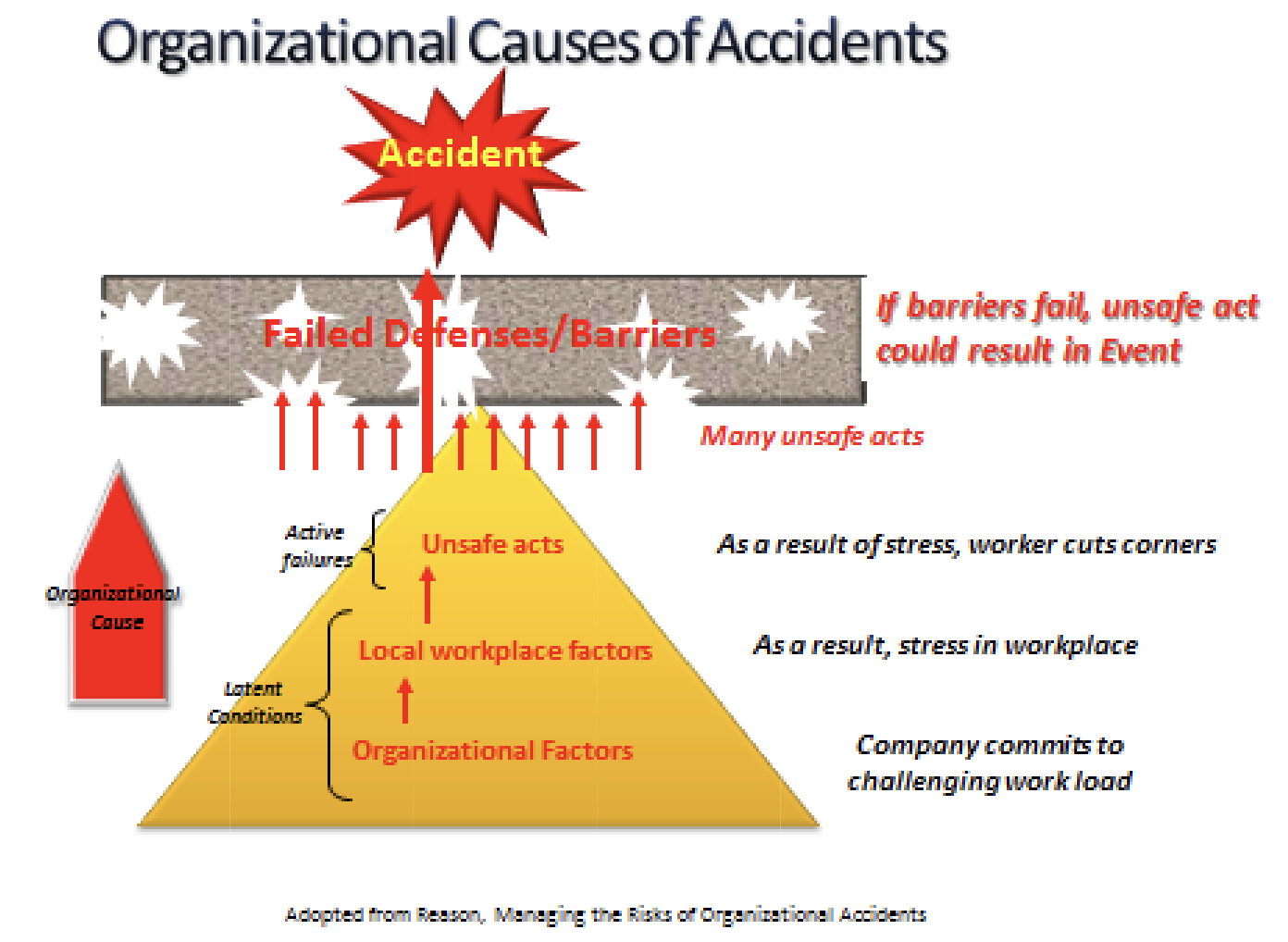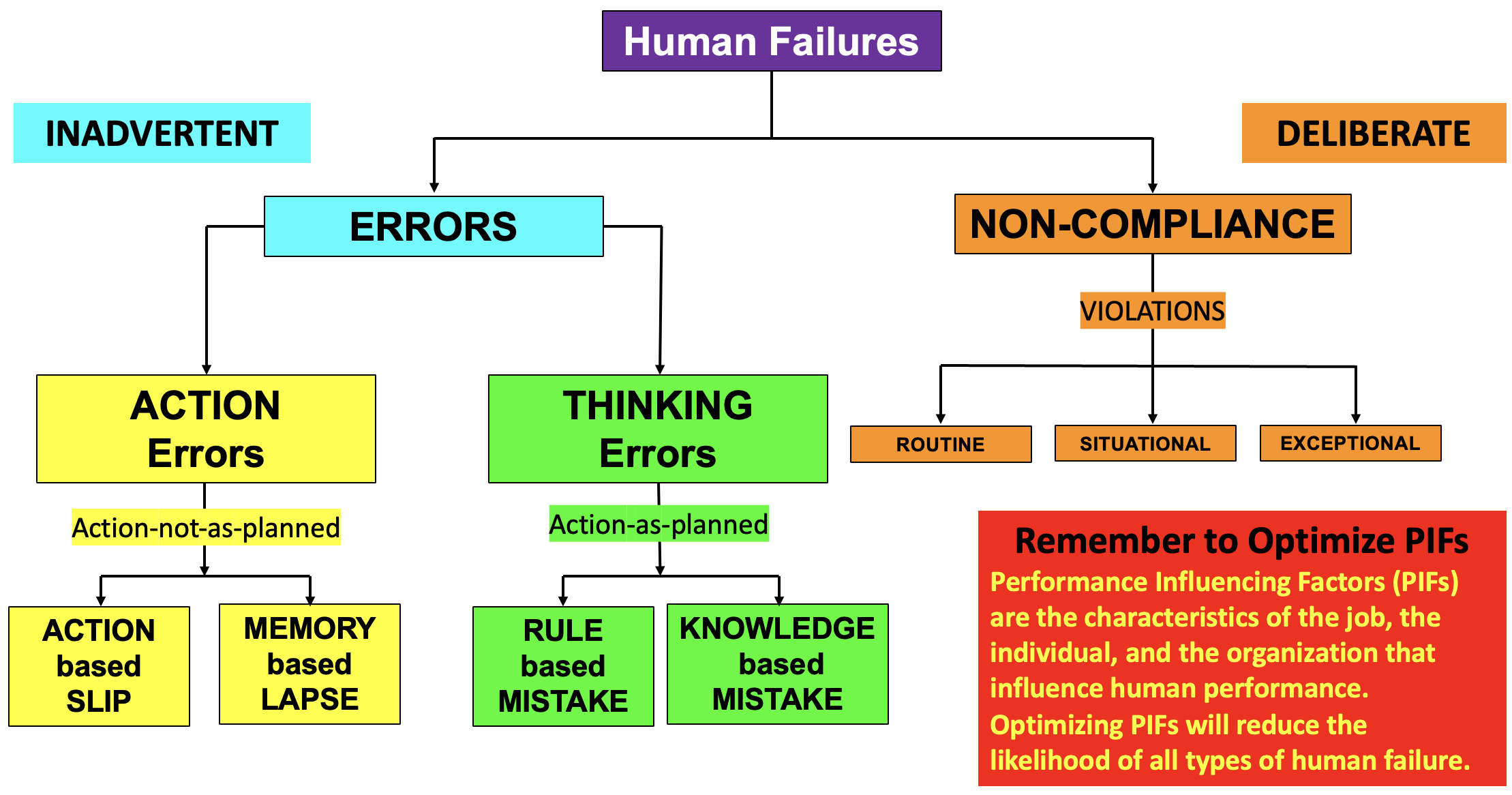
Effective SMS implementation heavily depends upon a clear, mutual understanding of ERRORS and VIOLATIONS and the differentiation between the two. The difference between ERRORS and VIOLATIONS lies in INTENT. While an error is unintentional, a violation is a deliberate act or omission to deviate from established procedures, protocols, norms, or practices.
Errors or violations may result in non-compliance with regulations or approved operating procedures. Punitive measures taken in response to acts of non-compliance may reduce the reporting of errors in the absence of other processes. Accordingly, management MUST consider whether acts of non-compliance are the result of a violation or inadvertent error when determining whether punitive action is appropriate, with the criteria normally being whether non-compliance is the result of wilful misconduct or gross negligence.
Errors
An error is “an action or inaction by an operational person that leads to deviations from organizational or the operational person’s intentions or expectations.”
In the context of an SMS, management MUST understand and expect that humans will commit errors regardless of the level of technology used, the level of training, or the existence of regulations, processes, and procedures. An important goal, then, is to set and maintain safeguards to:
- REDUCE THE LIKELIHOOD OF errors and, just as importantly,
- REDUCE THE SEVERITY OF CONSEQUENCES OF errors when they do occur
To effectively accomplish this task, errors must be
- identified,
- reported, and
- analyzed
so that appropriate corrective action can be taken.
Errors can be divided into the two (2) following categories:
- Slips and Lapses are failures in the EXECUTION OF THE INTENDED action.
- Slips are actions that do not go as planned, while lapses are memory failures. For example, operating the wrong valve is a Slip. Forgetting a checklist item is a Lapse.
- Mistakes are failures in the PLAN of action.
- Even if the execution of the plan were correct, it would not have been possible to achieve the intended outcome.
Safety strategies must be put into place to CONTROL or ELIMINATE errors. The approach to control errors leverages the basic defenses within the SMS. These include the following:
- REDUCTION strategies provide direct intervention to reduce or eliminate the factors contributing to the error. Examples of reduction strategies include improving ergonomic factors and reducing environmental distractions.
- CAPTURING strategies assume the error will be made. The intent is to “capture” the error before any adverse consequences are felt. Capturing strategies differ from reduction strategies in that they utilize checklists and other procedural interventions rather than directly eliminating the error.
- TOLERANCE strategies refer to a system’s ability to accept that an error will be made but without experiencing serious consequences. Incorporating redundant systems or multiple inspection processes are measures that increase system tolerance to errors.
Since the performance of personnel is generally influenced by organizational, regulatory, and environmental factors, safety/risk management must include consideration of organizational policies, processes, and procedures related to communication, scheduling of personnel, allocation of resources, and budgeting constraints that may contribute to the incidence of errors.
Violations
A violation is “a deliberate act of wilful misconduct or omission resulting in a deviation from established regulations, procedures, norms or practices.” Nonetheless, non-compliance is NOT necessarily the result of a violation because deviations from regulatory requirements or operating procedures may result from an error. To complicate the issue further, while violations are intentional acts, they are NOT always acts of malicious intent. Individuals may knowingly deviate from norms, believing the violation facilitates mission achievement without creating adverse consequences. Violations of this nature are errors in judgment and may not automatically result in disciplinary measures depending on the policies in place. Violations of this type can be categorized as follows:
- Situational violations are committed in response to factors experienced in a specific context, such as time pressure or high workload.
- Routine violations become the standard way of doing business within a work group.
Such violations are committed in response to situations where compliance with established procedures makes task completion difficult. This may be due to
- practicality/workability issues,
- deficiencies in human-technology interface design, and
- other issues that cause persons to adopt “workaround” procedures, which eventually become routine.
These deviations, referred to as “drift,” may continue without consequence, but over time, they may become frequent and result in potentially severe consequences.
In some cases, routine violations are well-grounded. They may result in the incorporation of routine violations as an accepted procedure after a proper safety assessment has been conducted and it is shown that safety has not been compromised.
ORGANIZATIONALLY INDUCED VIOLATIONS may be considered an extension of routine violations. This violation occurs when an organization attempts to meet increased output demands by ignoring or stretching its safety defenses.
Sources:
Organizational Accidents Revisited, James Reason, 2016
MANAGING THE RISKS OF ORGANIZATIONAL ACCIDENTS, James Reason, 1997