
Like many safety professionals, I learned there is a HUGE difference in flammable liquids the HARD WAY. Having a strong background in fire/HAZMAT, even as an IFSTA instructor 20 years ago, I thought flammable liquids were all about flash points and LEL. To an emergency responder, that may work, but as a safety engineer responsible for a PSM/RMP-covered process containing non-conductive flammable liquids, there is much more.
Flammable liquids (liquids with a flashpoint of less than 100F) can be divided into conductive and non-conductive. It almost sounds like electrical talk…well, it is electrical talk. When we say a flammable liquid is “non-conductive,” we are saying that it is NOT a good conductor of electrical charges, namely the static electricity (#1 enemy of flammable liquids processing!) it generates as it moves. You know all the bonding and grounding we do to pump flammable liquids safely; well, all of those measures are NOT ENOUGH for non-conductive flammable liquids. Why is this?
Simply put, the liquid cannot transfer the static charge it generates as it travels through the pipe/hose/air, etc., to the grounded tank/pipe/hose. Since the liquid cannot transfer its charge to the ground, it builds up a charge as it travels, and these charges can be HUGE in the realm of static electricity. Keep in mind that the little shock you get from the doorknob in the wintertime is about 15.0 milli joules (mJ), and most flammable liquid vapors have a Minimum Ignition Energy (MIE) in the range of 0.15-1.15 mJ. So you can see, static has PLENTY of energy to be your ignition source.
NOTE: Be sure to see my previous postings in the “Basics” section to learn more about MIEs and Vapor Cloud ignition.
The other category is Conductive Flammable Liquids, which have properties that make them better conductors; therefore, they can deliver their static charge to the pipe wall or tank wall and then onto the “ground.” Water is a good conductor; hence, we say water and electricity are not a good mix – if we are standing in water and the water is charged with electricity, the water will transfer the charge to us. On the other hand, Toluene is a poor conductor, which is why it is considered one of the worst flammable liquids for processing safety. Here is a scale you can use to determine where your flammable liquid may fall on the conductivity scale:
- Conductive >100 Picosiemens/meter (pS/m)*
- Semi-Conductive 50 –100 pS/m
- Non-Conductive <50 pS/m
*Keep in mind that some literature calls for a flammable liquid to be considered truly conductive, it needs to be at 10,000 pS/M
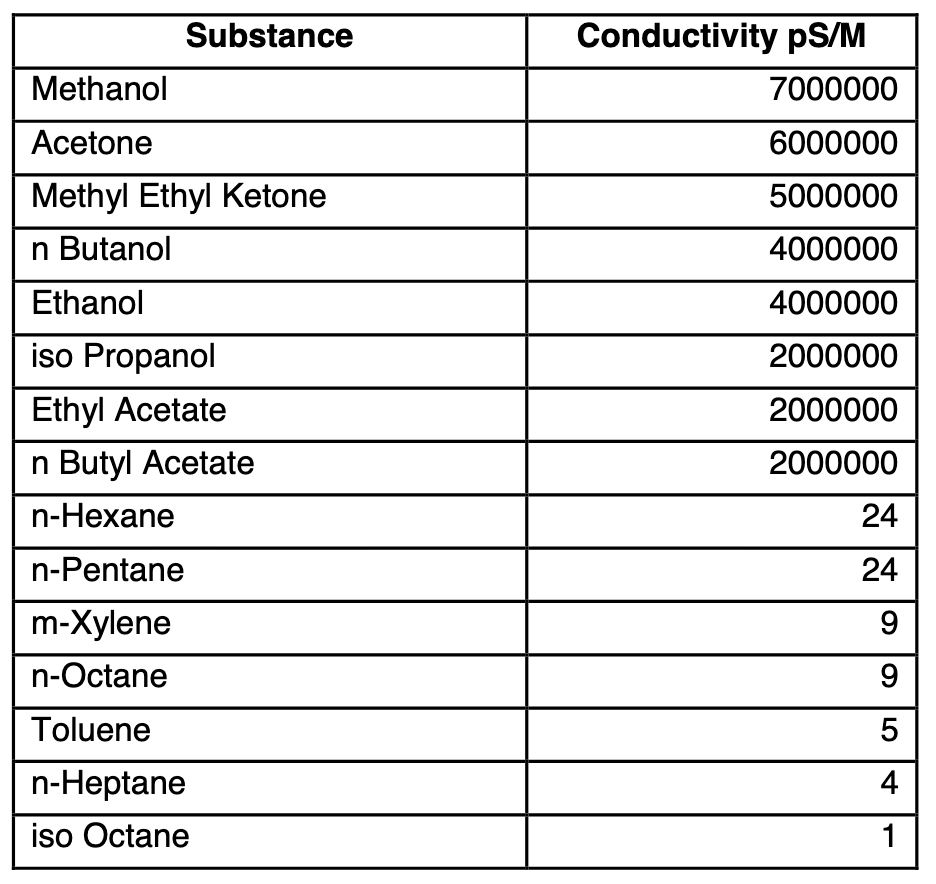
Here is a nice table from the Solvents Industry Association (SIA) over in the UK showing us the wide variation in conductivity of some common flammable liquids:
Who can tell me the #1 safeguard we can engineer/design into our process for non-conductive flammable liquids?
Most people would say bonding and grounding, and they would be WRONG. I am in NO WAY telling you that bonding and grounding are not needed, as it is the FUNDAMENTAL SAFEGUARD for the transfer of flammable liquids; HOWEVER, if your flammable liquid is a non-conductive flammable liquid, bonding and grounding fall WELL SHORT of meeting our needs as a safeguard. I even feel it lulls folks into believing they are as safe as possible.
SPEED! Speed, or a better term may be velocity, is the #1 safeguard we can use. Specifically, I mean the velocity at which our non-conductive material travels through the pipe/hose/vessel, etc. NFPA 77 (the recognized RAGAGEP for controlling static) requires non-conductive materials to have a travel speed of no more than 5 m/s, and in many cases (such as filling an empty tank) it should be reduced to 1 m/s until the fill pipe is submerged either two (2) pipe diameters or 0.6 m, whichever is less.
With speed in mind, ask ourselves what can increase speed inside a pipe/hose without changing the pump parameters. How about a partially closed in-line ball valve? As the material flows by this restriction, will it not speed up? Most certainly, it will, and if we have several ball valves we are using to “throttle back the process,” then we could be setting ourselves up for a big surprise. Remember, any charge that is generated by this non-conductive flammable liquid is contained within the liquid, and it WANTS TO GO TO GROUND or “equalize” with its surroundings. So it is looking for somewhere to shed this charge. If this place ends up with enough oxygen and water vapor (e.g., inside our vessel), we are in BIG TROUBLE!
How many of you have “filters” in your process to filter out impurities from your flammable liquid(s)? If a partially closed valve can generate unsafe levels of static, what do we think a filter with millions of pores will do to the material as it flows by “millions of restrictions”? Some filters can increase the static level by 100X the normal charge it would generate when traveling through the line/hose. Filter PLACEMENT is EXTREMELY IMPORTANT because once the material flows through it, we have to allow the “charge to relax” back to its normal level before it enters a vessel. All flammable liquids have a “relaxation time”, meaning this is the amount of time it takes for the liquid to lose the charge it generates. Some are fast, and some can take 10-20 minutes.
Sadly, all of this information is NOT on most SDS sheets. The CSB conducted a study of [M]SDS sheets after the Barton Solvent plant explosion and found only one or two out of 90 or so they reviewed. They also mentioned some basic hazards of the materials, and, indeed, none of the information I am sharing with you is. I STRONGLY encourage everyone with a flammable liquid at their facility, whether in drums, totes, or large storage tanks, to take 10 minutes to watch their video; they do an EXCELLENT job explaining static, non-conductive liquids, etc.
CSB video: http://www.csb.gov/investigations/detail.aspx?SID=58&Type=2&pg=1&F_All=y
If you would like more on flammable liquids, I encourage you to read my previous post in the Flammable Liquids “Basics”:
Flammable Liquids 101 – Part B
Flammable Liquids – 102, Surface area and MIE’s
Sources of Static Generation in Flammable Liquid Processes
In the next post, I will probably scare the !@#$ out of you, as most safety professionals and design engineers think Nitrogen is the answer to all of our flammable liquid hazards. I will actually show you how the nitrogen we use in inert tanks can be the generator of the static we work so hard to get rid of. If you watch the CSB video posted above, you will begin to see some ideas as to how I will open your eyes.