First, let me say this upfront if your facility has not evaluated your local fire department’s rescue capabilities in the past 2-3 years, I STRONGLY ENCOURAGE it to do so ASAP. With the drastic swing in the economy and many cities on the brink of bankruptcy, I know of at least 50 FDs that have scrapped their special rescue teams and are relying on County or Regional wide teams to cover special rescues like Confined Space, High Angle, Trench, Swift Water, etc. We have seen it numerous times where the facility will have documentation in the form of a letter that all is good, only to have us show up for an audit and find out that because of budget cuts the training program for CS rescue was canceled. This problem is MUCH BIGGER than an audit finding; it may become a matter of life or death. If you have an arrangement with your local FD to provide CS Rescue, please get in touch with them to ensure they are still capable of providing this service. From a compliance point of view, if they have stopped their annual hands-on training, cut their overtime, or officially disbanded the rescue team, it is your facility that will receive the OSHA citation, not the FD.
Now with that said, let’s assume your local FD has agreed to provide this service to your facility. In my last post, I wrote about the “evaluation” we have to do on our CS rescue services. Even if your facility has an in-house rescue team, this information will apply to your in-house rescue team. We still have to evaluate them! Let me touch on the evaluation process for a second. This process should take about 1-2 hours in a face-to-face meeting with the highest official in the FD/Rescue Service, who is directly involved with the rescue team. This will often be a Captain or higher, depending on the department’s size. OSHA has provided a VERY GOOD evaluation tool in 1910.146 Appendix F, and I recommend facilities use this tool, as I know that OSHA will use it to make their determination if your rescue service is staffed, equipped, and trained to provide rescue in your spaces. The appendix is a “non-mandatory appendix,” which means OSHA cannot cite you for not using it, but if you use some inferior evaluation process. OSHA discovers serious deficiencies in the rescue services you have selected that you failed to find in your inferior evaluation, nothing is stopping them from citing you under 1910.146(k).
Please do not make the mistake of calling the FD and asking if they have been trained in “Confined Spaces.” I want to think that every single FD in this country, including volunteer departments, has received some level of CS training. All too often, the training they received is a 1-2 hour course that trains them to STAY OUT of these spaces. A common term you will hear used in the fire service is “we are trained to be an operations-level rescue team”. What they mean by this, and this is EXTREMELY IMPORTANT that you understand this, is that they will NOT enter your spaces to rescue your entrant(s). They can ONLY assist outside the space and provide medical aid once the entrant(s) is outside. So when you call and ask, or better yet you go to the firehouse/station to conduct your evaluation, it is CRITICAL that you understand their FULL and/or LIMITED capabilities. You do not want to call them when you need them to only find out they came, but they cannot enter to get your entrant.
Now to get to my point of this post…you have evaluated your FD, and they passed and have agreed to provide confined space rescue services to your facility. You have even worked out a date for a mock rescue from one of your spaces in the coming months (which, by the way, is a REQUIREMENT of 1910.146(k)(1)(v)). The drill goes off without a hitch, and everyone is all smiles. Are we done? Do we still have some work to do? You better believe it!
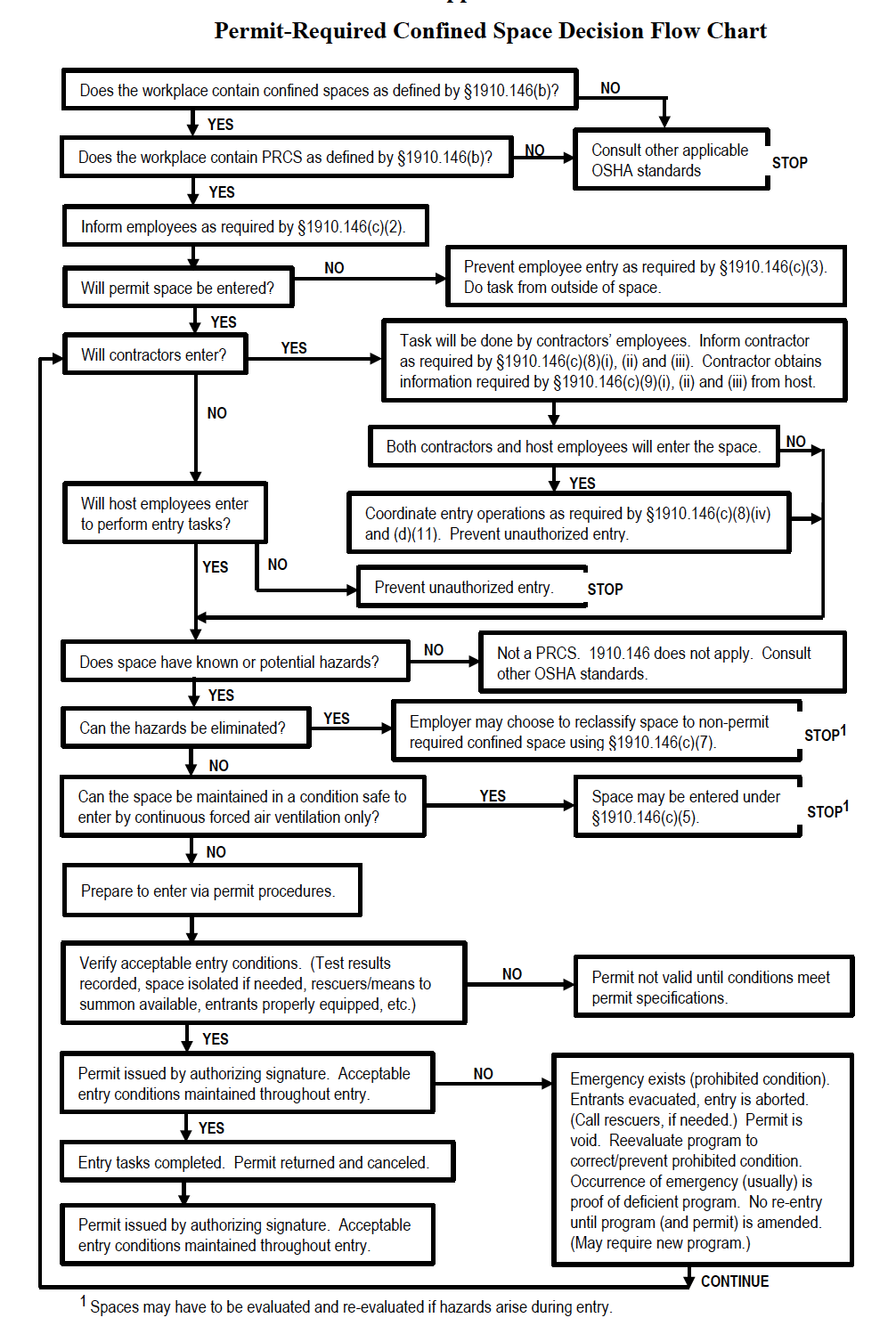
1910.146(f)(11) requires the entry supervisor to ensure that rescue services are available and that the means to summon those services are operational BEFORE he/she authorizes entry. This means that if the entry calls for entry-style rescue (see my early post as to when this would be required), the entry supervisor will have the means to contact the FD to ensure their rescue team is available BEFORE signing the permit and authorizing entry. I can assure you 911 dispatchers get ticked off with repeatedly non-emergency calls from the same facility! This means we have to have some type of communication where we can contact the FD Rescue leader without going through 911. In some cases, this can be much harder than it sounds, as you need to be making these notifications through some official channels and not someone’s personal cell phone. Not saying it cannot be done through personal cell phones, but there could be issues with this, both in efficiency and legal. So your entry supervisors will have to make this notification and verification on each entry. Keep in mind at times, in large facilities, there may be multiple entries taking place at the same time under different entry supervisors. That would be multiple people calling the FD.
Of course, I suggest that your facility set up some type of “Permit Program Approval System” where the entry supervisors are calling in their entry to a guardhouse, and the guards document on some type of log the entry and where it is taking place. Then let the guards make the notification to the FD. This will somewhat reduce the number of calls but could still cause issues with the FD. What I just suggested ALSO MEANS that there is some PLANNING taking place on organizing/coordination of the entries! Keep in mind you are not the only one in the community with Permit Required Confined Spaces, so if your neighboring businesses are complying with 1910.146(d) and (k) and they too are relying on the local FD for rescue, imagine how often the phone may be ringing at the fire station!!!!
So let’s say we have worked through the issue with the entry supervisor verifying that rescue services are available; the next item for us to tackle is how we are going to know when the FD becomes UNAVAILABLE! This is a real issue. If we rely on the local FD for rescue services and they get an emergency call to the other side of town – they are UNAVAILABLE! What does this mean to our entry permit…it means the permit is NO LONGER VALID, and the entry MUST STOP UNTIL the FD becomes AVAILABLE once again. This could be minutes or hours (maybe even an entire day or two). The bottom line, is when we rely on our local FD as our rescue service, we are at their mercy, and when duty calls, they have to respond, which means our situation takes a back seat to their emergency call! The bigger question is…what do we have in our “permit system” that will ensure we know when they become UNAVAILABLE? Do we really think they will stop and think to call us to let us know they have an emergency and are no longer available for our rescue services?
Here is what OSHA stated about this back in 2008…
Compliance may require the employer to be in close communication with the off-site rescue service immediately prior to each permit space entry. In the scenario you describe, the employer must ensure close communication with the rescue service during entry operations so that if the rescue service becomes unavailable while an entry is underway, the employer can instruct the attendant to abort the entry immediately. Entry operations cannot resume until the entry supervisor verifies that rescue services are able to respond in a timely manner. CLICK HERE for the full LOI
IMPORTANT UPDATE: With OSHA’s newer Construction Confined Space standard, OSHA saw fit to make this “communication” a requirement in the standard:
1926.1211(a)(3)(iii) Agrees to notify the employer immediately in the event that the rescue service becomes unavailable;
How about this little bit of data…I can guarantee your local FD does not have a CS rescue team sitting at the fire station waiting for someone to call. The FD’s rescue team comprises FFs and EMS personnel from different stations around your community. Ask your FD how many runs they made last year. Ask for a breakdown of fire and EMS runs, then ask how many of the CS Rescue team or part of the EMS group. Once you get this staggering number of EMS runs, think about how many times your entries will be interrupted by all these runs. We have to understand how our local FD is staffed; your rescue team is NOT staffed at the closest fire station, which means any fire run from any station will most likely void your entry permit since the rescue team is pulled from multiple stations.
Are you starting to see a flaw with claiming our FD is our rescue team?!?!?!
Lastly, let’s look at the timing for a rescue to take place. In some cases, the entry may be into an IDLH atmosphere or a space that could develop an IDLH atm quickly. The space configuration rules out non-entry rescue, so we must provide entry-style rescue services. OSHA has defined this type of entry as needing the rescue team to stand by at the space. Is your FD willing to do this for your entry? Will your taxes cover this cost, or will the FD ask for payment to have 3-5 of their trained FF/EMTs on stand-by for free as a community service? Something you need to work out in advance, and trust me…you will need to budget for this. FDs have cut all overtime, and for them to send out 3-5 FFs/EMTs for your stand-by, they will send you a bill!
Things are much different in this economy, but we still have to rescue workers entering permit-required confined spaces. Doing anything but this spells disaster for a worker and their family. Permit-Required Confined Space Rescue is an EXTREMELY DANGEROUS task, and the training is long, hard, and exhausting; but it is a MUST for those who will be entering these spaces with lethal atmospheres. We cannot take shortcuts with our rescue efforts. Take the time to visit your local FD and discuss your needs and their capabilities at length with them. As a former FF/EMT, I can tell you we love the visits, and we LOVE TO TALK RESCUE. Good luck, and if you have questions or concerns, feel free to contact me.
Next week I will provide some critical lessons learned from my 20+ years as a Special Rescue Technician. Some of these lessons learned occurred during actual emergencies, but luckily most occurred when we did our annual mock rescues.