
Most workers have been taught what a Class A fire is, but have they been taught what 1-A, 2-A, 3-A, 4-A, 6-A, and 8-A… mean? Here are some basic facts regarding fire extinguisher ratings. Class A and B extinguishers will only have numerical ratings; Class C and D do not. The rating is an indication of how much fire they will SAFELY extinguish. For example, 2-A:20-BC will look something like this…
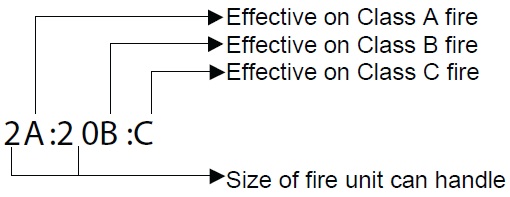
The letters (A, B, and C) represent the type(s) of fire for which the extinguisher has been approved. The number in front of the A rating indicates how much water the extinguisher equals and represents 1.25 gallons of water for every unit of one. For example, a 2-A rated extinguisher would be equal to 2.25 (2 x 1.25) gallons of water. The number in front of the B rating represents the area in square feet of a class B fire that a non-expert user should be able to extinguish. Using the above example, a non-expert user should be able to put out a flammable liquid fire that is as large as 20 square feet.
The bigger the numbers in the unit label, the bigger the fire the unit can handle. For example, a unit labeled 2A can handle a fire twice as big as a 1A unit. A 4A unit can handle a fire twice as big as a 2A unit. A 2A:20B:C extinguisher will protect up to 3,000 square feet of area where a moderate fire may occur. This could be a storage, display, or shop area. It is also a good unit to carry on a tractor or a pickup truck.
To achieve a Class “A” rating, the extinguisher must be capable of putting out the wood crib, wood panel and excelsior (shredded paper) tests. Ratings are based on the size of the material that can be repeatedly extinguished.
|
Rating |
Wood Crib |
Wood Panel |
Excelsior |
|
1-A |
20 x 20 x 20 |
8 x 8 |
6 |
|
2-A |
25 x 26 x 26 |
10 x 10 |
12 |
|
3-A |
30 x 30 x 30 |
12 x 12 |
18 |
|
4-A |
33 x 30 x 30 |
14 x 14 |
24 |
|
6-A |
38x 38 x 38 |
17 x 17 |
36 |
|
10-A |
48 x 48 x 48 |
17 x 17 |
36 |
To achieve a class “B” rating, the extinguisher must repeatedly put out a flaming liquid fire. Ratings are based on the size of the fire.
|
Rating |
Pan Size |
Gallons of |
|
1-B |
2.25 |
3.25 |
|
2-B |
5.0 |
6.25 |
|
5-B |
12.5 |
15.5 |
|
10-B |
25.0 |
31.0 |
|
20-B |
50.0 |
65.0 |
|
30-B |
75.0 |
95.0 |
|
40-B |
100.0 |
125.0 |
To achieve the Class “C” rating the extinguisher and contents must pass certain electrical conductivity measurements in accordance with UL711 and UL299.
From NFPA…
A fire extinguisher is rated and classified 4-A:20-B:C, which imparts the following information:
- It should extinguish approximately twice as much Class A fire as a 2-A [2 1/2 gal (9.46 L) water] rated fire extinguisher.
- It should extinguish approximately 20 times as much Class B fire as a 1-B rated fire extinguisher.
- It is suitable for use on energized electrical equipment.
Currently, laboratories classify fire extinguishers for use on Class A fires with the following ratings: 1-A, 2-A, 3-A, 4-A, 6-A, 10-A, 20-A, 30-A, and 40-A. Effective June 1, 1969, fire extinguishers classified for use on Class B fires have the following ratings: 1-B, 2-B, 5-B, 10-B, 20-B, 30-B, 40-B, 60-B, 80-B, 120-B, 160-B, 240-B, 320-B, 480-B, and 640-B. Inclusive ratings from 1-A to 20-A and 1-B to 20-B are based on indoor fire tests; ratings at or above 30-A and 30-B are based on outdoor fire tests.
For Class B fires, it should be recognized that the amount of fire that a particular fire extinguisher can extinguish is related to the degree of training and experience of the operator. No number is used for fire extinguishers classified for Class C fires since Class C fires are essentially either Class A or Class B fires involving energized electrical wiring and equipment. Other then when being discharged from an extinguisher, water-based agents are conductive, and agent pooling after discharge might present additional hazard concerns. The size of the different suitable fire extinguishers installed should be commensurate with the size and extent of the Class A or Class B components, or both, of the electrical hazard being protected.
No number is used for fire extinguishers classified for Class D fires. The fire extinguisher nameplate details the relative effectiveness of these fire extinguishers for use on specific combustible metal fires.
Fire extinguishers that are effective on more than one class of fire have multiple letters and number-letter classifications and ratings.