
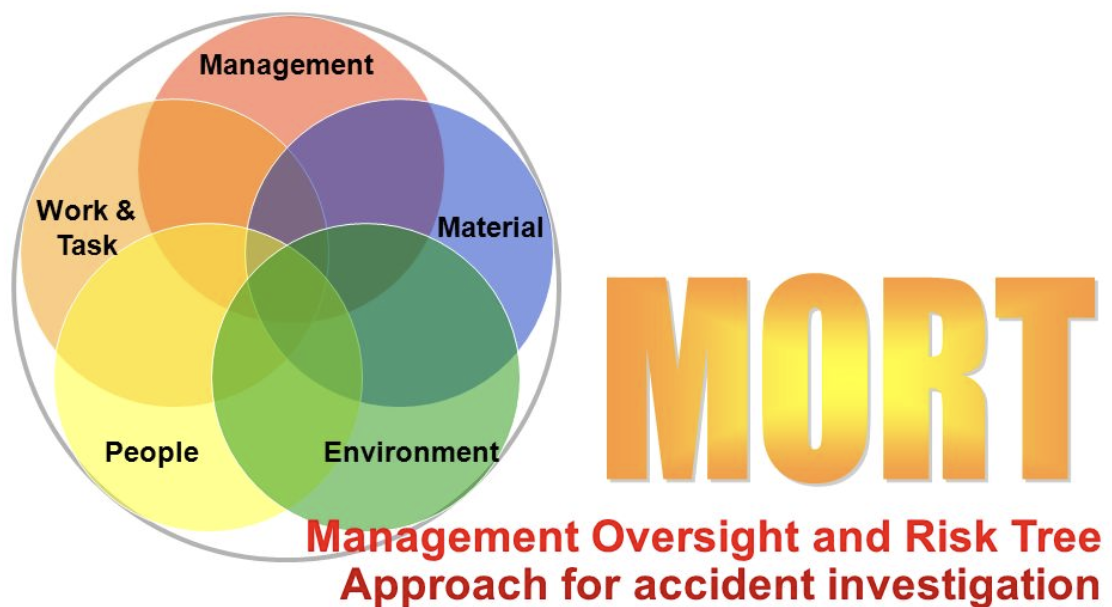
 MORT was first developed in the USA to analyze the root causes and causal factors for incidents in the nuclear power and aviation industries, but it has now been applied in many industries. However, it seems to be a “lost art” these days!
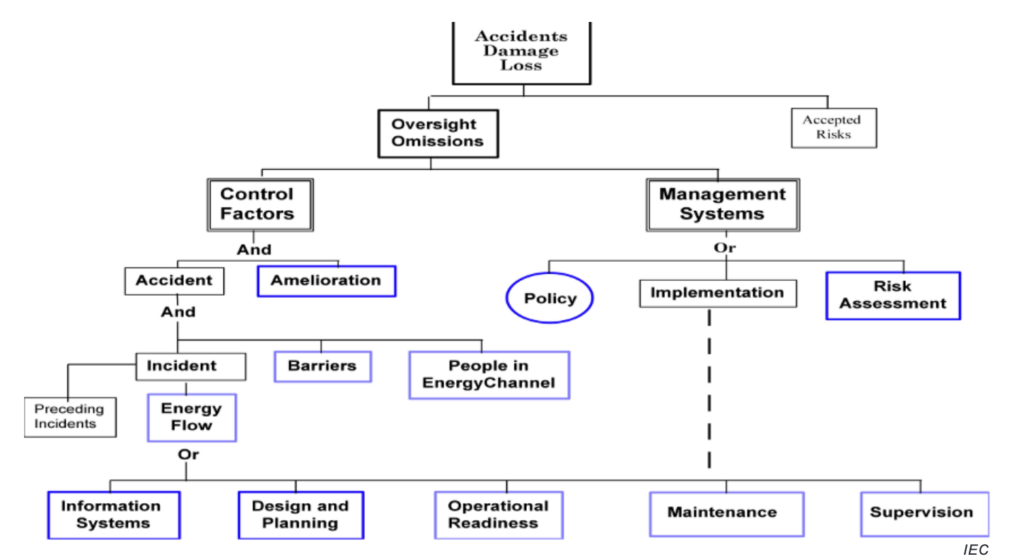
MORT is a pre-populated tree based on a model of an organization’s [safety] management system, which effectively provides a detailed checklist for reviewing which parts of management and control systems were less than adequate when the focus event occurred.
The most significant advantage of using MORT is that it assumes that a failure occurs due to oversights or omissions in either management systems or the specific control factors that should have prevented the event from happening.
Ultimately, failures in either branch of the tree occur because something within the general management systems (information systems, design, planning, operational readiness, maintenance, or supervision) was inadequate. Each box below is developed into a detailed tree structure showing factors that might have been less than adequate.
The basic structure of the tree is shown below…
The strengths of MORT are as follows:
- provides comprehensive guidance for seeking all possible aspects of the system that were not adequate at the time of the focus event;
- less specialist expertise is needed than in some techniques because detailed guidance is provided on possible causal factors;
- identifies weaknesses in the system that might apply across a wide range of failure scenarios.
The limitations of MORT are as follows:
- Explores weaknesses in the system in general that might have played a role in the focus event rather than seeking immediate or necessary causal factors;
- a vast number of questions (around 1,500) are asked, so the method is time-consuming and, hence most appropriate for serious events;
- unless the organization to which it is applied is a high-reliability organization, a very large number of weaknesses are found, which make it difficult to implement changes;
- tedious when first learning or applying the method.