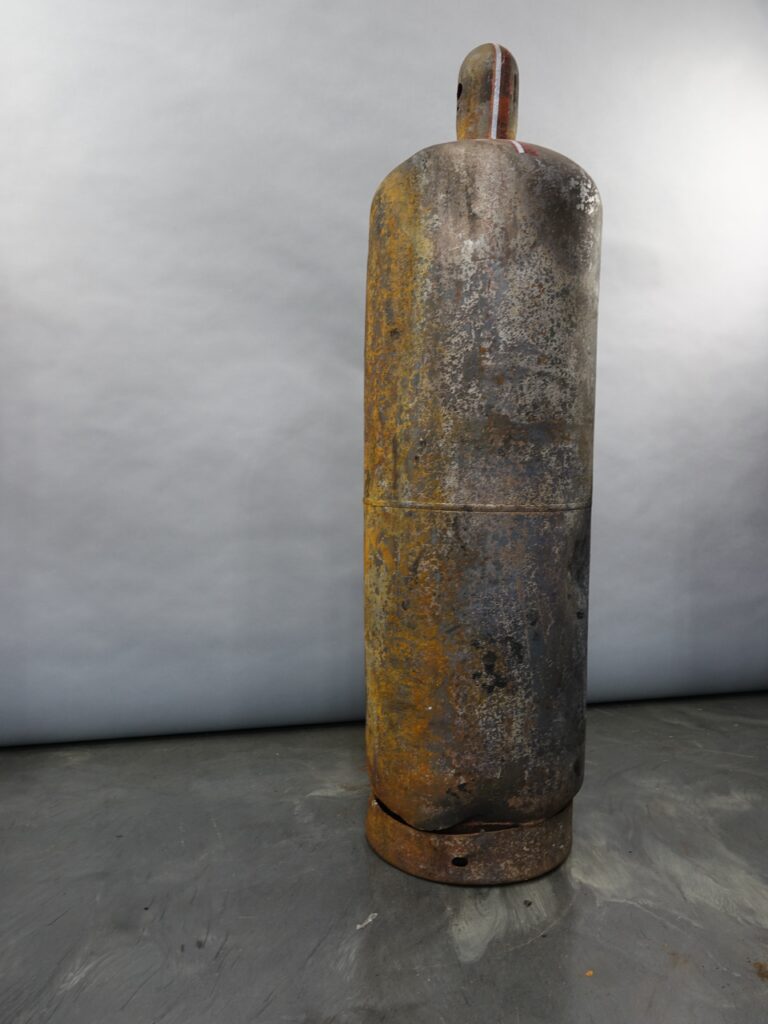
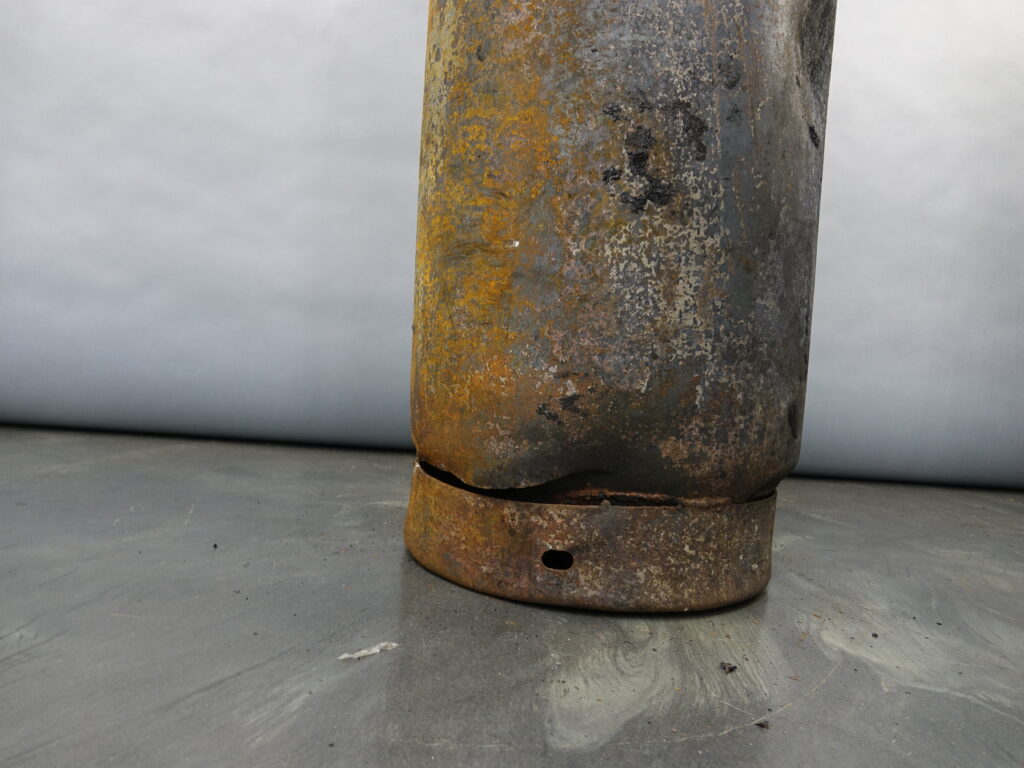
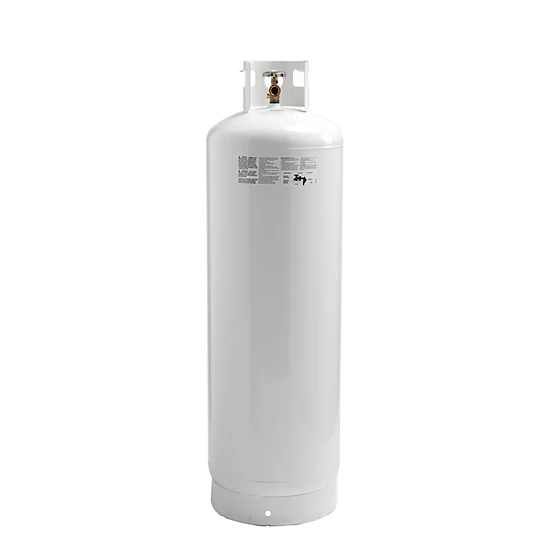
 The explosion at an auto repair shop in Hillsboro, OH that claimed the lives of three (3) workers, aged 19, 33, and 47 in 2023 has been determined to have been caused by a rupture to an LPG cylinder that had been overfilled and past its requalification date by 33 years.
I would also like to make note of the following facts, as stated in the SFM report, that could have played a role in this tragedy. This is MY ANALYSIS, not the SFM’s.
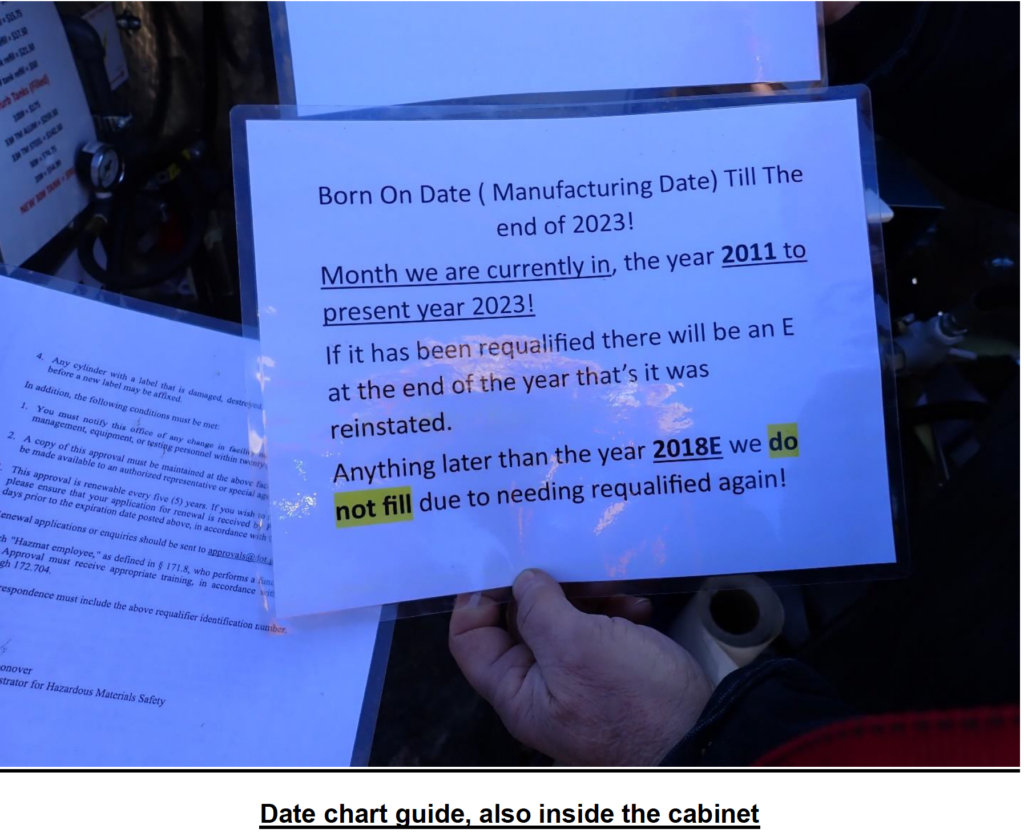
The business had a "cylinder fill cabinet" that allowed for small LPG cylinders to be filled by weight. However, this cabinet could NOT accommodate a 100-pound cylinder due to the cabinet being only 3'4" tall (see pics below). It should also be understood that 100-pound cylinders are NOT equipped with an "Overfilling Protection Device"(OPD). This resulted in the 100-pound cylinder being overfilled as there was no physical manner to put the cylinder on the scale! The business had a chart at the filling station that went up to 100-pound cylinders (see pic below). NONE THE LESS, this specific cylinder nor those brought in by another customer on the day the SFM and DOT inspector(s) were at the business should have NEVER been filled as they were way past due for their recert/requalification.
State investigators found that the tank involved in this explosion was improperly filled at a local Farm Supply store.
On the day of the explosion, an employee of the Defendants refilled four (4) 100-pound propane cylinders at the request of the Auto Repair business. Notwithstanding the lack of requalification/recertification of the 100-pound propane cylinder that burst on November 28, 2023, which was required by law to be requalified/recertified before being filled on November 28, 2023, the propane cylinder at issue was overfilled by Defendant.
The 100-pound propane cylinder at issue was manufactured in 1950, over 70 years before its catastrophic failure. According to all applicable standards, codes, and regulations, the propane cylinder at issue was required to be marked with its manufacture date, which it was.
NOTE1:  seeing the enlarged and enhanced video evidence, it is clear that a cylinder catastrophically failed, and filled the enclosed garage with LPG gas, which ignited several seconds later.
NOTE2: the cylinder that failed was NOT in use at the time and still had its safety cap in place.
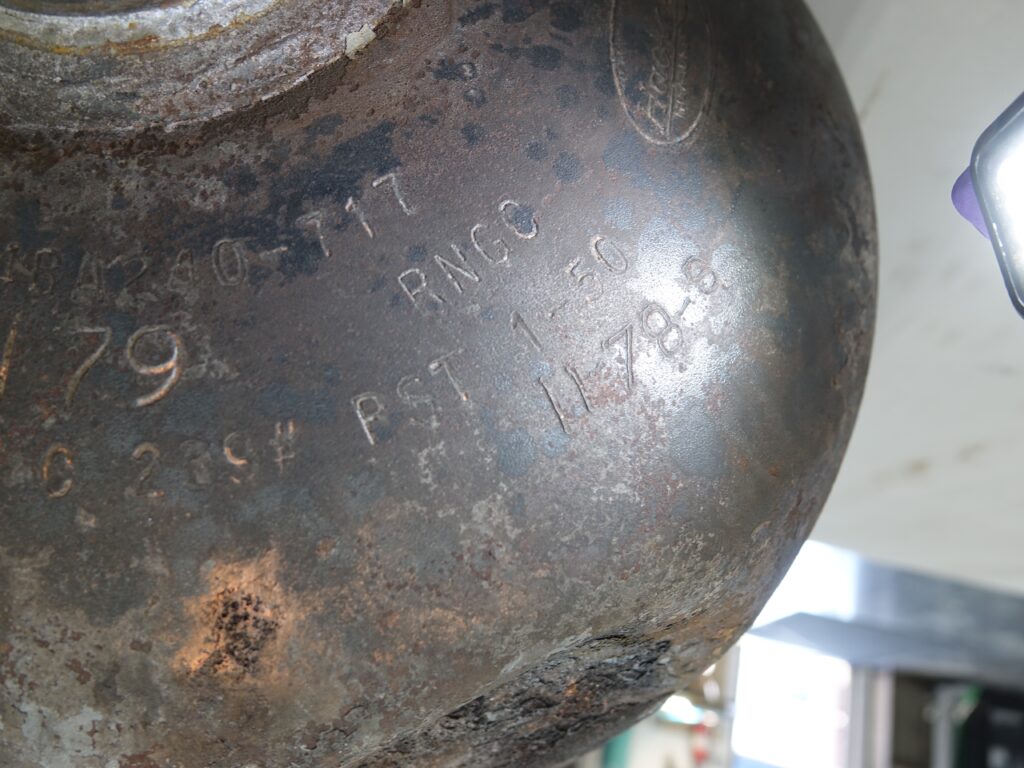
After manufacture, the propane cylinder at issue was to be requalified/recertified as mandated by applicable standards, codes, and regulations, usually on either 5-, 7- or 12-year intervals, depending on the characteristics of the cylinders. When propane cylinders are inspected and requalified/recertified, the date of such requalification/recertification is to be stamped onto the propane cylinder. The propane cylinder at issue was not requalified/recertified within either a 5-, 7- or 12-
year interval before November 28, 2023. The only requalification/recertification date on the propane cylinder at issue was 11-78-S, suggesting that it was last requalified/recertified in November 1978 (45 years).
Specifically, the LPG supply business failed to:
- properly inspect and examine the propane cylinder at issue presented for refilling;
- requalify/recertify the propane cylinder at issue presented for refilling;
- properly inspect the propane cylinder at issue for requalification/certification date and condition before refilling;
- observe the old, deteriorated, and damaged condition of the propane cylinder at issue;
- determine whether the propane cylinder at issue was equipped with appropriate and functioning overfill prevention devices;
- determine the age of the propane cylinder at issue presented for refilling;
- properly fill the propane cylinder at issue;
- remove the propane cylinder at issue from service
Source: OH SFM Report and Besty Beaver Lawsuit
The LPG business that filled the cylinder involved was inspected by OSHA and cited.
| Violations/Penalties | Serious | Willful | Repeat | Other | Total |
|---|---|---|---|---|---|
| Initial Violations | 2 | 2 | |||
| Current Violations | 1 | 1 | 2 | ||
| Initial Penalty | $7,604 | $0 | $0 | $0 | $7,604 |
| Current Penalty | $3,500 | $0 | $0 | $1,500 | $5,000 |
| FTA Penalty | $0 | $0 | $0 | $0 | $0 |
| # | Citation ID | Citaton Type | Standard Cited | Issuance Date | Abatement Due Date | Current Penalty | Initial Penalty | Contest | Latest Event | Note |
|---|---|---|---|---|---|---|---|---|---|---|
| 1. | 01001 | Other | 19101200 E01 | 05/02/2024 | $1,500 | $2,765 | I – Informal Settlement | |||
| 2. | 01002 | Serious | 19101200 H03 | 05/02/2024 | 07/01/2024 | $3,500 | $4,839 | I – Informal Settlement |
Source: https://www.osha.gov/ords/imis/establishment.inspection_detail?id=1715262.015
The OH SFM interviews with the business employees who were “LPG cylinder fillers”
November 30, 2023, On-Site Interview:
- The two male employees, who fill propane tanks, were identified as:
- a. XXXXXXXXXX, m/w, age 62
- b. XXXXXXXXXX, m/w, age 21
- On that date, it was found that the two employees were not taking any measures to determine how much gas was in propane tanks prior to filling them.
- XXXXXXXXX was the “main” propane gas “filler”, unless he was busy then another employee would help out.
- XXXXXXXXX stated that they fill each propane tank until the relief valve engages, he never measures the tank prior to filling.
- Neither were not making visual inspections of tanks prior to filling them with propane. A customer was in the process of removing several propane tanks from his vehicle, and XXXXXXXXX was filling them without utilizing safety and filling directives. Several tank fillings were stopped by Investigator Turner before they could be filled, due to the employees failing to inspect the tanks. The tanks were found to have been expired by 12 and 15 years respectively. This is in violation of USDOT requirements.
- A large digital scale, used for measuring tanks, was inside the enclosed box containing the propane filling “station”. Employees, XXXXXXX and XXXXXXX, stated they do not measure the 100-pound propane tanks prior to filling them. They do not take a reading on how much propane is in the tank prior to filling.
- Employees have not documented the tank condition or how many gallons go in each tank, they charge by the tank, not per gallon.
- Employees have not maintained their training records in accordance with requirements.
- Investigator Turner advised them to cease filling propane tanks until they get additional education to become compliant with filling laws due to the safety concerns of overfilling the tanks.
- The owner, XXXXXXXXX, had to leave in the middle of the inspection due to a delivery at his home, leaving employee XXXXXXXXX, to handle the remaining inspection/interview.
- XXXXXXXX stated he understood they were wrong as far as filling the propane tanks.
- Investigator Turner spent a great deal of time with XXXXXXX to help her understand the importance of record keeping and training to keep everyone safe.
Possible Charging Affidavit:
After a lengthy and comprehensive investigation, Investigators found that XXXXXXXXX is an employee with XXXXXXX Steel and Farm Supply employee since 2016. [His] main role is as “load operator” and the main propane filler.
Investigation has determined that [he] violated NFPA and U.S. Department of Transportation requirements and guidelines in failing to inspect and overfilling 100-pound propane cylinder that ruptured and exploded, killing three people at 502 S. Main Street, Hillsboro, Ohio.
On November 28, 2023, [he] was the main and only employee who knowingly did fill a “grey” 100-pound LP “propane” cylinder/tank while employed by XXXXXXXX Steel and Farm Supply. The 100-pound cylinder belonged to James “Jimbo” Chambers, owner of Jimbo’s Auto Repair. This 100-pound cylinder was one of 4 cylinders filled at that time by [him]. All four propane cylinders that day were found to have been overfilled with propane gas.
As a result of the overfilling of the 100-pound propane cylinder, the cylinder ruptured and killed three people in the city of Hillsboro, Ohio.
On November 30, 2023, Investigators from the State Fire Marshal’s Office and from the U.S. Department of Transportation interviewed XXXXXX Steel and Farm Supply employees. While at the business, [he] was observed filling three propane cylinders from a customer. One cylinder when shook, had loose metal inside rattling, and the two other cylinders were expired by 12 and 15 years. These cylinders were being filled in violation of 49 CFR federal codes, and NFPA Section 58 codes. Due to an extremely hazardous condition created by [him] improperly filling these tanks, the U.S. DOT Inspection immediately stopped [him] from filling the cylinders.
Investigators received the expert opinion report, from the agreed upon interested parties, on April 12, 2024, from the grey, ruptured, 100-pound cylinder testing. The testing facility found the cylinder/tank was built in the 1950’s and last certified in 1978. The cylinder in question was not currently certified, and should not have been filled with propane.
As a result of the findings, [he] was interviewed on April 17, 2024, at XXXXXXXX Steel and Farm Supply.
[he] , who was read his Miranda Warning, he initially denied filling the cylinders on the day in question. [he] stated he is the “main employee” who fills the propane cylinders. He was able to remember “Jimbo” coming to XXXXXXX to get the 4 propane cylinders filled on the day in question, describing the young boy passenger, with long hair and other specific details. [he] stated he was interviewed by the insurance company attorney.
[he] admits to filling propane cylinders on the day in question, but not Jimbo’s.
On April 22, 2024, [he] was interviewed again, rereading his Miranda Warning. [he] confirms he has known James “Jimbo” Chambers for about 7-8 years, and he used to work next to [his] wife in 2011. [he] remembered specific details about that day, and he described the vehicle, and specifically how and where the four 100-pound cylinders were stacked in the back of XXXXXXXX red Ford pickup truck, and described debris in the bed of the truck on the day the cylinders were filled.
[he] was able to recall how XXXXXXX had the “grey” tank stacked in the bed of his truck, and it’s specific location in the bed of the truck.
[he] confirmed that the owner of XXXXXXXX Steel and Farm Supply, XXXXXXXX, responded to the scene of the fatal explosion on the day in question, and returned to the shop and informed [him] that if they filled the “tanks” they will lose everything they have.
Interviews with the U.S. DOT federal investigator and the OSHA investigator, both believe [he] filled the four 100-pound propane cylinders on November 28, 2023, as a result of their respective investigations.
James “Jimbo” Chambers and his nephew, Bradly McCravy, positively identified [him], as the XXXXX Steel and Farm Supply employee who filled the four 100-pound propane cylinders on November 28, 2023, including the grey 100-pound propane cylinder which ruptured.
They recited specific conversations and interactions they had with [him] during the filling of the propane cylinders, an employee interaction with [him], and they have known him for over 7 years.
These four 100-pound propane cylinders were overfilled in violation of NFPA and U.S. DOT standards and guidelines. Three of the 100-propane tanks were located at the owner’s residence and were still “off gassing” over 14 days after being filled at XXXXXX Steel and Farm Supply on November 28, 2023.
The “grey” 100-pound propane cylinder which ruptured inside of Jimbo’s Auto Repair on November 28, 2023, was built in the 1950’s and then recertified in 1978. The tank was filled in violation of NFPA and 49 CFR, and should have not legally been filled by [him].
The investigation has determined XXXXXXXX, aka: Griz negligently failed to visually inspect, weigh the cylinder (s) in violation of the NFPA 58, and US DOT Requirements, which ruptured, resulting in an explosion killing three people. The investigation found the grey, ruptured cylinder still had the transportation cap attached (from just being filled) and was not hooked up or in use.
The ruptured 100-pound cylinder, ruptured from being overfilled with propane inside Jimbo’s Auto Repair, and caused an explosion killing Jimbo’s Auto Repair employees: XXXXXXXXX, XXXXXXXXXX and XXXXXXXXXX.
[He] completed his official propane training, titled “Certificate of Training Completion, Dispensing Propane Safely – Small Cylinder Filling by Weight and Volume on July 25, 2023, at XXXXXXXX Steel and Farm Supply.
Evidence discovered during the investigation was that [he], nor XXXXXXXXX Steel and Farm Supply were tracking or measuring how much propane was being dispensed into each tank as a standard business practice, and in particular the grey, 100-pound, ruptured propane cylinder in question.
The day of the explosion, and the days following [he] was not complying with Federal or NFPA standards and guidelines for safely filling propane tanks, resulting in violations from the U.S. DOT and the Code Bureau from the State Fire Marshal’s Office.
State Fire Marshal Citations
Violation 1 – Fire safety General violation – Corrected on 12-07-2023
Description: Fire safety general violation. Refer to more details of the violation under the code section and the required action to resolve the issue
6106.2 LP-gas containers shall not be filled or maintained with LP-gas in excess of either the volume determined using the fixed liquid-level gauge installed in accordance with the manufacturer’s specifications and in accordance with section 5.75 of NFPA 58 as listed in rule 1301:7-7-80 of the Administrative Code or the weight determined by the required percentage of the water capacity marked on the container. Portable LP-gas containers shall not be refilled unless equipped with an overfilling prevention device (OPD) where required by section 5.7.3 of NFPA 58 as listed in rule 1301:7-7-80 of the Administrative Code.
The facility stated that employees were not weighing the LPG tanks when they were filling them. LPG tanks shall be properly weighed to accurately measure the amount of LPG pumped into the tanks as required to prevent overfilling.
Corrective Action: Properly weigh the LPG tanks to accurately measure the amount of LPG pumped into the tanks to prevent overfilling.
Violation 2 – Fire safety General violation – Corrected on 12-07-2023
Description: Fire safety general violation. Refer to more details of the violation under the code section and the required action to resolve the issue
6106.1 Dispensing of LP-gas shall be performed by a qualified attendant in accordance with section 4.4 of NFPA 58 as listed in rule 1301:7-7-80 of the Administrative Code.
Corrective Action: Cease dispensing LPG by unqualified attendants (employees).