
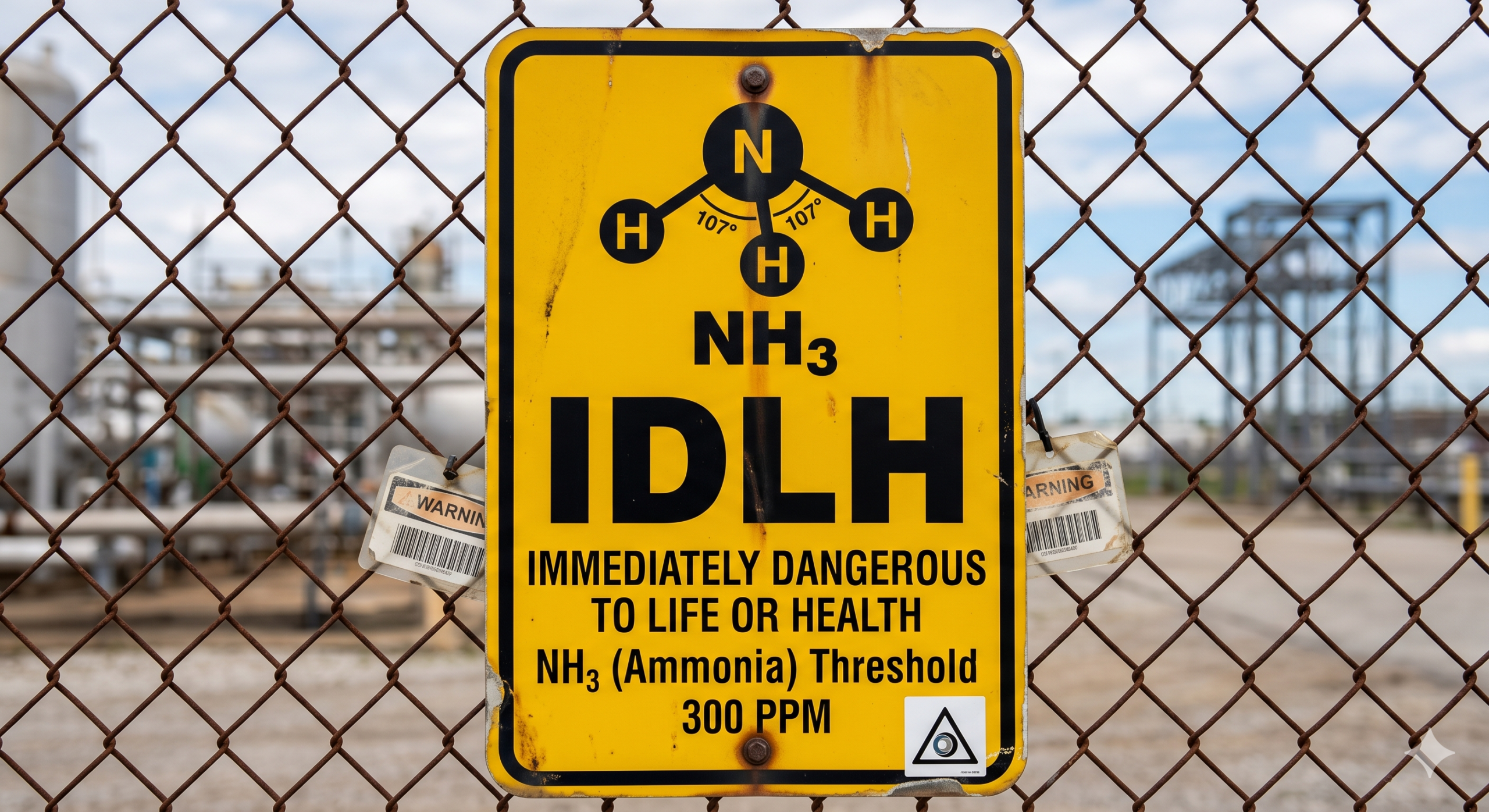
The history of ammonia’s Immediately Dangerous to Life or Health (IDLH) levels is a classic example of how occupational safety standards evolve as toxicological data becomes more refined. Since the concept was first introduced in the 1970s, the ammonia limit has undergone significant downward revisions based on a better understanding of acute human tolerance.
1. The Original IDLH (1974): 500 ppm
When NIOSH and OSHA first established IDLH values during the Standards Completion Program (SCP) in the mid-1970s, the level for ammonia was set at 500 ppm.
- The Rationale: This value was largely based on early 20th-century literature. Specifically, researchers Henderson and Haggard (1943) noted that 300-500 ppm was the maximum short-term exposure (30–60 minutes) that humans could tolerate without incapacitation.
- Safety Margin: At the time, data suggested that truly “dangerous” levels—those leading to death—were much higher, ranging from 2,500 to 10,000 ppm.
2. The Revised IDLH (1994): 300 ppm
In 1994, NIOSH conducted a massive review of all IDLH values to incorporate modern toxicological research. During this update, the ammonia IDLH was lowered to 300 ppm, where it remains today.
- The Rationale: The revision was triggered by more precise human data. Studies showed that even at 500 ppm, subjects experienced significant changes in respiration rates and severe irritation.
- The “Escape” Factor: Because the IDLH is defined as the maximum concentration from which one could escape within 30 minutes without a respirator (and without permanent health effects), 500 ppm was deemed too high. It was determined that 300 ppm better represented the threshold where a worker could still realistically perform a “self-rescue” without being incapacitated by the gas’s corrosive effects on the eyes and respiratory tract.
Comparison of Key Safety Benchmarks
To put the 300 ppm IDLH in context, it is helpful to look at how it sits between everyday exposure limits and lethal concentrations:
| Level | Concentration (ppm) | Significance |
| Odor Threshold | 5 – 50 ppm | Most people can smell it; “pungent” odor. |
| OSHA PEL (TWA) | 50 ppm | Legal limit for an 8-hour workday. |
| NIOSH REL (TWA) | 25 ppm | Recommended limit for an 8-hour workday. |
| IDLH (Current) | 300 ppm | Immediate danger; respirator failure requires escape. |
| Lethal (Human) | 2,500 – 5,000+ ppm | Likely fatal within 30 minutes. |
Technical Note on AEGLs
While the IDLH is the primary “emergency” number for OSHA compliance and respirator selection, many safety engineers now also look at AEGLs (Acute Exposure Guideline Levels) for community planning.
- AEGL-2 (Disabling): ~160 ppm (for a 1-hour exposure)
- AEGL-3 (Lethal): ~1,100 ppm (for a 1-hour exposure)
The gap between the 300 ppm IDLH and the 1,100 ppm AEGL-3 highlights the conservative nature of the IDLH, which prioritizes the ability to physically escape (e.g., being able to see and breathe well enough to find an exit) rather than just surviving the exposure.