
DISCLAIMER: This is a “cheat sheet” for safety professionals to get a general idea of the “safe distances.” ALWAYS refer to ASME PCC-2, Mandatory Appendix 501-III) for the exact distance. Just understand, ALL pneumatic pressure testing REQUIRES a “safe distance”.
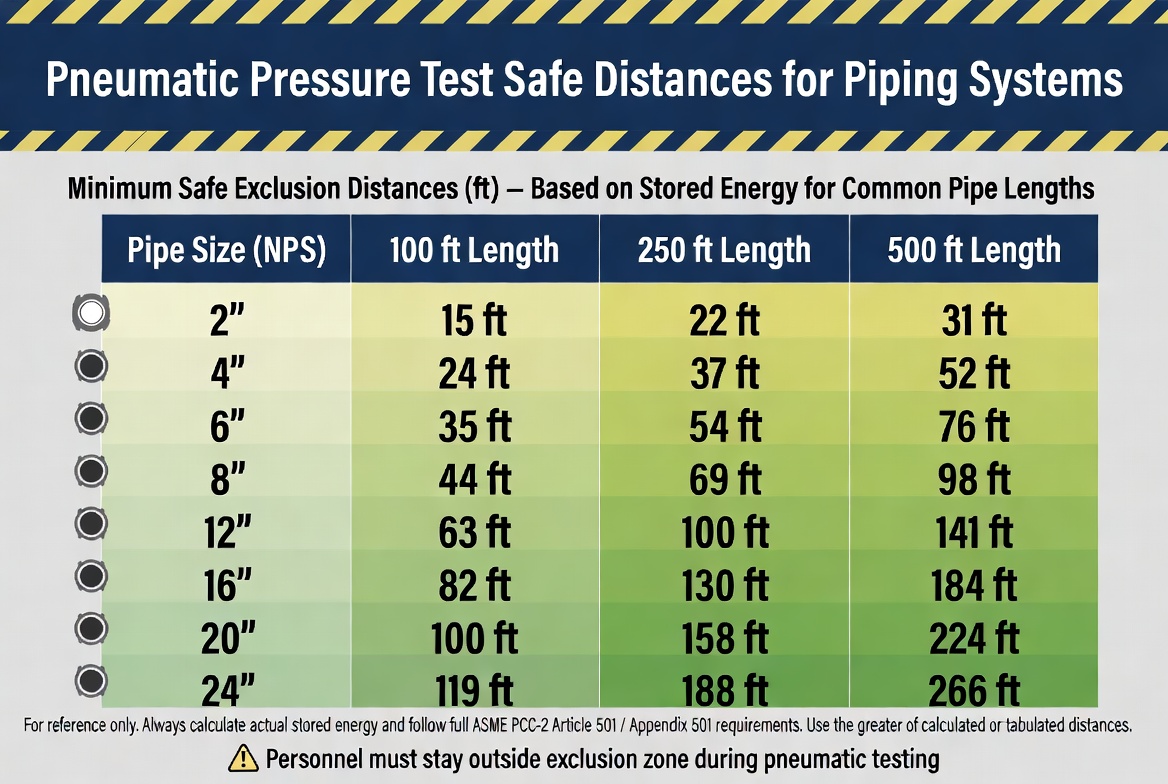
According to ASME PCC-2, Mandatory Appendix 501-III, determining safe distances for pressure testing—specifically, pneumatic testing—requires calculating the system’s stored energy. While hydrostatic testing distances are generally much smaller, pneumatic testing distances are based on the potential energy release (TNT equivalent) of the compressed gas.
The table below provides the Minimum Safe Distance (dmin) for various pipe sizes and lengths, assuming a test pressure of 150 psi (a common threshold for piping). Note that as pressure increases, these distances will expand significantly.
Minimum Safe Distances for Pneumatic Pressure Testing (150 psi)
| Pipe Size (NPS) | 100′ Length | 250′ Length | 500′ Length |
|---|---|---|---|
| 2″ | 15 ft | 22 ft | 31 ft |
| 4″ | 24 ft | 37 ft | 52 ft |
| 6″ | 35 ft | 54 ft | 76 ft |
| 8″ | 44 ft | 69 ft | 98 ft |
| 12″ | 63 ft | 100 ft | 141 ft |
| 16″ | 82 ft | 130 ft | 184 ft |
| 20″ | 100 ft | 158 ft | 224 ft |
| 24″ | 119 ft | 188 ft | 266 ft |
Critical Engineering Assumptions
These values are calculated using the formula found in ASME PCC-2, Mandatory Appendix 501-III
dmin = R×(E1/3)
- R (Scaled Distance): Usually taken as 50 ft/lb1/3 for public or unprotected areas, or 20 ft/lb1/3 for essential personnel within a controlled perimeter. The table above uses a conservative approach for general safety.
- Stored Energy (E): The total energy is a function of the internal volume and the absolute pressure ratio.
- Material Factor: Distances may need to be adjusted if the piping material is brittle or if the stored energy exceeds certain thresholds (e.g., 100,000,000 ft-lb).
Safety Requirements
- Exclusion Zone: All non-essential personnel must remain outside the calculated dmin for the duration of the pressure ramp-up and the hold time.
- Hydrostatic vs. Pneumatic: If these same tests were performed hydrostatically, the dmin is typically reduced to a standard distance (often 15-20 ft) because the stored energy in an incompressible liquid is negligible compared to compressed gas.
- Barriers: If the required distance is not physically possible due to site constraints, blast mats or engineered shielding must be utilized to mitigate the risk of fragment throw.
Source: me and Google Gemini +