
To determine the internal static overpressure generated by the catastrophic failure of a liquid Nitrogen (LN2) dewar, we look at the physics of a Boiling Liquid Expanding Vapor Explosion (BLEVE) and the resulting rapid phase transition.
The Scenario Parameters
- Source: 1,000 Liters of LN2 (approx. 264 gallons).
- Room Volume: 40′ X 40′ X 20′ = 32,000 ft3
- Expansion Ratio: Nitrogen expands at a ratio of approximately 694:1 from liquid to gas at room temperature.
Calculating Gas Volume
If 1,000 liters of LN2 flashes instantaneously to gas:
1,000 L X 694 = 694,000 L of gas
Converting to cubic feet (since 1 m3 = 35.3 ft3
694,000 L = 24,500 ft3 of new gas
Calculating Overpressure
The resulting pressure in the room is determined by the addition of this new volume into the existing 32,000 ft3 of air. Using a simplified gas law approach for an enclosed space:
- Initial Volume (V1): $32,000 ft3 at 14.7 psia (Atmospheric).
- Final Volume (V2): Effectively tries to occupy 32,000 + 24,500 = 56,500 ft3 within the same rigid boundaries.
- Pressure Increase: The ratio of the added gas to the room volume determines the pressure rise.
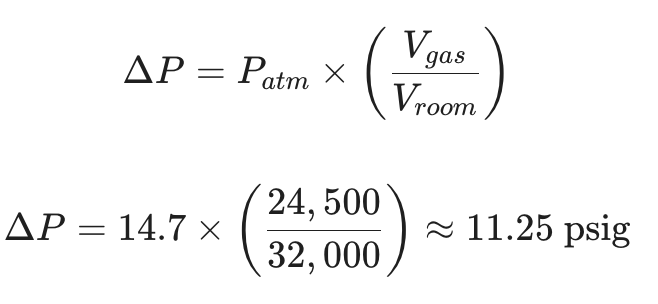
The Result: ~11.25 psig
Structural Impact and Safety Context
While 11.25 psig might sound low compared to a car tire, in the context of structural engineering, it is catastrophic:
- 1 psig: Sufficient to shatter conventional glass windows.
- 2–3 psig: Generally enough to collapse non-reinforced concrete block walls (CMU).
- 5–10 psig: Total destruction of most standard commercial buildings and steel-frame structures.
- 11+ psig: Likely to cause total structural failure of the 40′ X 40′ X 20′ room, blowing out the roof and all four walls.
The “TNT Equivalent” Note
As noted in the SAFTENG technical articles you were viewing, safety professionals often calculate the “TNT Equivalent” of such failures. Because the liquid is stored under pressure, the “expansion energy” released during a vessel rupture is comparable to a high-explosive detonation in terms of the initial shock wave.
Warning: This calculation assumes a sealed room. In reality, doors or windows would fail long before 11 psig is reached, which might vent some pressure, but the speed of an LN2 flash is so high that the structural failure would likely occur before significant venting could mitigate the wave.
Source: me and Gemini+