
Many may be familiar with “flange jumpers,” or some may call them “bonding jumpers,” that are used to ensure a continuity to ground across a flange with gaskets that act as “insulators”, such as PTFE gaskets. During a recent walkdown of a flammable liquids process, I came across this “jumper”. Design called for “jumpers” on each flange, and the contractor did exactly as instructed… Why is there a “jumper” on an N2 pipe?
NOTE: Members can read my 2012 post about these “jumpers.“
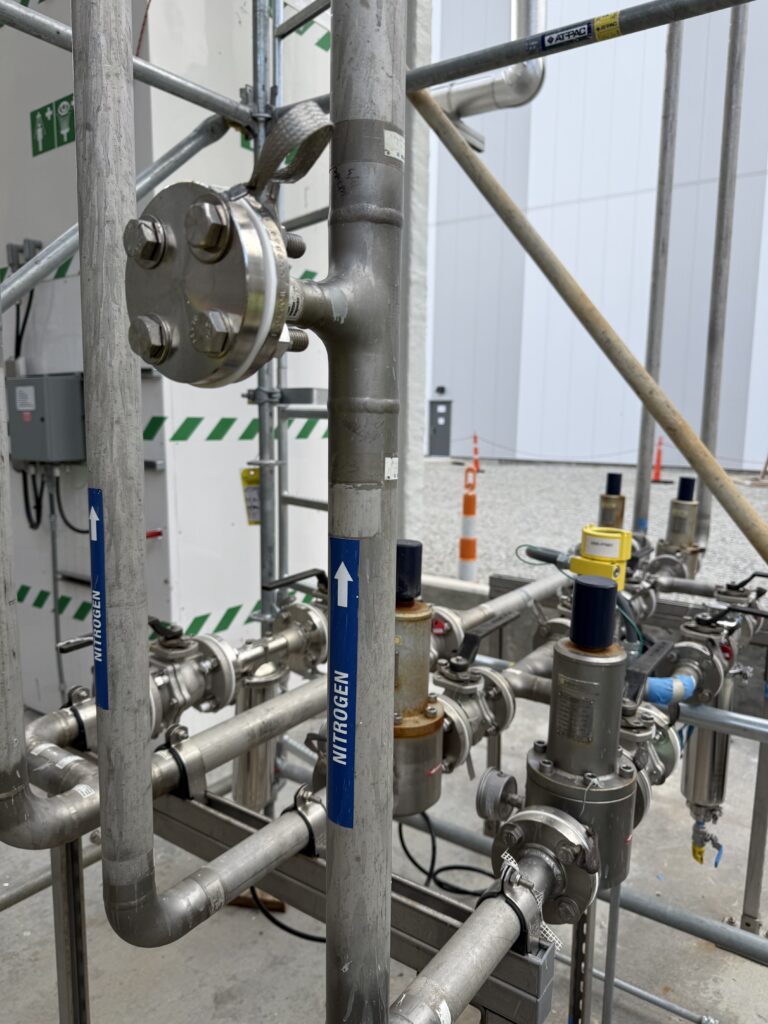
For a Nitrogen gas line, the requirement for bonding jumpers is determined by how the piping interacts with your “flammable process” and the specific hazardous area classification of the room.
While Nitrogen itself is inert and non-flammable, it can still accumulate and transport static electricity under certain conditions, and its piping can serve as a conductive path for stray currents.
If the Nitrogen line enters a Class I, Div 1 or Div 2 area, the exterior of the pipe must be considered.
- The Risk: If the Nitrogen pipe is electrically isolated (e.g., by a non-conductive gasket) and it sits within a flammable atmosphere, a static charge could build up on the pipe surface due to induction or external friction. If that charge sparks across a flange to a grounded pipe, it could ignite the surrounding flammable vapors.
- The Requirement: In these areas, ensure the piping system has a continuous path to ground. If you are using insulating gaskets or have heavily coated flanges, bonding jumpers are a common way to guarantee that continuity
Nitrogen is often used for “padding” or “blanketing” flammable liquids.
- Dry Gas: Pure, clean, dry Nitrogen is a poor generator of static.
- The “Dirty” Gas Exception: If the Nitrogen stream contains particulates (like rust, scale, or catalyst fines) or liquid droplets (condensate), the friction of these particles hitting the pipe wall at high velocity can generate significant static charges.
- The Requirement: If the gas is “dirty” or moving at high velocities into a vessel containing flammable vapors, bonding the flanges ensures the charge doesn’t “pool” on a specific section of piping before reaching the vessel.
The most critical point is where the Nitrogen line connects to the flammable process vessel.
- The Risk: If the vessel is grounded but the Nitrogen piping is isolated by a gasket at the tank nozzle, the piping could maintain a different electrical potential than the tank.
- The Requirement: Ensure there is no potential difference between the Nitrogen supply line and the vessel it is blanketing. A jumper at the final connection point is standard practice to ensure the entire system is at a single “equipotential.”
- NFPA 77 (Recommended Practice on Static Electricity): Emphasizes that all conductive parts of a system handling flammable liquids (or operating in their presence) should be bonded and grounded.
- NFPA 70 (NEC) Article 500-505: Focuses on ensuring that “all metal raceways and enclosures” in hazardous locations are bonded to provide a safe path for fault current.
You likely do need jumpers on your Nitrogen line if:
- The line uses non-conductive gaskets (PTFE/Teflon) in a classified hazardous area.
- The line is painted or coated at the flange faces, preventing metal-to-metal contact through the bolts.
- The Nitrogen is being used for high-velocity purging of a vessel that contains flammable vapors.
- Your facility’s internal engineering standards or insurance provider (like FM Global) require visible bonding for all piping in PSM-covered processes.
Recommendation: If the Nitrogen line is part of your Process Safety Management (PSM) scope, it is usually safer and easier for inspection purposes to install the jumpers. It provides a visible, verifiable “positive bond” that auditors and inspectors can confirm without needing a megger (ohmmeter) test at every flange.