
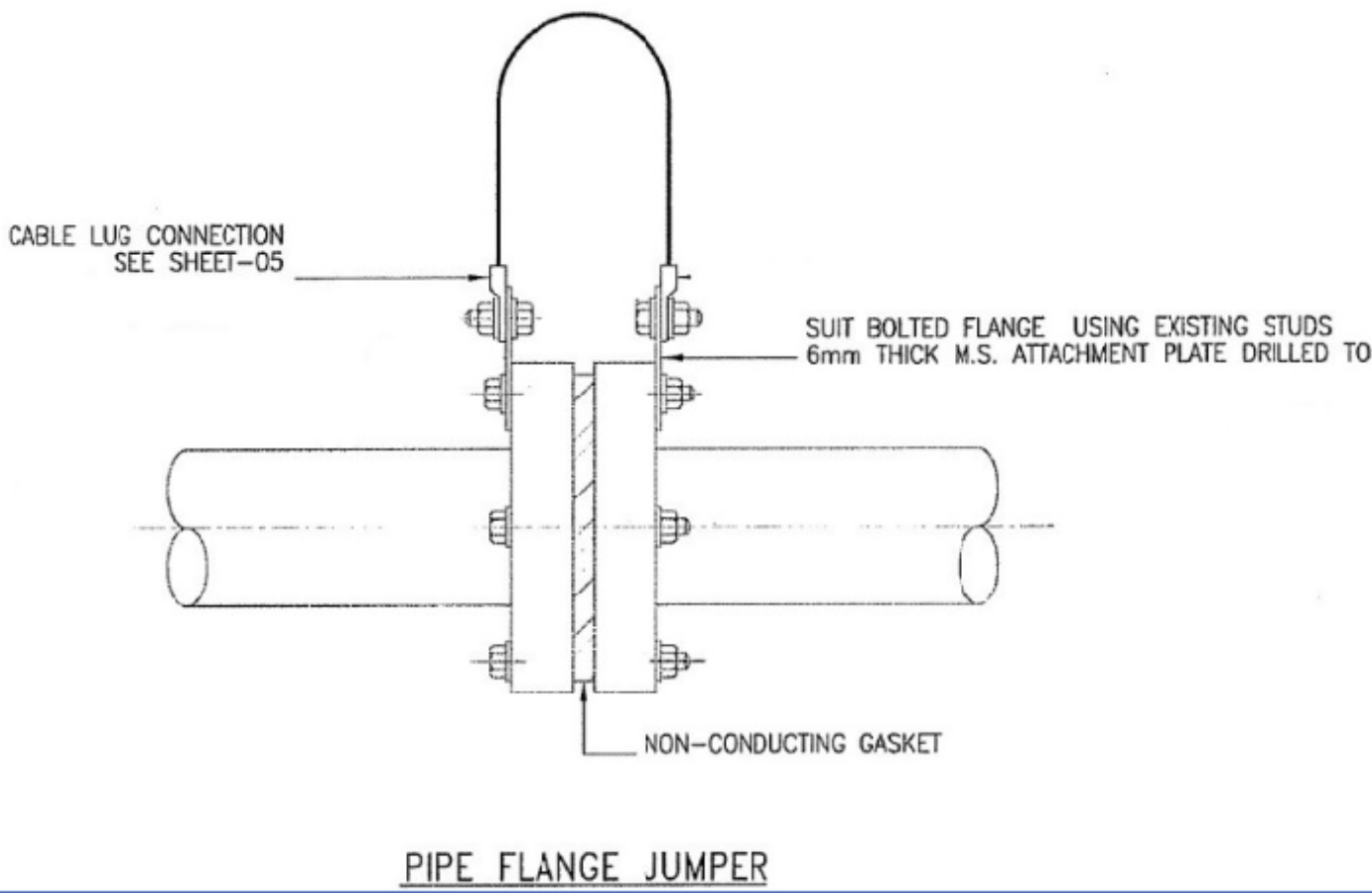
In processes handling flammable liquids, “flange jumpers” (also known as “bonding jumpers”) are critical safety components designed to maintain electrical continuity across piping joints. Since piping systems are often coated, gasketed, or subject to corrosion, a standard flanged connection may not provide a sufficiently low-resistance path to ground.
The primary goal is to prevent the accumulation of static electricity. When flammable liquids flow through piping, static charges can build up due to friction (streaming current). If a flange pair is electrically isolated by a non-conductive gasket or paint, a potential difference can develop between the two (2) pipe sections.
- Spark Discharge: Without a jumper, the charge may eventually jump the gap, creating a spark with enough energy to ignite flammable vapors if a leak is present.
- Stray Currents: Jumpers also ensure that stray currents or lightning energy have a continuous, predictable path to the grounding grid.
Technical Specifications
For effective protection, jumpers should adhere to several mechanical and electrical standards:
- Material: Typically made of braided copper or flexible copper cable to allow for thermal expansion and vibration without snapping.
- Resistance: Most industry standards, such as NFPA 77 (Recommended Practice on Static Electricity), suggest that the resistance across the bonded joint should be less than 10 ohms, though many engineering specifications require less than 1 ohm.
- Hardware: Connections should use “star” washers or specialized grounding lugs that bite through paint and oxidation to ensure metal-to-metal contact with the flange or pipe wall.
When are they required?
While modern metallic piping with conductive gaskets (like spiral-wound graphite) often provides inherent continuity, jumpers are mandatory in specific scenarios:
- Non-Conductive Gaskets: When using Teflon (PTFE) or rubber gaskets that act as insulators.
- Coated Piping: If the internal or external surfaces are heavily lined or painted with non-conductive materials.
- Loading/Unloading Stations: Critical areas where hoses are frequently connected and disconnected.
- Swivel Joints: Where mechanical movement might intermittently break the metal-to-metal contact.
Bonding jumpers are prone to atmospheric corrosion and physical damage. A robust inspection/testing program should include:
- Visual Inspection: Checking for frayed cables, loose bolts, or heavy corrosion.
- Continuity Testing: Periodically using a micro-ohmmeter to verify that the resistance remains within the specified safety limits.
- Correct Fastening: Ensuring jumpers are not just wrapped around bolts but are secured to the flange using dedicated grounding points.
NOTE: In some high-integrity systems, engineers may opt for conductive gaskets or specialized grounding washers (such as serrated washers) to establish continuity through the flange bolts themselves, though external braided jumpers remain the “gold standard” for visual verification of safety.
NFPA 77 References:
Chapter 10 Fluid Flow in Piping, Hose, Tubing, and Filters

10.1 Metal Piping Systems.
10.1.1 All parts of continuous all-metal piping systems should have a resistance to ground that does not exceed 10 ohms. A significantly higher resistance could indicate poor electrical contact, although this will depend on the overall system. For flanged couplings, neither paint on the flange faces nor thin plastic coatings used on nuts and bolts will normally prevent bonding across the coupling after proper torque has been applied. However, care should be taken to avoid accumulation of excessively thick coatings of paint over successive repaintings. Jumper cables and star washers are not usually needed at flanges. Star washers could even interfere with proper torquing. Electrical continuity of the ground path should be confirmed after assembly and periodically thereafter.

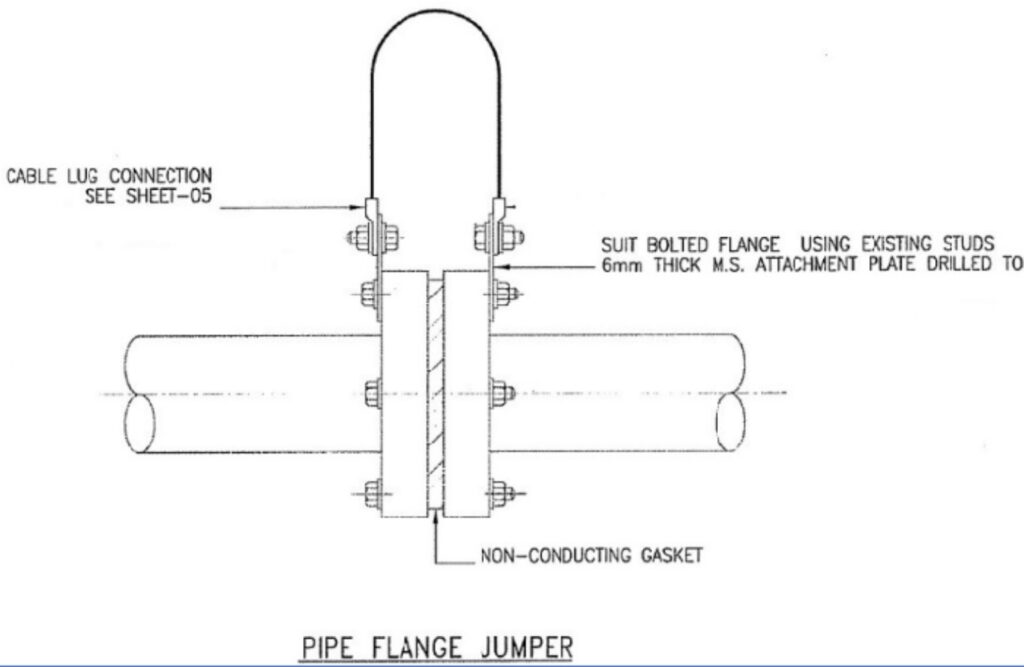
10.1.2 Bonding wires might be needed around flexible, swivel, or sliding joints. Tests and experience have shown that resistance in these joints is normally below 10 ohms, which is low enough to prevent accumulation of static charges. However, the manufacturer's specifications should be checked or the joints should be inspected, because a few are fabricated with insulating surfaces. Where painted, slip flanges (lap joints) using nonconductive gaskets can cause loss of continuity in the grounding path. This loss of continuity can be remedied by using a conductive gasket, such as a flexible, graphite-filled, spiral-wound gasket, or by installing a jumper wire across the joint.
Chapter 15 Powders and Dusts
15.7.2.2 Where the use of pipe-joining methods or installation of piping components results in an interruption of continuity of the ground path, one of the following criteria should be met:
(1) A jumper cable should be used to maintain continuity.
(2) An independent ground should be provided for the isolated section of the conduit, as shown in Figure 15.7.2.2.