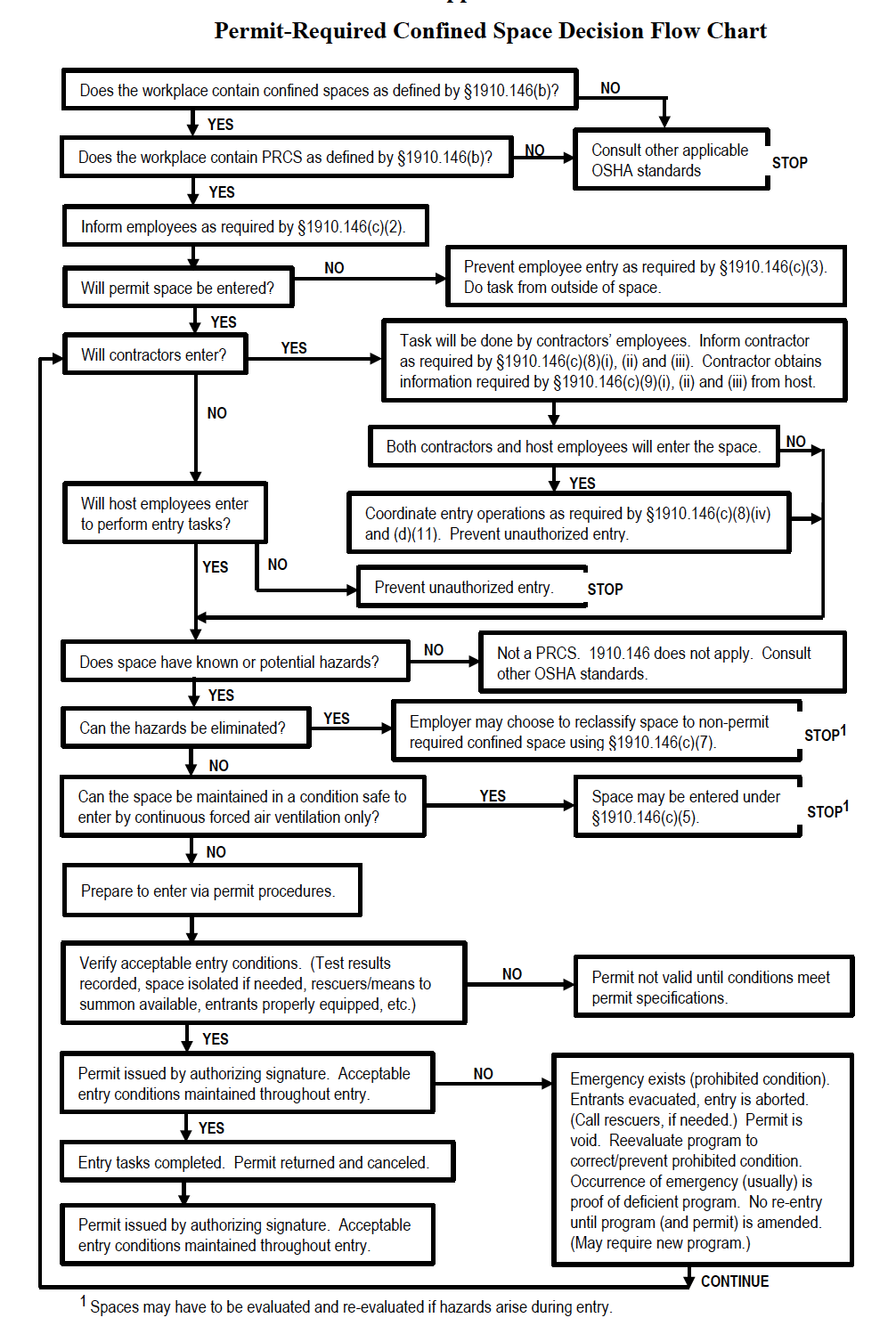
By definition, confined spaces have limited or restricted access that may make rescue difficult. There must be written rescue procedures for confined spaces. Read this section for information on the responsibilities of rescue personnel and rescue procedures and equipment. Some employers believe that having a good rescue team is the most important part of a confined space entry program. A rescue team and procedures should not be used as a substitute for making a confined space safe. It is essential that the air is safe to breathe before entry so that a rescue team is not required except for serious injuries or medical emergencies.
Studies have shown that over 60% of confined space deaths occur among would-be rescuers. Rescue plans and proper training for rescuers must be in place before any confined space entry. This will prevent well-meaning workers who are untrained in rescue from entering confined spaces to assist workers in distress and themselves becoming victims.
Provision for rescue
The employer must provide for the services of rescue persons when a worker enters a confined space. If the rescue persons are employees of another firm or an agency, there must be a written agreement detailing the services to be provided.
A rescue plan includes practicing the plan. This helps to ensure that personnel, equipment, and procedures are in place to effect rescue. The written rescue plan provides a step-by-step means of ensuring all possibilities are considered. Practicing the plan provides information about where improvements must be made. For example, the plan may state that a gurney will be used to remove workers from a confined space. Practice may reveal that the stretcher will not fit into the space, the workers cannot lift the injured worker from inside the space, or the winch apparatus needs to be replaced. The more often the rescue plan is practised, the less likely something will go wrong if a rescue is required. A practice drill must be held at least once each year.
If rescue cannot be effected by the standby person(s) using harnesses, lifelines and lifting equipment, then one or more additional workers must be stationed at the entrance to the confined space and these workers must be equipped and capable of entering the space and effecting rescue.
Every person assigned rescue duties must be properly equipped and adequately trained to carry out these duties. Employers may use their own trained workers or another firm or an agency. In such cases, there must be a written agreement detailing the services to be provided. If additional rescue services may be required, there must be prior planning and pre-entry discussions with the rescue services.
Records of training and practice drills must be maintained by the employer of the rescue persons.
Supervisor of the entry, or the standby person
The supervisor of the entry, or the standby person, must notify rescue personnel of work to be done before a worker enters a confined space. If more than one confined space is to be entered at the same time, rescue personnel need to know this and be on alert status. The supervisor of the entry or standby person must also notify rescue personnel when all workers have completed their work and left the space.
Note: Notification requirements do not apply if a written agreement with the rescue agency indicates that rescue personnel are available on a 24-hour basis.
Employer
The employer must ensure that rescue personnel are monitoring any signaling system that will be used to summon them in an emergency. The employer must ensure rescue procedures include every possible means of eliminating, controlling, or reducing the risk to emergency personnel, including the use of mechanical ventilation. All employers are responsible for the provision of first aid equipment, supplies, facilities, and services, as determined by an assessment that would meet the requirements of section 3.16 of the Occupational Health and Safety Regulation.
Person directing the rescue
The person who directs the rescue or evacuation must be adequately trained in such procedures and must be the supervisor of the entry or a qualified rescue person. There must be voice communication at all times between the person directing the rescue and the workers who are performing the rescue.
Rescue workers
Trained rescue workers will know how to conduct a rescue and will consider the following:
- Additional workers located outside to assist
- Rescue from the outside (if possible)
- Requirements for use of a safety harness and lifeline
Trained rescue workers will also know that if IDLH conditions exist or could develop, they must enter only with an SCBA or supplied-air respirator equipped with an escape bottle. Small-diameter openings will require special consideration for rescue workers who are encumbered with SCBA apparatus. A key objective is to correct atmospheric hazards prior to entry, and supply adequate ventilation to ensure a safe atmospheric environment whenever practicable.
Written procedures for rescue
Written procedures for rescue must be in place before every confined space entry. The procedures will consider:
- All hazards of the space as specified in the hazard assessment
- Dimensions of the space, location of entry and exit points, and obstacles to removing an injured worker
- Rescue equipment required for each space
- Personal protective equipment for rescuers, including appropriate respirators for any contaminants or IDLH conditions
- Communication between workers, rescuers, the supervisor of the entry, and standby persons
- Procedures to follow immediately after an incident has occurred
- Possible hazards that may arise during rescue, the appropriate evaluation of these hazards, and control methods recommended by the qualified person
- Rescue methods for a worker who is unconscious, unresponsive (on or off of a lifeline), or distressed
Contact protocols
Do NOT rely on a call to 911 to provide the rescue services unless you have a specific written agreement with your local public emergency service provider. You are required to pre-arrange any rescue services. However, if you unexpectedly find you need additional medical or rescue services (911), then the contact person must be prepared to provide as much information as possible in order to inform the responders who will be attending the emergency:
- Exact location: If the address is hard to find, provide easy access instructions—for example, “from the intersection of Highway 10 and Main Street, follow Route 7 for 3 km and then turn left at the crossroads.”
- Exactly what was being done and what happened to the worker: Not all people understand specific names of equipment, such as a “batch digester.” So, simplify the description without losing the necessary information. For example, “the worker was applying a coating inside a tank and he lost consciousness and fell off a 2-metre-high platform.”
- State what you need: For example, “We require a hazmat team, a rescue team, and emergency medical services.”
Not all fire departments have the equipment or the training necessary to enter confined spaces to rescue someone. It is essential that employers pre-plan rescue with a rescue service provider.
Rescue equipment
Harnesses
The type of harness depends on whether the worker must be rescued in a vertical direction or otherwise. If the rescue is anything other than a vertical rescue, the qualified person will consider the equipment required. In a vertical rescue, a full-body harness must be used to keep the worker in an upright position. Safety harnesses with leg, waist, and shoulder straps must meet the requirements of CSA Standard CAN/CSA Z259.1-M90, Full Body Harnesses, or other standard acceptable to WorkSafeBC.
Wrist harnesses attached to each wrist of the worker are designed only to help prevent contact of the arms with hazard points. Safety lines attached to wrist harnesses must not be used as rescue equipment.
Lifelines and connections
Select lifelines for strength, chemical stability, abrasion resistance, and, where high voltages may be encountered, electrical resistance. For example, nylon has good breaking strength and abrasion resistance, but may not be a good choice around high voltages because of its ability to absorb moisture. Lines must be free of knots and splices (except at the ends) and must be securely anchored. Connections to harnesses should be made with locking snaphooks or a locking-type carabiner.
Lifting equipment
Lifting-assist devices include the following:
- A worker-rated hand winch with a dog-action brake or a block and tackle to provide mechanical assistance, capable of both lifting and lowering
- A powered winch, when the length of lift is substantial, capable of both lifting and lowering, and with an effective means of control that has been tested before use
- Edge rollers to protect the lifeline from abrasion where the line encounters sharp edges
- A rope grab, brake bar, or other similar device to help prevent return slippage
For more GREAT tips from WorkSafe BC http://www.worksafebc.com/publications/health_and_safety/by_topic/assets/pdf/confined_space_entry_bk84.pdf