
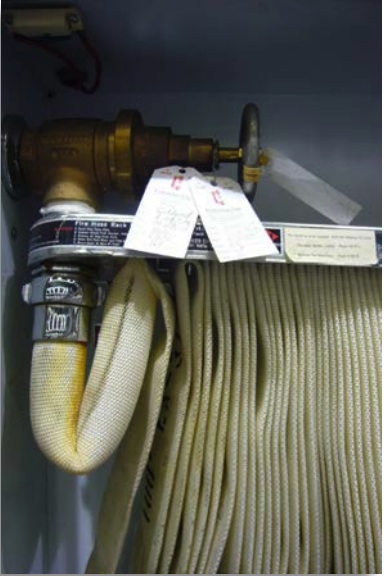
Class II standpipe hose systems are found in a variety of properties/facilities where occupants may be expected or may be able to provide suppression operations early in a fire. Unfortunately, this equipment often is subject to tampering by curious individuals or vandals, which then may affect its functionality. In the illustration, the 1 1/2-inch (38-millimeter) hose is stored on a pin rack assembly. Each hose fold is held in place by a small metal pin that falls aside when the hose is removed by the user. When water accumulates in one or more folds, it may bind the hose between the pin and rack to prevent it from being removed.
The model fire codes require periodic inspection of these systems to identify and correct problems like this. National Fire Protection Association (NFPA) 25, Standard for the Inspection, Testing, and Maintenance of Water-Based Fire Protection Systems provides guidance for the inspector. According to NFPA 25, hose and cabinets should be inspected annually, and nozzles should be inspected annually and after each use.
Any signs of mildew, cuts, abrasions, deterioration or other damage to the hose is a trigger to replace it. Damaged couplings or hose stations should be repaired or replaced. Hose that is improperly racked or rolled should be removed and returned in its proper position. The hose should be reracked, rereeled or rerolled so that any folds do not occur at the same position on the hose. Hose that has passed its test period should be retested or replaced. NFPA 1962, Standard for the Care, Use, Inspection, Service Testing, and Replacement of Fire Hose, Couplings, Nozzles, and Fire Hose Appliances provides inspection and test criteria for the hose.
In-service hose designed for occupant use only should be removed and service tested at intervals not exceeding five years after the date of manufacture and every three years thereafter. The hose should be tested to the pressure shown on its outer jacket. The test procedure should be conducted under controlled conditions as described in NFPA 1962, not at the hose station where the hose is installed.
When hose is taken out of service for testing, replacement hose should be installed on the rack, on the reel, or in the storage area until the tested hose is returned to service. For additional information, consider attending the National Fire Academy course “Fire Inspection Principles” (R0220). You can obtain more information and apply at http://apps.usfa.fema.gov/nfacourses/catalog/details/47.
CLICK HERE for the pdf from USFA.