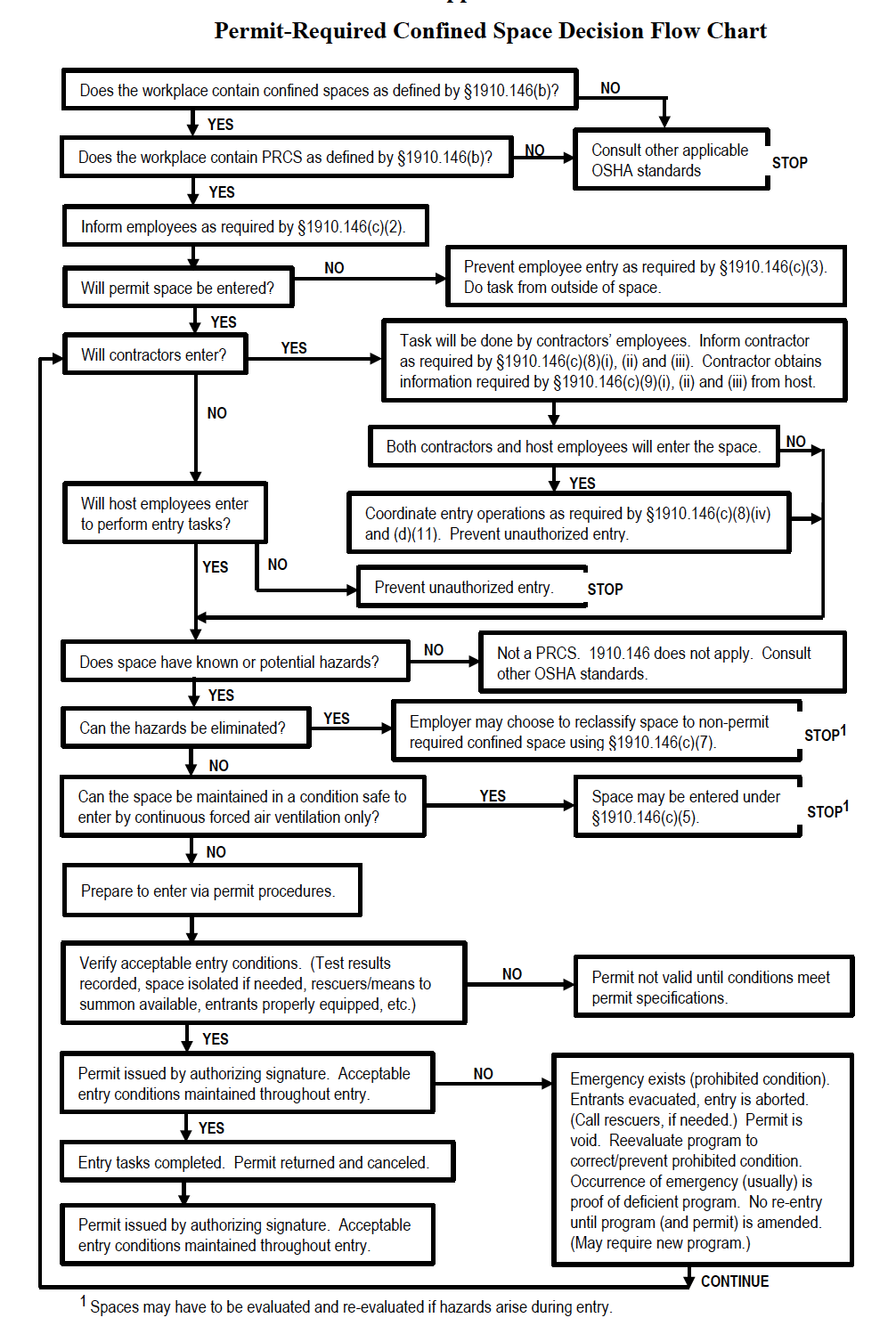
There is significant confusion among businesses about how the “reclassification” method under 1910.146(c)(7) should be applied. I always suggest that safety professionals take the time to read OSHA’s preamble to any standard that has one. The preamble to 1910.146 is an EXCELLENT source of information, as it is where OSHA justifies the requirements in the standard and explains its intent and rationale. It is in the preamble that I turn to for when and how OSHA intended 1910.146(c)(7) to be used…
(emphasis added by me – NOT OSHA)
Paragraph (c)(7) of the final rule gives procedures under which the employer may ELIMINATE hazards within a permit space so that it may be reclassified as a non-permit confined space. OSHA believes that this paragraph will protect employees by encouraging employers to eliminate hazards (as opposed to controlling hazards such as in (c)(5)) within permit spaces. OSHA anticipates that some spaces will be reclassified back and forth from time to time, because of changes in their configuration or use. Accordingly, OSHA has included language in this paragraph to indicate clearly that the reclassification is valid ONLY as long as the hazards remain eliminated.
OSHA believes that employees are fully protected from the hazards of permit space entry once ALL hazards within the space have been eliminated. Clearly, if there are no hazards within the permit space, an entrant is in no danger. By contrast, if the hazards are simply controlled rather than removed/eliminated, the entrant could be injured upon failure of the control system. Therefore, OSHA has determined that it is appropriate to allow employers who ELIMINATE hazards within permit spaces to reclassify those spaces as non-permit confined spaces.
Paragraph (c)(7)(i) of the final rule allows the employer to reclassify a permit space as a non-permit confined space if there are NO actual OR potential atmospheric hazards AND if ALL other hazards within the space are eliminated WITHOUT entry into the space. The reclassification would be valid as long as the non-atmospheric hazards remain eliminated.
This paragraph applies ONLY to permit spaces containing NO actual or potential atmospheric hazards. OSHA expects that this provision will apply primarily to spaces containing hazardous energy sources OR containing engulfment hazards. The control of hazardous energy sources is addressed by existing section 1910.147, The control of hazardous energy sources (lockout/tagout). That standard covers the service and maintenance of machines and equipment in which the unexpected energizing or start up of the machines or equipment or release of stored energy could cause injury to employees. OSHA believes that it is possible in some cases to deenergize and lockout machinery and equipment, using the procedures specified in section 1910.147 (15), so that the energy hazards are eliminated without any entry into the permit space. For spaces posing ONLY engulfment hazards, it may be possible to remove the hazard by removing the engulfing material from the space before entry. In these cases, the Agency believes that entry into these spaces, after the hazards have been removed, is at least as safe as (if not safer than) entry in accordance with the full permit space program requirements given in paragraphs (d) through (k). Paragraph (c)(7)(i), therefore, allows the reclassification of these types of spaces after their hazards have been eliminated.
__________
Footnote(15) If the equipment or machinery is not deenergized and locked out or tagged in accordance with section 1910.147, then it must be guarded as required in other general industry standards, such as Subpart O, for machine guarding, and section 1910.303(g) and (h), for the guarding of electric equipment. As long as the equipment or machinery inside the permit space remains guarded, employees within the space are not considered to be exposed to any equipment-related hazards.
The reclassification of permit spaces allowed under paragraph (c)(7)(i) of the final rule recognizes that spaces such as mixers and material bins can have their hazards removed BEFORE entry, so that entrants are fully protected without the need for permits, attendants, or other features required by the full permit space program requirements given in paragraphs (d) through (k). Mixers can be locked out before it is entered for servicing or maintenance, removing the mechanical hazards. A material bin posing an engulfment hazard can be emptied before entry, thus removing that hazard. These are the types of spaces that can be made safe for entry following paragraph (c)(7)(i) of the final rule.
Permit spaces that contain or have the potential to contain hazardous atmospheres may also be reclassified as non-permit spaces, under paragraph (c)(7)(ii) of the final rule. The Agency believes that these spaces need to be treated the same as any space that must be entered in order to eliminate hazards. After this type of space is isolated, purged, and ventilated from outside, it must be entered to test the atmosphere and inspect conditions within the space in order to ensure that the hazards have indeed been eliminated. (Once again, control of a hazardous atmosphere is not the same as its elimination.) Paragraph (c)(7)(ii) of the final rule allows the employer to reclassify a permit space as a non-permit confined space AFTER a permit entry is performed to eliminate hazards within the space. The permit entry must be conducted in accordance with the full permit space program requirements given in paragraphs (d) through (k). This reclassification would also be valid only as long as the hazards remain eliminated.
As noted earlier, OSHA believes that entry into a permit space whose hazards have been removed is safe. Some spaces, however, must be entered either to remove the hazards or to verify that the hazards have been eliminated. For example, if the disconnecting means for an energy source is inside the permit space, the space must be entered in order to deenergize it and lock it out. Also, as noted previously, if the permit space poses any atmospheric hazards, it must first be entered in order to perform the testing and inspection that is necessary to determine whether the hazards have been eliminated. As long as the entry to remove the permit space hazards is conducted in accordance with the full permit space program requirements given in paragraphs (d) through (k), the space can be considered as safe and reclassified after the hazards have been removed.
The types of permit spaces that could fall under paragraph (c)(7)(ii) include such spaces as chemical tanks and boilers. Chemical tanks can frequently be made safe by draining them of their contents, purging any residual chemicals with water, and ventilating the space after purging is complete. Boilers can be made safe for entry by shutting them down, opening the access ports to allow for temperature reduction and natural ventilation, and entering the space to remove any residual hazards, such as loose buildup that could fall onto entrants. In each case, an entry, conducted in accordance with the full permit space program requirements given in paragraphs (d) through (k), must be performed in order to ensure that the hazards have been eliminated. (SPECIAL NOTE: Although OSHA stated a permitted entry is required BEFORE the space can be reclassified, I do not believe this to be the case in many basic spaces).
Paragraph (c)(7)(iii) of the final rule requires employers seeking to reclassify a permit space to document the basis for the determination that all permit space hazards have been eliminated, through a certification that contains the date, the location of the space, and the signature of the certifying individual. The certification must be made available to each employee entering the space.
This provision is basically equivalent to paragraphs (c)(5)(i)(E) and (c)(5)(ii)(H) of the final rule. In each case, the employer must substantiate all determinations that compliance with the alternate provisions is appropriate, so that employers, employees, and the Agency have the means by which to evaluate those determinations. Compliance with this provision will require careful consideration of the spaces to be reclassified. OSHA believes that this paragraph imposes a reasonable burden, considering that compliance will enable employers to have employees enter these reclassified spaces without the need to implement the full array of permit space program requirements.
If a permit space hazard arises in a space that has been reclassified under paragraph (c)(7), paragraph (c)(7)(iv) of the final rule requires employees to exit the space and requires employers to reevaluate the space to determine if the space must be reclassified again as a permit space.
This provision indicates clearly that employers retain responsibility for the safety of employees who enter spaces after the spaces have been reclassified as non-permit confined spaces. The employer MUST determine if it is still appropriate, under the circumstances identified through the reevaluation, to classify the space where the hazard arose as a non-permit confined space. A reevaluation aimed at reestablishing compliance with paragraph (c)(7) will encompass the demonstrations, testing, inspection, and documentation required in paragraphs (c)(7)(i) through (c)(7)(iii) of the final rule. OSHA anticipates that some employers will seek to reestablish compliance with paragraph (c)(7), while others will choose to conduct the entries in accordance with the full permit space program requirements given in paragraphs (d) through (k). The Agency’s concern is that the approach chosen adequately protect employees who enter the spaces.