
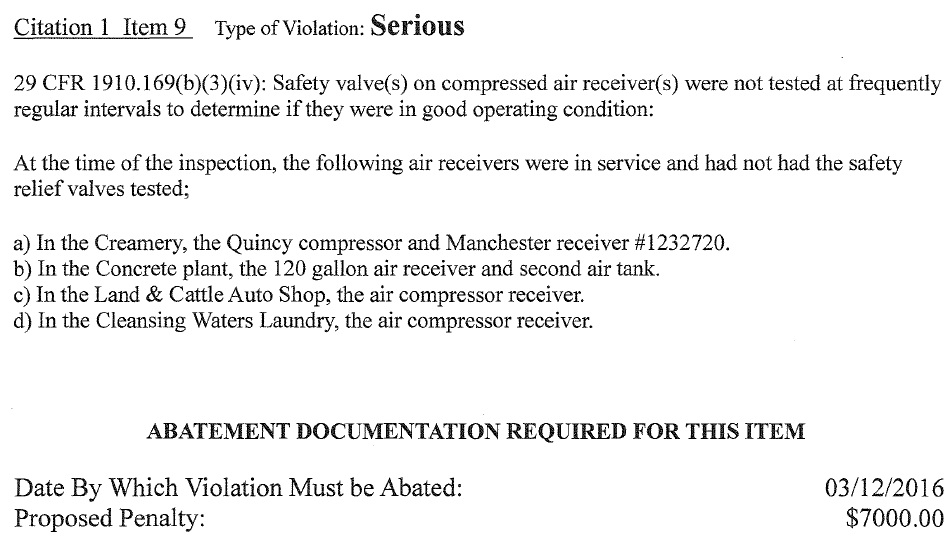
Here is another recent citation from OSHA on a standard that gets very little attention, 1910.169 Air ReceiversAir Receivers.
1910.169(b)(3)(iv) All safety valves shall be tested frequently and at regular intervals to determine whether they are in good operating condition.
Least we NOT forget about the vessel that the RV is attached!!!!
1910.169(a)(2)(i) All new air receivers installed after the effective date of these regulations [i.e. June 27, 1974] shall be constructed in accordance with the 1968 edition of the A.S.M.E. Boiler and Pressure Vessel Code Section VIII, which is incorporated by reference as specified in Sec. 1910.6.
1910.169(a)(2)(ii) All safety valves used shall be constructed, installed, and maintained in accordance with the A.S.M.E. Boiler and Pressure Vessel Code, Section VIII Edition 1968.
1910.169(b) Installation and equipment requirements –
1910.169(b)(1) Installation. Air receivers shall be so installed that all drains, handholes, and manholes therein are easily accessible. Under no circumstances shall an air receiver be buried underground or located in an inaccessible place.
1910.169(b)(2) Drains and traps. A drain pipe and valve shall be installed at the lowest point of every air receiver to provide for the removal of accumulated oil and water. Adequate automatic traps may be installed in addition to drain valves. The drain valve on the air receiver shall be opened and the receiver completely drained frequently and at such intervals as to prevent the accumulation of excessive amounts of liquid in the receiver.
1910.169(b)(3) Gages and valves.
1910.169(b)(3)(i) Every air receiver shall be equipped with an indicating pressure gage (so located as to be readily visible) and with one or more spring-loaded safety valves. The total relieving capacity of such safety valves shall be such as to prevent pressure in the receiver from exceeding the maximum allowable working pressure of the receiver by more than 10 percent.
1910.169(b)(3)(ii) No valve of any type shall be placed between the air receiver and its safety valve or valves.
1910.169(b)(3)(iii) Safety appliances, such as safety valves, indicating devices and controlling devices, shall be constructed, located, and installed so that they cannot be readily rendered inoperative by any means, including the elements.
PLEASE refer to my January 2015 Posting “A lesson in Pressure Vessel Safety via 1910.169” for more information on this topic.