
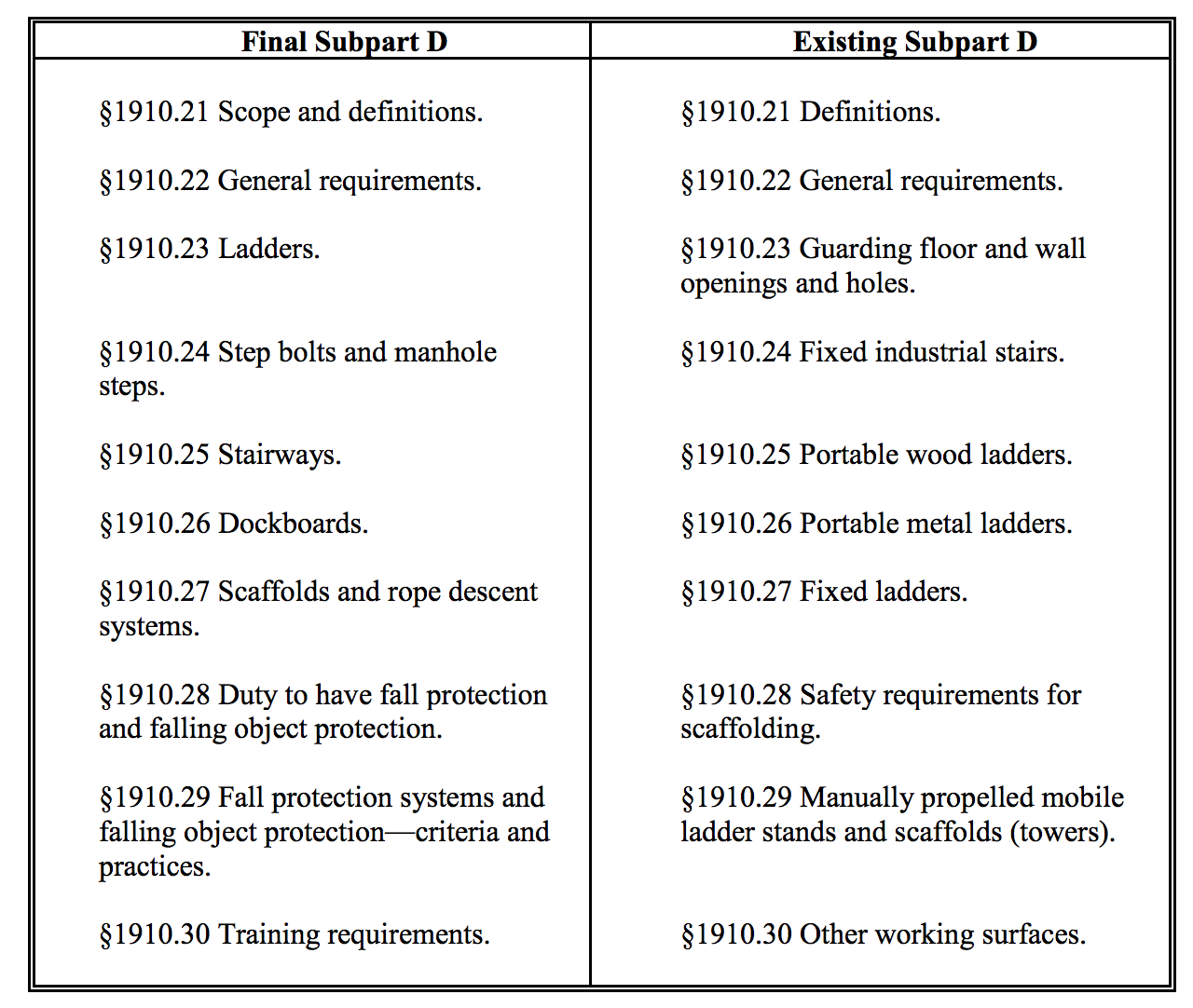
 Tomorrow OSHA will publish their new standard Walking-Working Surfaces and Personal Protective Equipment (Fall Protection Systems) in the Federal Register. This means that 60 days later (January 17, 2017), the standard will be EFFECTIVE, with some provisions having delayed enforcement dates. This rule, in the making since the 1990’s, will essentially change the way FALL PROTECTION in general industry workplaces will be managed and the BIGGEST change will come to FIXED LADDERS over the next 2 years and 20 years. The new rule will FINALLY CLARIFY (beyond question) that workers must be protected from fall hazards along unprotected sides or edges that are at least 4 feet above a lower level (NOT 6′ like in the construction industry!). The final rule revises and updates the requirements in the general industry WalkingWorking Surfaces standards (29 CFR part 1910, subpart D), including requirements for ladders, stairs, dockboards, and fall and falling object protection; and it adds new requirements on the design, performance, and use of personal fall protection systems (29 CFR part 1910, subpart I). The final rule also makes conforming changes to other standards in part 1910 that reference requirements in subparts D and I. Under the final rule, employers may choose from the following fall protection options:
- Guardrail System – A barrier erected along an unprotected or exposed side, edge, or other area of a walking-working surface to prevent workers from falling to a lower level.
- Safety Net System – A horizontal or semi-horizontal, cantilever-style barrier that uses a netting system to stop falling workers before they make contact with a lower level or obstruction.
- Personal Fall Arrest System – A system that arrests/stops a fall before the worker contacts a lower level. Consists of a body harness, anchorage, and connector, and may include a lanyard, deceleration device, lifeline, or a suitable combination. Like OSHA’s construction standards, the final rule PROHIBITS the use of body belts as part of a personal fall arrest system.
- Positioning System – A system of equipment and connectors that, when used with a body harness or body belt, allows a worker to be supported on an elevated vertical surface, such as a wall or window sill, and work with both hands-free.
- Travel Restraint System – A combination of an anchorage, anchorage connector, lanyard (or other means of connection), and body support to eliminate the possibility of a worker going over the unprotected edge or side of a walking-working surface.
- Ladder Safety System – A system attached to a fixed ladder designed to eliminate or reduce the possibility of a worker falling off the ladder. A ladder safety system usually consists of a carrier, safety sleeve, lanyard, connectors, and body harness. Cages and wells are NOT considered ladder safety systems.
-
In the final rule, a ladder safety system is a system designed to eliminate or reduce the possibility of falling from a ladder. The final definition explains that a ladder safety system usually consists of a carrier; a safety sleeve, which is a moving component that travels on the carrier; a lanyard; connectors; and a body harness as shown below.
-
Fixed Ladder Safety System
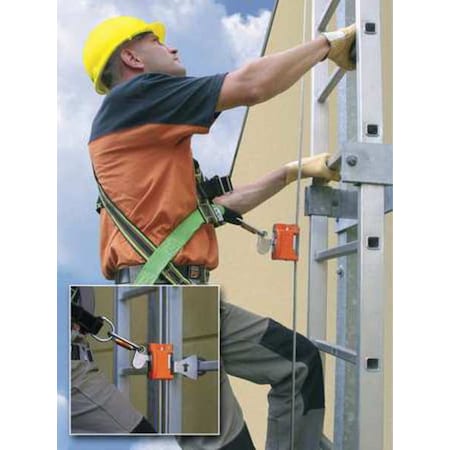
Source: Miller by Honeywell
LADDERS
The new rule includes requirements to protect workers from falling off fixed and portable ladders as well as mobile ladder stands and platforms. Theses ladder requirements do NOT apply to ladders used in emergency operations OR ladders that are an integral part of or designed into a machine or piece of equipment.
In general, ladders will be REQUIRED to be capable of supporting their maximum intended load, while mobile ladder stands AND platforms will be REQUIRED to support four times (4X’s) their maximum intended load.
Each ladder WILL BE REQUIRED to be inspected BEFORE INITIAL USE in a work shift, as well as more frequently as necessary to identify defects that could cause injury. For example, if a ladder tips over, falls off a structure (e.g., roof) or vehicle, is struck by an object (e.g., vehicle or machine), or used in a corrosive environment, it needs to be inspected to ensure damage has not occurred and the ladder is still safe to use.
FIXED LADDER CHANGES
Fixed ladders are those ladders that are permanently attached to a structure, building, or equipment, including individual-rung ladders, but NOT ship stairs, step bolts, or manhole steps.
The new rule phases in a requirement for employers to have LADDER SAFETY or PERSONAL FALL ARREST SYSTEM (PFAS) for fixed ladders that extend MORE THAN 24 feet, and PHASES OUT the use of cages or wells for fall protection. The new rule establishes a new framework to protect workers from fall hazards on fixed ladders that allows employers to gradually, over 20 years, phases in ladder safety systems/personal fall arrest systems and phase out the use of cages and wells as a means of fall protection. After this 20-year period ends, the final rule requires that employers must ensure all fixed ladders are equipped with either ladder safety or personal fall arrest systems to protect workers from fall hazards.
The new rule establishes the following phase-in/phase-out schedule:
- For existing fixed ladders (that is, for ladders erected BEFORE November 19, 2018) – employers have up to twenty (20) years to install LADDER SAFETY or PERSONAL FALL ARREST SYSTEM (PFAS)
- For new fixed ladders (that is, for new ladders erected ON OR AFTER November 19, 2018) – the employer MUST equip the NEW ladder with a LADDER SAFETY or PERSONAL FALL ARREST SYSTEM (PFAS)
- For ladder repairs and replacements – when an employer replaces any portion of a fixed ladder the replacement MUST be equipped with a LADDER SAFETY or PERSONAL FALL ARREST SYSTEM (PFAS); and
- The final deadline for ALL fixed ladders – on and after November 18, 2036 ALL fixed ladders MUST be equipped with a LADDER SAFETY or PERSONAL FALL ARREST SYSTEM (PFAS)
The gradual phasing out of cages and wells means that employers may continue to use existing fixed ladders during the 20-year phase-out period, even if the existing fixed ladders are equipped only with cages and wells. However, during the 20-year phase out period, when employers install new fixed ladders or replace a portion of a section on an existing fixed ladder, to install a new fixed ladder equipped with a LADDER SAFETY or PERSONAL FALL ARREST SYSTEM (PFAS) (when replacing the entire ladder) or equip the replacement section (e.g., a ladder with multiple, offset sections) with a LADDER SAFETY or PERSONAL FALL ARREST SYSTEM (PFAS) (when replacing a portion of an existing fixed ladder). At the end of 20 years, ALL fixed ladders must be equipped with LADDER SAFETY or PERSONAL FALL ARREST SYSTEM (PFAS). (OSHA notes that after the 20-year phase out period ends employers may still have or equip fixed ladders with cages and wells, but OSHA will NOT consider them to be a means of fall protection.)
Final paragraph (b)(9)(i)(A) requires that employers ensure existing fixed ladders are equipped with at least one of the following four devices no later than November 19, 2018:
- A cage;
- A well;
- A ladder safety system; or
- A personal fall arrest system.
Although the existing rule requires that employers already must have installed cages or wells on fixed ladders, the record indicates some have not. Therefore, OSHA is giving employers two (2) years to come into compliance with the existing rule (existing §1910.27).
Providing two (2) years will ensure that employers have adequate time to order and install devices on fixed ladders and will reduce costs for employers who have ordered and not yet installed new fixed ladders equipped with cages or wells. Although the final rule is phasing out the use of cages and wells as a fall protection device, final paragraph (b)(9)(i) allows employers to continue to use existing fixed ladders that have a cage or well, but not ladder safety or personal fall arrest system, until:
- The fixed ladder, cage, or well, of portion of it is replaced (final paragraph (b)(9)(i)(C)); or
- November 18, 2036 (final paragraph (b)(9)(i)(D)), whichever comes first
This means that employers may not have to install ladder safety or personal fall arrest systems on their existing fixed ladders for up to 20 years. However, OSHA believes that many employers already have installed ladder safety systems and personal fall arrest systems or will install those systems long before the 20-year deadline comes due.
For fixed ladders that do not have any fall protection, which appears to be the case in the outdoor advertising industry, final paragraph (b)(9)(i)(A) requires that employers install a cage, well, ladder safety system, or personal fall arrest system before November 19, 2018. OSHA believes that most of those employers will install ladder safety or personal fall arrest systems during that time.
Final paragraph (b)(9)(i)(C) does not require that employers install ladder safety or personal fall arrest systems when they make minor repairs to fixed ladders, cages, or wells, such as replacing a bolt or repairing a weld on a cage. However, when employers determine that they cannot simply make a repair to a section or a portion of a section of a fixed ladder, cage, or well but must replace that portion or section, employers must ensure the replacement is equipped with a ladder safety or personal fall arrest system. OSHA believes the inspection requirement in final §1910.22(d) will help employers identify when simple repairs or corrections will be adequate and when the situation, such as a condition that affects the structural integrity of the fixed ladder, cage, or well, necessitates replacement of the fixed ladder, cage, or well section.
Final paragraph (b)(9)(ii) adds new requirements for one-section fixed ladders that are equipped with personal fall arrest systems or ladder safety systems and fixed ladders equipped with those systems on MORE THAN ONE ladder section. For these ladders, the final rule requires that employers ensure:
- The personal fall arrest or ladder safety system provides protection throughout the entire vertical distance of the ladder, including all ladder sections (final paragraph (b)(9)(ii)(A)); and
- The ladder has rest platforms provided at least every 150 feet (final paragraph (b)(9)(ii)(B)).
In final paragraph (b)(9)(ii)(A), OSHA clarified the proposed language (“vertical 415 distance”) so the Agency could eliminate the need for the proposed note to paragraph (b)(9). OSHA stresses that the entire vertical distance of a fixed ladder includes all sections of a ladder, as well as any vertical distance in between ladder sections (sometimes referred to as “entire length of climb”). This means that employers must protect workers for the entire vertical distance of fixed ladders equipped with ladder safety or personal fall arrest systems. The final provision also addresses the hazard of attempting to connect to a ladder safety or personal fall arrest system part way through a climb (i.e., at 24 feet), which would require that the worker release one hand from the ladder, and thereby increase the risk of falling. This requirement is consistent with the construction fall protection standard and ANSI A14.3-2008 (Section 7.1.6)
OSHA notes that final paragraph (b)(9)(ii)(A) does NOT apply when only one (1) section of a multiple-sectioned fixed ladder has a personal fall arrest system or ladder safety system AND the other sections have only cages or wells. In this case, final paragraph (b)(9)(i)(C) applies, and employers need only ensure that the ladder safety or personal fall arrest system protects the worker during that section of the climb. However, when one-section fixed ladders and multiple sections of a fixed ladder have a ladder safety or personal fall arrest system, final paragraph (b)(9)(ii)(A) applies, and the employer MUST ENSURE the system protects the worker throughout
the entire climb.
The rule requires that employers ensure fixed ladders that have personal fall arrest or ladder safety systems also have landing platforms at intervals of at least every 150 feet. This final provision generally is consistent with OSHA’s construction ladder standard and ANSI A14.3-2008. OSHA’s ladder standard for construction requires that fixed ladders with self-retracting lifelines have rest platforms every 150 feet, while the ANSI standard requires that fixed ladders equipped with ladder safety systems have rest platforms at the same intervals (Section 4.1.4.2)
Final paragraph (b)(9)(iii), applies during the gradual phase out of cages and wells. The final rule requires that employers ensure ladder
sections that have cages or wells:
- Are offset from adjacent sections (final paragraph (b)(9)(iii)(A)); and
- Have landing platforms provided at maximum intervals of 50 feet (final paragraph (b)(9)(iii)(B))
Final paragraph (b)(9)(iii) is the same as the ladder standard for construction (§1926.1053(a)(19)(iii)). ANSI/ASC A14.3-2008 requires that each section of multiple section ladders equipped with only cages or wells be horizontally offset from adjacent sections and have
landing platforms to provide safe access/egress (Section 4.1.4.1). Figure 5a in the A14.3 standard specifies platform landings at intervals of at least 50 feet. The existing rule in §1910.27(d)(2), however, requires landing platforms at 30-foot intervals if the fixed ladder has a cage or well, and at 20-foot intervals when there is no cage or well. OSHA based the existing rule on the ANSI A4.13-1956 rule in effect at the time. OSHA believes that making final paragraph (b)(9)(iii) consistent with the construction ladder requirements and the current ANSI A14.3-2008 standard will allow workers who perform both general industry and construction
activities to use the same fixed ladders while cages and wells are being phased out. OSHA notes that once employers equip fixed ladders with a ladder safety or personal fall arrest system this provision no longer applies, even if the ladder also still has the cage or well.
PORTABLE LADDERS
Portable ladders usually consist of side rails joined at intervals by steps, rungs, or cleats. They can be self-supporting or lean against a supporting structure. The final rule will be easier for employers and workers to understand and follow because it uses flexible performance based language instead of detailed specification and design requirements. Under the revisions, employers must ensure that:
- rungs and steps are slip resistant;
- portable ladders used on slippery surfaces are secured and stabilized;
- portable ladders are NOT moved, shifted, or extended while a worker is on them;
- top steps and caps of stepladders are NOT used as steps;
- ladders are NOT fastened together to provide added length unless designed for such use; and
- ladders are NOT placed on boxes, barrels, or other unstable bases to obtain added height
TRAINING REQUIREMENTS
The rule adds a requirement that employers ensure workers who use personal fall protection and work in other specified high hazard situations are trained, and retrained as necessary, about fall and equipment hazards, including fall protection systems. A QUALIFIED PERSON (e.g. a person who, by possession of a recognized degree, certificate, or professional standing, or who by extensive knowledge, training, and experience has successfully demonstrated the ability to solve or resolve problems relating to the subject matter, the work, or the project) must train these workers to correctly:
- identify and minimize fall hazards;
- use personal fall protection systems and rope descent systems; and
- maintain, inspect, and store equipment or systems used for fall protection
When there is a change in workplace operations or equipment or the employer believes that a worker would benefit from additional training based on a lack of knowledge or skill, then the worker MUST BE RETRAINED. The training MUST be provided in a language and vocabulary that workers understand.
Rolling Stock and Motor Vehicles
Since the Agency did not propose any specific fall protection requirements for rolling stock or motor vehicles, OSHA has NOT included any in this final rule. However, it will continue to consider the comments it has received, and in the future the Agency may determine whether it is appropriate to pursue any action on this issue
TIMELINE
Most of the rule will become effective 60 days after it is published in the Federal Register, but some provisions have delayed effective dates, including:
- Ensuring exposed workers are trained on fall hazards (6 months),
- Ensuring workers who use equipment covered by the final rule are trained (6 months),
- Inspecting and certifying permanent anchorages for rope descent systems (1 year),
- Installing personal fall arrest or ladder safety systems on new fixed ladders over 24 feet and on replacement ladders/ladder sections, including fixed ladders on outdoor advertising structures (2 years),
- Ensuring existing fixed ladders over 24 feet, including those on outdoor advertising structures, are equipped with a cage, well, personal fall arrest system, or ladder safety system (2 years), and
- Replacing cages and wells (used as fall protection) with ladder safety or personal fall arrest systems on all fixed ladders over 24 feet (20 years).
Here is OSHA’s Walking-Working Surfaces and Personal Fall Protection Systems Final Rule Frequently Asked Questions