March 2018 UPDATE – OSHA has cited an egg processing facility for multiple safety violations after an employee suffered fatal injuries when he was struck by a dock leveler. A dock leveler is a device that allows a forklift to move between a loading dock and a trailer. One of the employer’s dock levelers was undergoing maintenance. OSHA investigators determined that the employer failed to properly brace the dock leveler during maintenance, causing it to fall onto an employee assisting with the maintenance. OSHA cited the facility for exposing employees to hazards associated with failing to properly brace equipment during servicing and maintenance; failing to develop written and effective training and procedures for lockout/tagout; and failing to conduct periodic reviews of the company’s lockout/tagout safety procedures. It also found violations relating to electrical and arc flash hazards. The company faces $188,464 in proposed penalties. NO citations were issued for PRCS.
2018 UPDATE – LOTO FATALITY OSHA investigating fatal accident at Michael Foods (fatal incident happened at about 11:15 AM when an employee was hurt after a dock leveler unexpectedly dropped – a dock leveler is often used to bridge the gap between a truck and the dock or warehouse floor – in 2014, OSHA fined the company more than $30,000 dollars after a worker died)
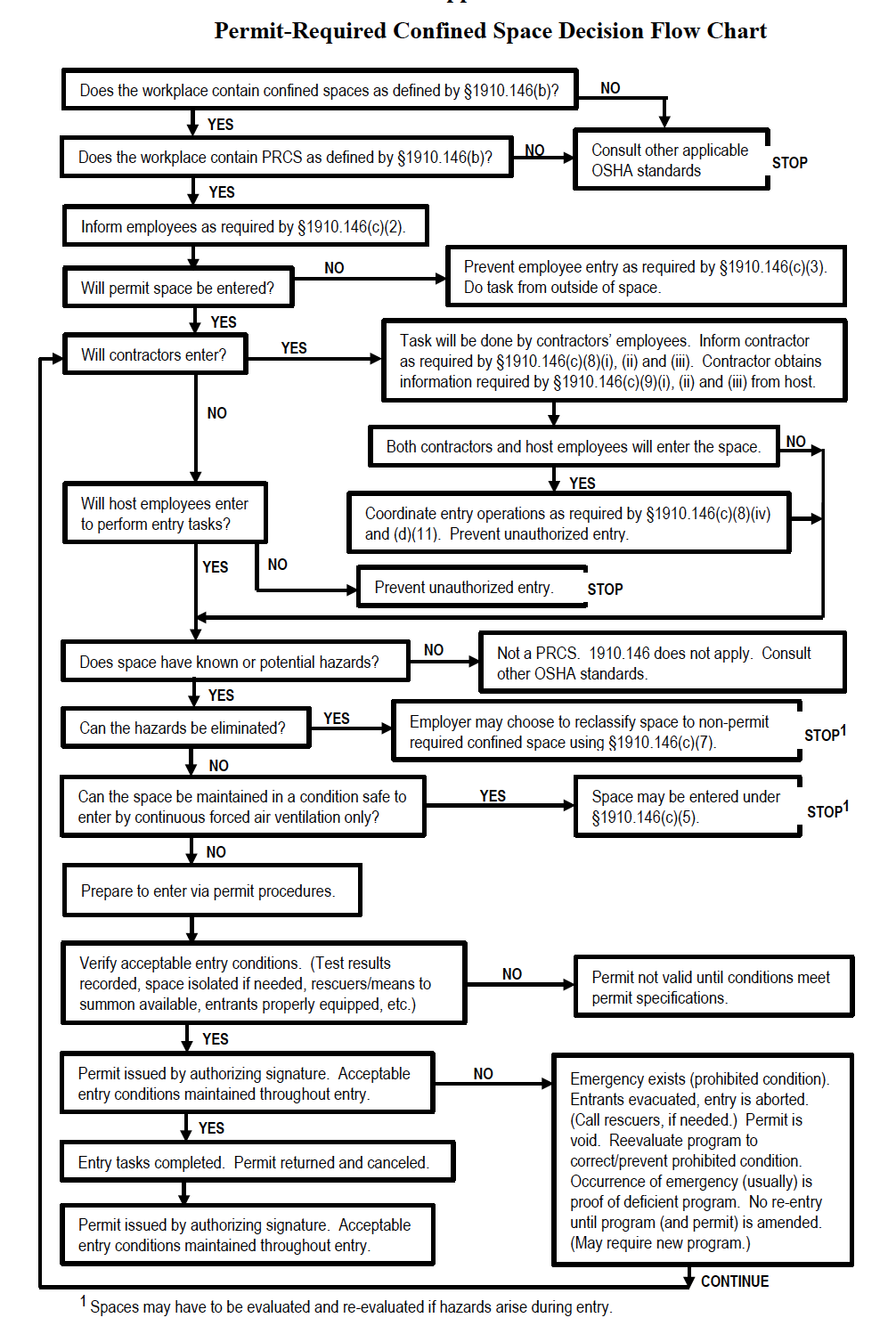
Over the past two weeks, I have had two training sessions (Safety for PSM Managers and a BLR on-line Webinar on PRCS Rescue Requirements and Best Practices) where I was asked about “dock levelers” and OSHA’s position on them as a “Permit-Required Confined Space” (PRCS) and this week we saw a worker lose his life under a “dock leveler”. So I figured it must be a topic that needs some discussion…
Disclaimer: I am NOT an expert on dock levelers nor have I ever issued an entry permit to enter one or “reclassified” one using (c)(7), but I do know a thing or two about CS’s/PRCS,’s and I did sleep at a Holiday Inn Express last week. (LOL)
In 2002, OSHA issued a Letter of Interpretation (LOI) in which they walked through a CS Assessment and then a PRCS assessment and concluded that, based on the information provided by the organization asking the questions, there was indeed a PRCS under their “dock leveler”. OSHA then went on to explain how these spaces could be entered using (c)(7). But there’s more to the story…
CLICK HERE for OSHA’s 2002 LOI.
I love YOUTUBE, but I am very careful about what I watch and share as there are some real “doosey’s” out there that NO ONE SHOULD BE WATCHING (case in point my 2017 Video of the Week #39 (PRCS Entry into tanker – so many things WRONG!)! But I found this video very helpful in showing how these dock levelers work and, more importantly, what the hazards are when climbing under one. I encourage you to watch the 7-minute video before continuing to read; however, VIEWER DISCRETION is advised, as this video does show what happens to critters, a cat in this case when someone does not manage their equipment properly. STOP watching the video @ 7:07 if seeing the carcass of a dead critter (assumed to be a cat) upsets you.
So as we can see from the video, there are indeed HAZARDS of crawling under a dock leveler AND the space under this equipment:
- is large enough and so configured that an employee can bodily enter and perform assigned work; and
- has limited or restricted means for entry or exit; and
- is not designed for continuous employee occupancy
so, therefore, we have ourselves a PRCS. Albeit one that can be reclassified to a non-permit status using (c)(7).
SAFTENG members can read all my articles about “reclassifying” using (c)(7).
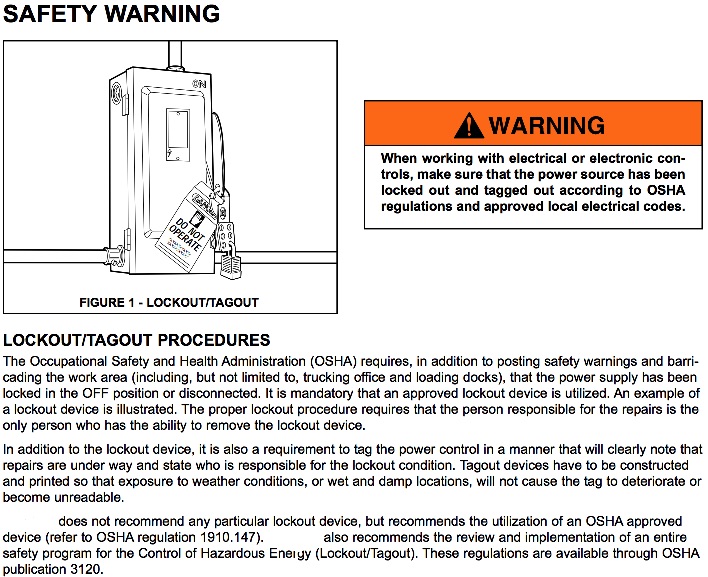
But I was curious how the manufacturers viewed their products, and sadly, I was unable to find a single manufacturer that stated their “dock leveler” created a PRCS. I will say that almost all (sadly NOT ALL) of the manufacturers did cover lockout/tagout in their manuals, albeit most were incorrect in their explanations of how LOTO would actually apply to their product(s). Here’s an example of a manufacturer’s maintenance manual…
NOTE: I have erased the manufacturer’s name in the image below, but for those LOTO “aficionados” who can tell me where this manufacturer is incorrect in their application of OSHA LOTO requirements??? But hey, at least they cover it and added OSHA requirements that are not called for – I’ll take it!!!!
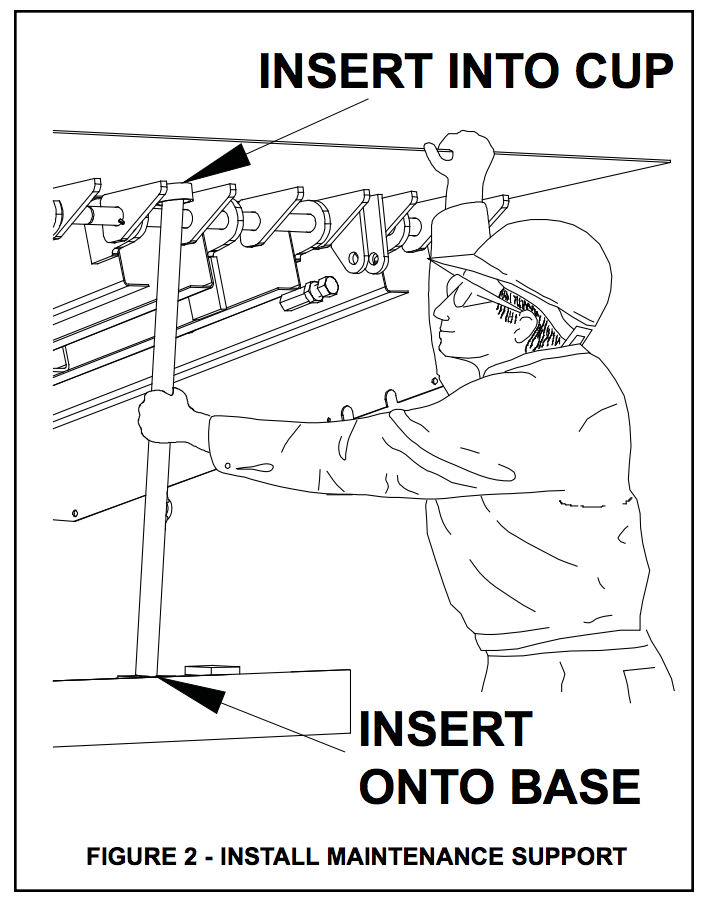
This manufacturer also covers the use of what they call their “maintenance support” rod. This rod/pole/post is a CRITICAL aspect of energy isolation for working UNDER the dock leveler and yet I was unable to find a single manufacturer who made mention of this rod/pole/post as being part of the energy isolation plan for their product. I know the dock levelers we had at BFGoodrich Speciality Chemical back in 1999-2003 had a means to actually lock this rod/pole/post in place, but I am starting to think the site modified the “pin” in order to allow this to happen as I have not been able to find a single manufacturer who has a rod/pole/post that can be locked into place. It was a simple lockout, when the locking pin was slid into place, instead of putting a “cotter pin” in place, we threaded “shark leader” wire through the locking pin and applied a lockout lock. And yes, we checked our “shark leader” was stronger than a “cotter pin”.
Now, remember, the video above shows the hazards of a “spring-aided” leveler, and the ONLY energy isolation device used on that type of leveler is this rod/pole/post. I am sure that there are some facilities that would lay claim that the person (as long as there was only 1 person under the leveler) under the leveler has “exclusive control” of this rod/pole/post since they are “arms-reach and line of sight” of the device and such there is no need to apply a lockout device. I would be hard-pressed to argue otherwise, but for those sites who do NOT allow this “exclusive control” application without the use of a lockout lock in their program, they should be LOCKING the “maintenance support” rod into place with a Lockout Lock.
And once we have ALL the energy sources LOCKED OUT, then we can “reclassify” this PRCS to a Non-Permit Space using (c)(7). I ask that anyone who finds an owners manual that requires lockout of the “maintenance support” rod to please e-mail me a copy so that I may update this article.
2020 UPDATE: Leif Berner with Southern Material Handling, Inc. was kind enough to send me their Owners and Maintenance Manual for these dock levelers, and it DOES REQUIRE the “maintenance support” rod to be locked out!!!
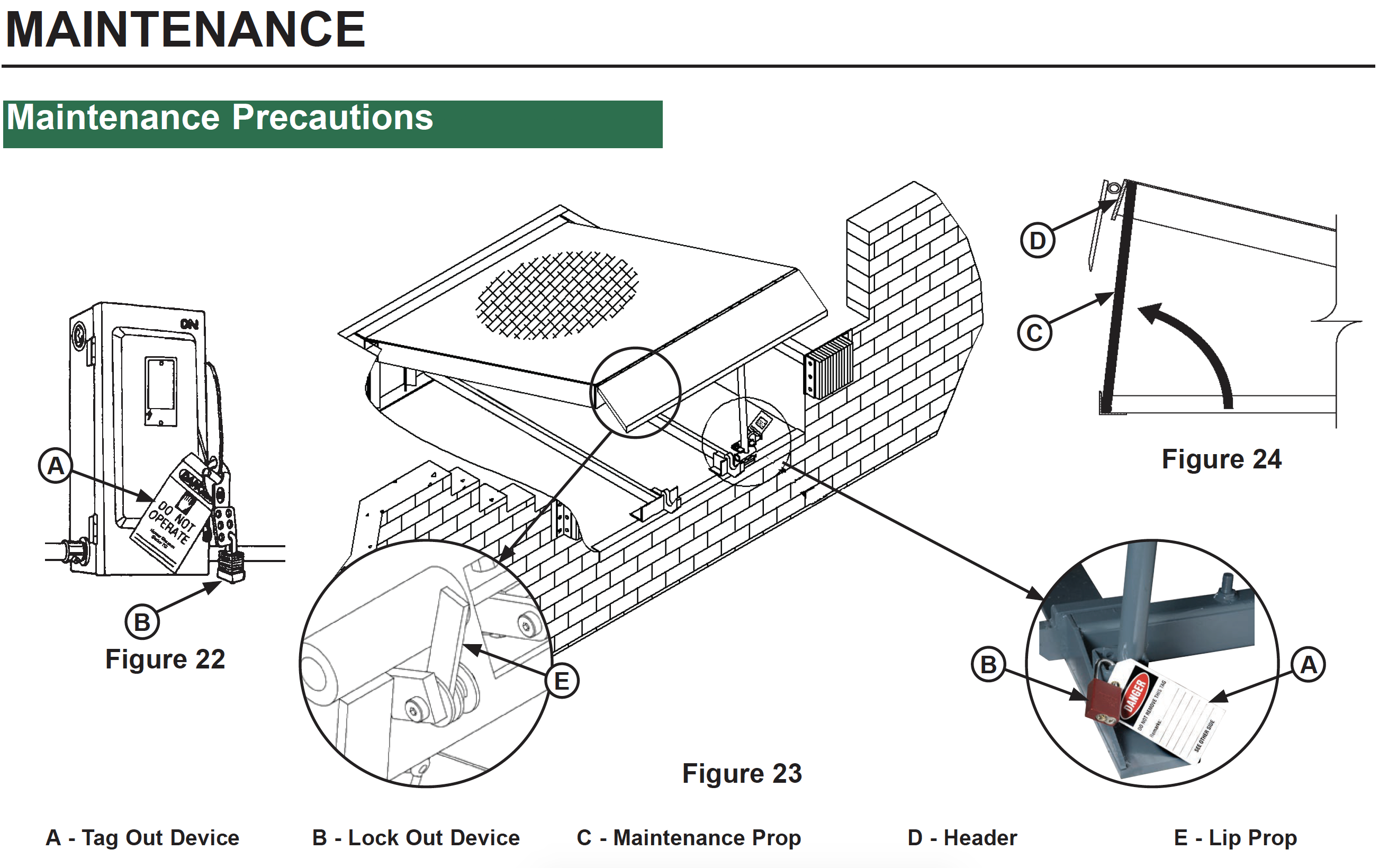
When working with electrical or electronic controls, make sure that the power source has been tagged (A) and locked out (B) according to OSHA regulations* and approved local electrical codes (see Figure 22).