
This morning, we had some serious weather pass through the Cincinnati area, and many areas lost power. Ironically, I was conversing with a client in MI about emergency lighting inspections when the power at the facility where I am this week went out. Of course, this facility’s emergency lighting activated and worked properly, so employees could make their way to our severe-weather shelter (Tornado Sirens were going off). So this spurred me to write this post, as my friend in MI (a damn fine safety professional) had been told by his “Authority Having Jurisdiction” (AHJ, which was his local Fire Marshal) that he was not meeting code when it came to his monthly and annual inspections of his emergency lighting. Almost every workplace will need “Emergency Lighting”. This lighting is intended SOLELY for illuminating an egress path so that employees, contractors, and visitors can safely find their way out of the building (or to a Shelter-in-Place safe haven). In a separate article, I will discuss the “EXIT” sign lighting requirements, which are entirely different than this “Emergency [egress] Lighting”. OSHA addresses this requirement in 1910.37, Maintenance, safeguards, and operational features for exit routes, and the International Fire Code, the fire code most states adopt, has very specific requirements for lighting, monthly testing, and annual testing. First, let’s look at OSHA’s baseline requirements:
(emphasis by me)
1910.37(a)(4) Safeguards designed to protect employees during an emergency (e.g., sprinkler systems, alarm systems, fire doors, exit lighting) must be in proper working order at ALL times.
…
1910.37(b) Lighting and marking must be adequate and appropriate.
1910.37(b)(1) Each exit route must be ADEQUATELY LIGHTED so that an employee with normal vision can see along the exit route.
As we can see, OSHA does not provide many specifics in its requirements, so I turn to the IFC or the state fire code when I am in a particular state conducting an Audit/Assessment/Evaluation. The IFC and most states that have adopted a “revised” version of the IFC will have the same language…
1031.10.1 Activation test.
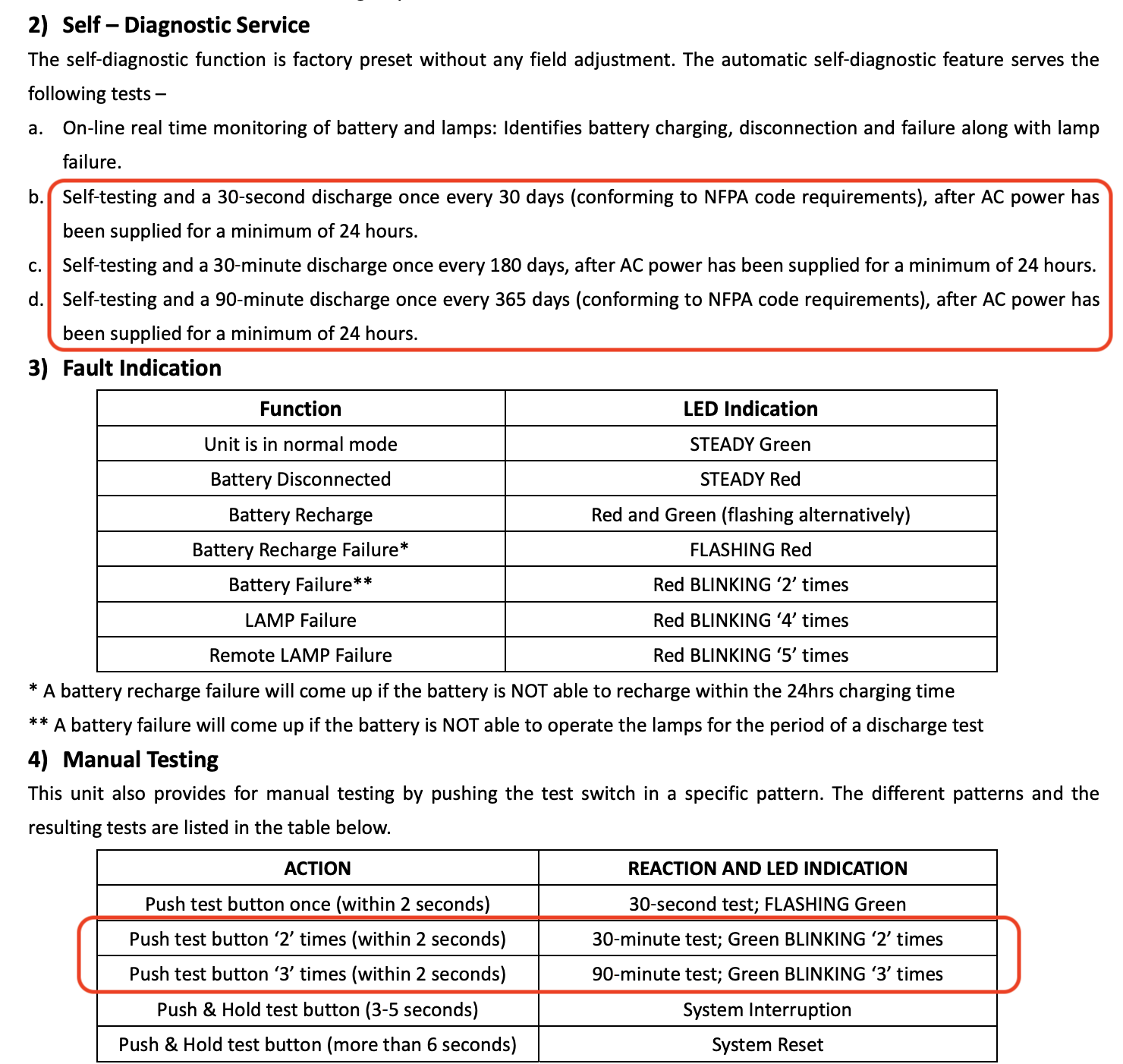
Emergency lighting equipment shall be tested monthly for a duration of NOT LESS THAN 30 seconds. The test shall be performed manually or by an automated self-testing and self-diagnostic routine. Where testing is performed by self-testing and self-diagnostics, a visual inspection of the emergency lighting equipment shall be CONDUCTED MONTHLY to identify any equipment displaying a trouble indicator or that has become damaged or otherwise impaired.
NOTE: Most manufacturers and AHJs will require this test to be conducted by turning off the normal power supply circuit that serves the unit, NOT by simply pressing the “test” button on the unit.
1031.10.2 Power test.
Battery-powered emergency lighting equipment shall be tested annually by operating the equipment on battery power for NOT LESS THAN 90 minutes.
IFC Section 1008.3.4 Duration requires that emergency lighting for means of egress has a duration of 90 minutes. This section requires a 90-minute operational test of battery units ANNUALLY to verify:
- the condition of the battery,
- unit-powered bulbs or luminaires, and
- unit circuitry
As with the activation test in Section 1031.10.1, this test should be conducted by turning OFF the normal power supply to the unit. The determination of whether the unit remains “sufficiently illuminated” for the full 90-minute test should be based on the performance requirements for emergency lighting for means of egress established in Section 1008.3.5
1008.3.5 Illumination level under emergency power.
Emergency lighting facilities shall be arranged to provide initial illumination that is NOT LESS THAN an average of 1 footcandle (11 lux) and a minimum at any point of 0.1 footcandle (1 lux) measured along the path of egress AT FLOOR LEVEL. Illumination levels shall be permitted to decline to 0.6 footcandle (6 lux) average and a minimum at any point of 0.06 footcandle (0.6 lux) at the end of the emergency lighting time duration. A maximum-to-minimum illumination uniformity ratio of 40 to 1 shall not be exceeded. In Group I-2 occupancies [Small Assembly Spaces], failure of a single lamp in a luminaire shall not reduce the illumination level to less than 0.2 foot-candle (2.2 lux).
So here is what each business has to decide: How important is your emergency lighting to you, your employees and your business as a whole?
For facilities that have decided NOT to have employees trained on Fire Extinguishers and rely 100% on getting everyone out of the structure in a timely manner, this lighting becomes ever more important. OSHA will most likely not cite you if the facility is not doing the 30-second monthly test or the annual 90-minute test… UNTIL the day the fire happens and the power is knocked out and panic sets in. OSHA will learn of the failures from formal complaints or during their inspection if they conduct one due to the fire event. But the question is, what if the facility has records that they have done their monthly inspections, albeit NOT to the method prescribed in the Fire Code, and it turns out the monthly inspections did not ensure “Safeguards designed to protect employees during an emergency (e.g., sprinkler systems, alarm systems, fire doors, exit lighting) was NOT in proper working order at ALL times.
Here is the kick in the gut and where OSHA can go if they wish to… Manufacturer’s Recommendation(s)
Yep, if the maker of your emergency lights has established an inspection/test frequency that is more detailed than OSHA’s requirements, it is incumbent upon us to meet the “manufacturer’s recommendations”. Those of you who practice in the “process safety arena” know all too well what I am talking about, as the “manufacturer’s recommendations” are our FIRST LINE of RAGAGEP. The same enforcement practice can be applied outside of PSM! Here is a screenshot of our spec-sheet for the emergency lighting at the facility I am at today. BTW, this is a PSM/RMP facility and we consider our “emergency lighting” a mitigation safeguard so this spec-sheet is in our PSI. About 5 years ago, ALL Emergency Lighting was upgraded to meet the monthly and annual testing requirements in the Fire Code without major disruptions to the business.
Bottom line… don’t waste an employee’s time, or pay a contractor, to do a half-a_s job inspecting your EMERGENCY LIGHTING/Equipment. Set some inspection parameters and maybe even have an SOP/SWP that provides detailed inspection protocols that include an inspection document checklist.